SLO County eyes additions to camping ordinance. What could change?
About 70 people gathered in front of a northern Cambria home Oct. 2 to learn more about possible additions to San Luis Obispo County’s camping regulations.
If approved, the modifications covered in a draft document could affect their neighborhood and the entire county.
As currently drafted, adding “incidental outdoor stays” would allow for permanent or temporary camping facilities on privately owned residential, agricultural and rural properties as small as one acre. That would include properties offering campsites via the popular site Hipcamp.
That size parcel could accommodate up to two campsites, according to the proposal.
The draft would allow up to 15 campsites on parcels of 30 acres or more.
The possible modifications likely will be a topic for the county Board of Supervisors to consider during their Nov. 16 discussion about their 2022 agenda.
Supervisor John Peschong brought up the possible changes earlier this year after trying to help the owner of a Cambria campground.
In August, code enforcement officials ruled that the campground, located on a hill above Cambria’s East Village, was illegal.
During the Aug. 5 hearing, the county asked Cambria landowner Michael “Buddy” Campo to stop operating his property as a campground within 30 days and remove all illegal electrical, plumbing and gas connections.
His 4.12-acre property, located at 2705 Main St., is now listed for sale for nearly $1.9 million.
North Coast Advisory Committee chairman Brian Glusovich said council members and the public will likely get an update about the proposed camping ordinance changes from Supervisor Bruce Gibson or his aide, Blake Fixler, during NCAC’s Zoom meeting on Oct. 20.
During previous council meetings, county officials and the council have mentioned the possible ordinance changes, and council members have received that initial draft of what those changes might include.
Public comment is taken at NCAC and supervisors’ meetings. For details, go to www.ncacslo.org and www.slocounty.ca.gov.
Many people at the Oct. 2 brainstorming session in Cambria said they plan to attend both the NCAC’s Oct. 20 meeting and the Nov. 16 supervisors meeting to their opposition to the camping ordinance changes as drafted.
Cambria residents concerned about risks of campgrounds
The Cambria neighbors said their primary concerns included the risk of wildfire from campfires or cigarettes in tinder-dry areas, as well as traffic, the impact to the small coastal town’s native Monterey pines and the availability and cost of fire insurance.
They also worry how campgrounds on private property could affect resale values in the county.
Some of the proposed changes, critics said, include reducing the required buffer zone between homes and campsites to 400 feet from the current 1,000-foot setback, and reducing the level of project review for a potential campsite project to a simple, over-the-counter approval by staff. The current standard calls for a minor use permit, which requires public notice and hearings.
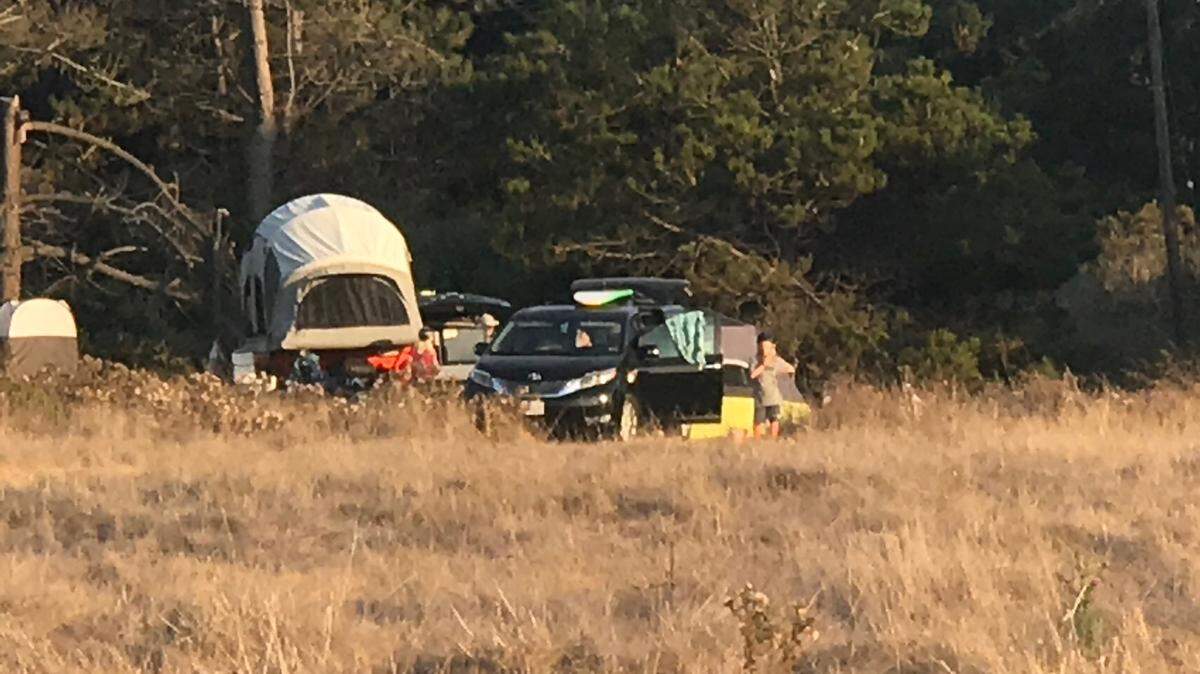
Attendees fretted that they could again experience what happened in Cambria on Labor Day weekend in 2020.
“We woke up, opened the blinds and there were campers on the property next door,” meeting organizer Karen Pearson said.
County code enforcers called the instance illegal camping, and told landowner Phillip Larson that if he wanted to camping on his 88 acres of land south of Cambria Pines Road, he needed to go through the process to change the rules or his property’s zoning.
While Larson assured initially told neighbors that he had no intention of doing that, he now hopes to make the camping option legal on his 88-acre parcel, Pearson and some county planning officials have said.
Attendees left the hourlong meeting with various assignments. They plan to seek legal advice from an experienced land-use attorney, and recruit others to join their efforts to convince county supervisors that the proposed ordinance changes are a bad idea.
The Hipcamp business model is similar to that adopted by Airbnb and other vacation rental websites, according to Jeff Bloom, a former city planner who’s now a Cambria resident.
Via phone, Gibson described Hipcamp as an “open-land version of Airbnb. They are an agent and they get their cut” from rental fees.
The supervisor said he’s “perfectly happy to consider a reasonable ordinance,” one that he defined as taking into proper consideration “all the risks and impacts of what they’re (Hipcamp) is promoting,” especially in the realms of “public health, welfare and safety.”
“That’s what the county processes are about,” Gibson said.
He said the planning department “may be processing some applications for camping under our existing ordinances, which are rather more burdensome than Hipcamp would prefer. We are also pursuing code-enforcement complaints on unauthorized camping activities.”
Hipcamp reaches out to SLO County landowners
An online campsite reservation system, Hipcamp apparently is involved in the move to change San Luis Obispo County’s camping ordinances.
Michal Rosenoer, Hipcamp’s government and community relations manager, wrote via email that the website wants to partner with the supervisors, local farming community and rural landowners.
She maintains that “this is very much a community-led effort.”
“The proposed changes will have such a positive impact for landowners and the local outdoor recreation and agritourism economy,” Rosenoer wrote.
Earlier this year, Hipcamp sent out a flyer to some San Luis Obispo County property owners, urging them to sign up for the site and rent out camping spaces on their land.
The flyer touted landowners’ ability to “earn up to $10,000 this month” and offered a $150 bonus to any potential campground host. “You set the rules and host when you want, all with Hipcamp’s $1 million insurance coverage behind you,” the mailer read.
According to Rosenoer, Hipcamp already “has roughly 50 hosts in the area, and we spend a significant amount of time listening to and working with members of the community; their responses have been enthusiastic about the proposed changes.”
It’s not known how many of those hosts have gone through the current approval process to get permits to operate camping facilities on private land, a process Rosenoer said “can take years and hundreds of thousands of dollars.”
She estimated that the average Hipcamp host makes $17,000 a year from renting a campsite.
“The fact that the county’s camping ordinances have not been updated since roughly the 1970s is hurting San Luis Obispo County at a time when small farmers, ranchers, and rural landowners can least afford it,” Rosenoer said.
She said the changes Hipcamp has proposed would “provide a more manageable and clear process for these landowners and help support a growing market for outdoor stays and agritourism.
“And on top of that, it could make visiting the county more accessible for people across income brackets, as the average cost for a Hipcamp stay in SLO County is $72 a night, which makes visiting significantly more affordable for working families.”
This story was originally published October 13, 2021 at 5:05 AM.
CORRECTION: A story that ran Thursday on Page 8A in The Cambrian misidentified Michal Rosenoer’s gender. She is Hipcamp’s government and community relations manager.