Popular Big Sur trail is reopening 13 years after devastating wildfire
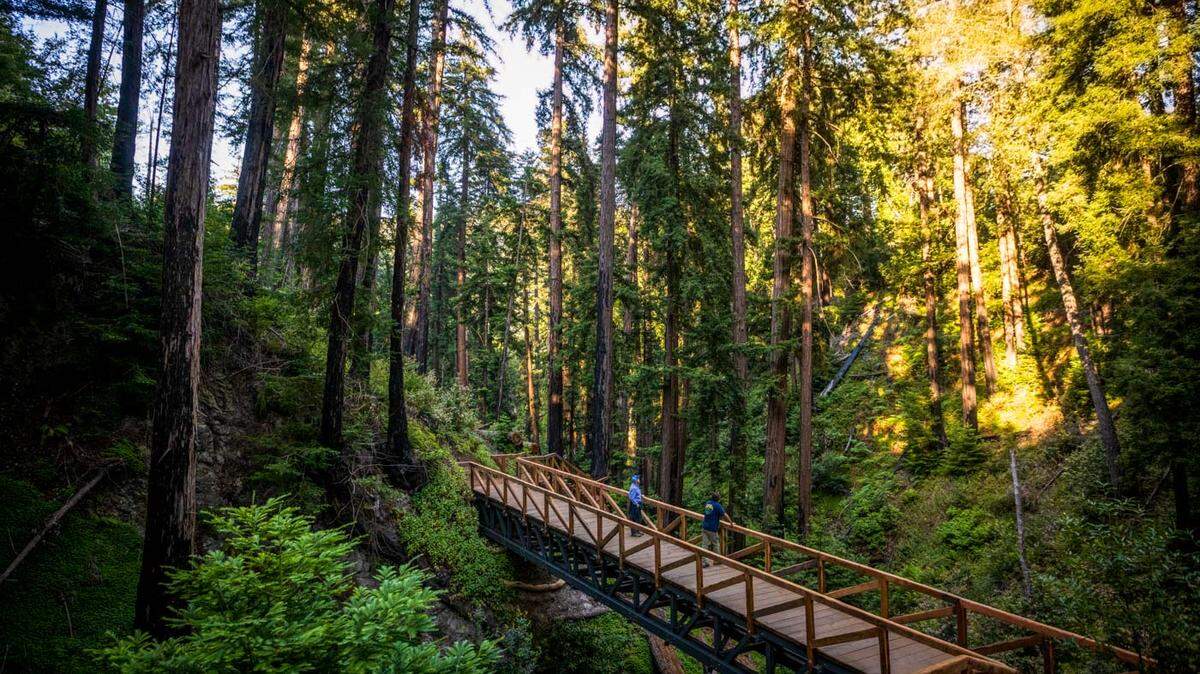
It’s taken more than a dozen years to repair and relocate one of Big Sur’s most popular trails — giving new meaning to the phrase “evergreen project.”
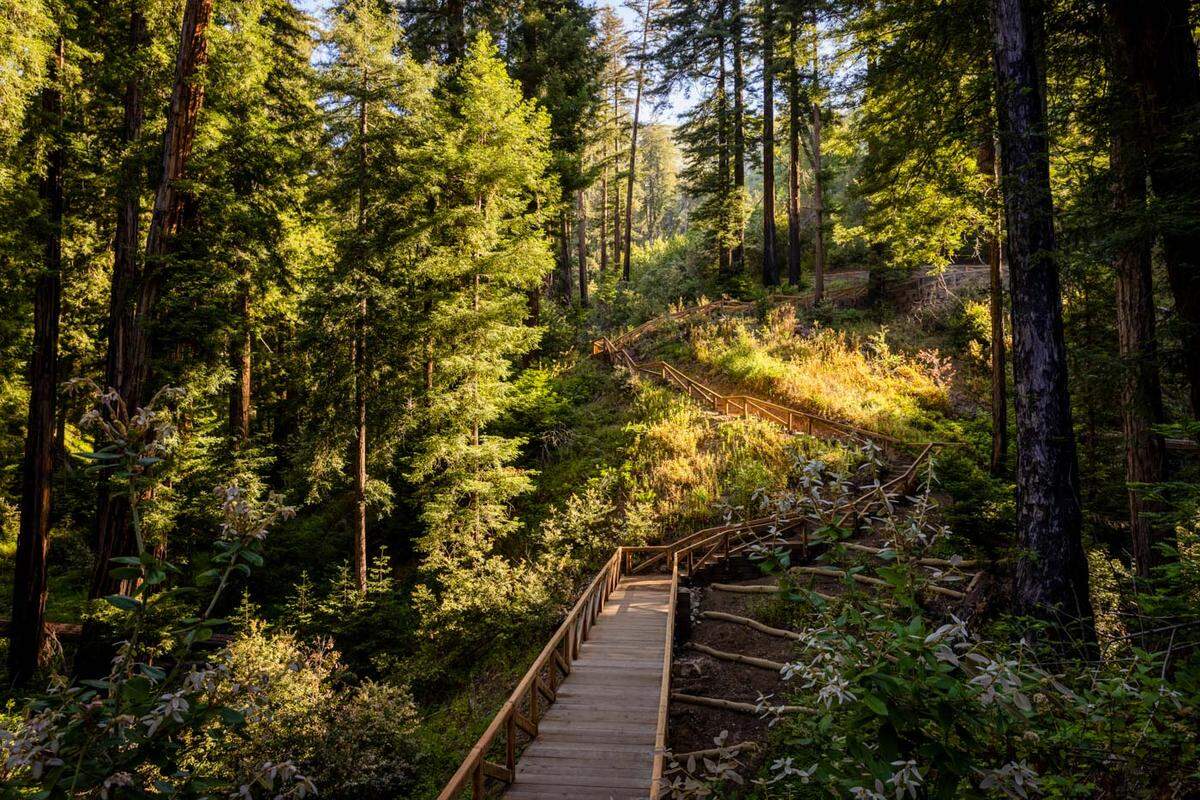
The new Pfeiffer Falls Trail, which winds through the redwoods down a gorge to a 60-foot waterfall, is set to reopen Friday, according to California State Parks and Save the Redwoods League.
The trailhead is located in Pfeiffer Big Sur State Park, about 72 miles north of Cambria.
The nearly $2 million project was a cooperative venture between the state agency and the century-old nonprofit organization.
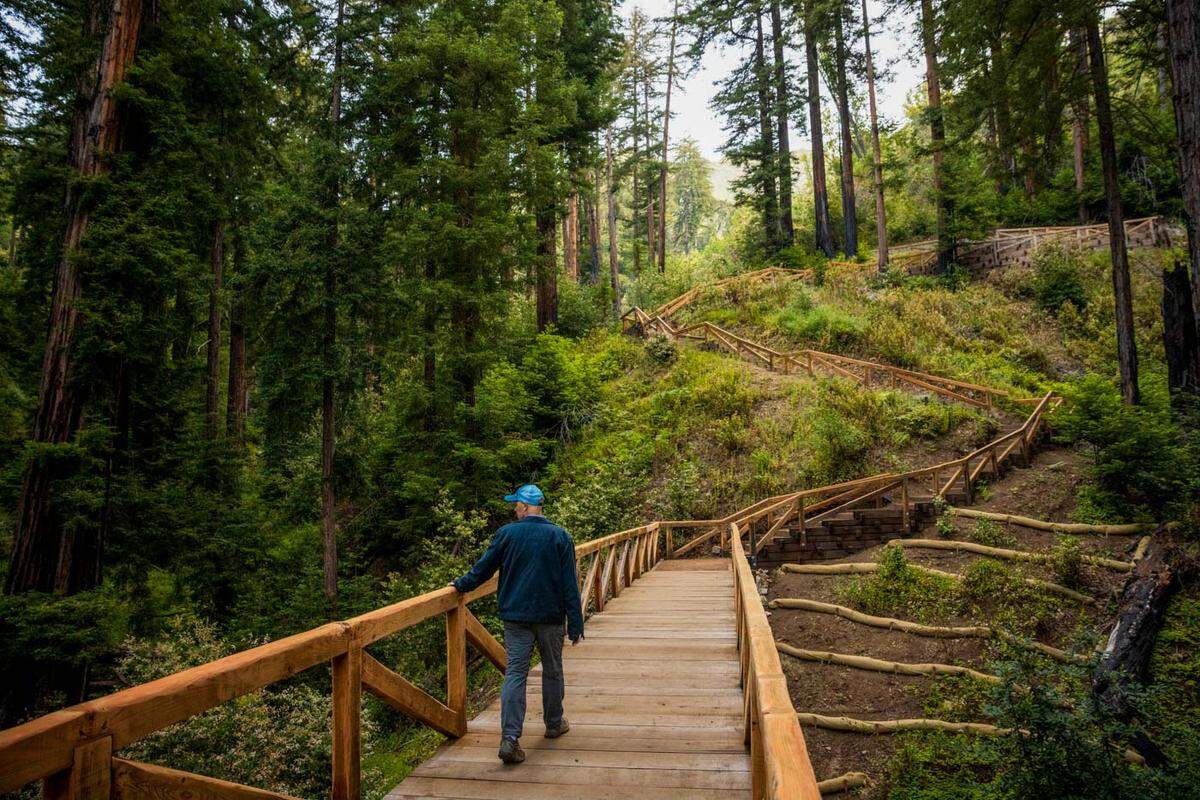
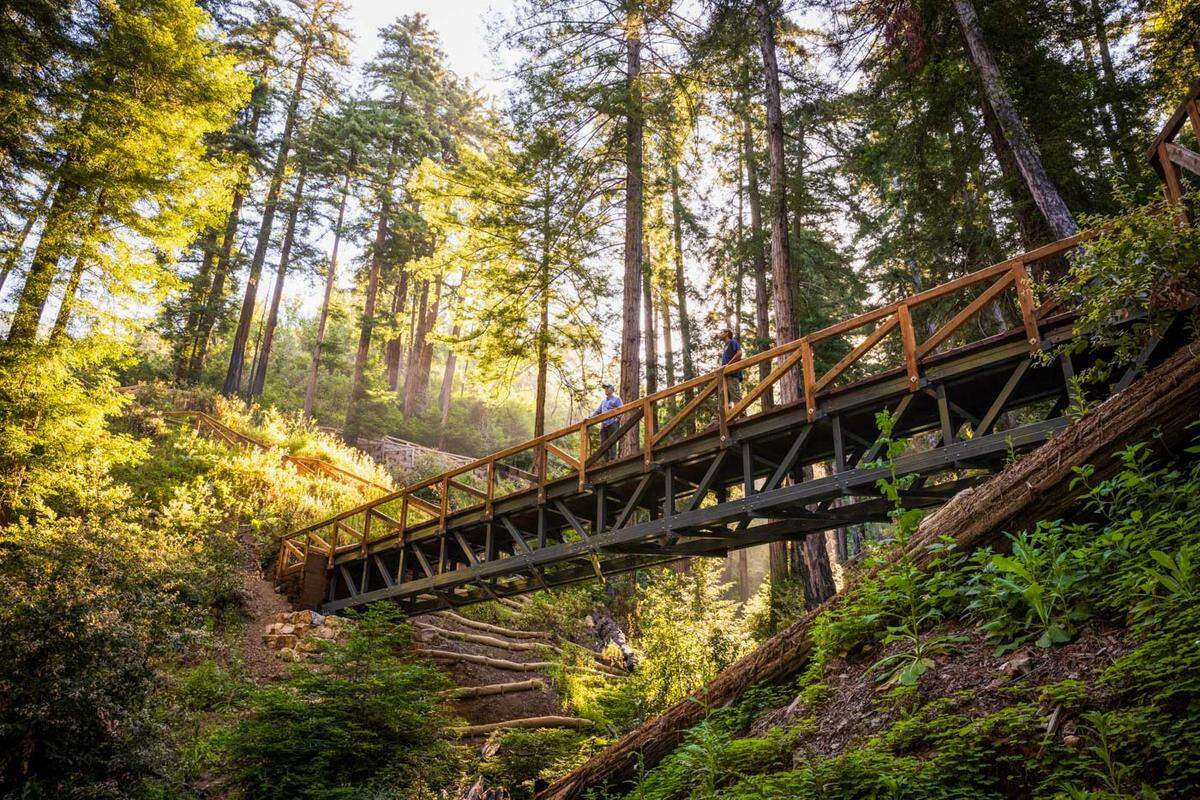
The lengthy project included moving the moderately steep hiking trail out of sensitive habitat areas; building a new 70-foot fiberglass-and-wood bridge; fixing retaining walls, steps and signage, and replacing more than 4,150 square feet of asphalt and concrete, according to officials.
The project moved the .075-mile trail further away from Pfeiffer Redwood Creek but officials say it still provides a stunning overhead view of the creek.
Jim Doran, program manager for roads and trails in State Parks’ Monterey District, said Monday that the newly renovated trail “provides a better overall user experience.”
“Areas of it are very close to the creek,” he said. “Then, as you progress further up, closer to the waterfall, you get incredible views into the redwood canopy because you’re farther up on the hillside. It provides a more diverse experience.”
Big Sur trail closed due to wildfire, reopening delayed
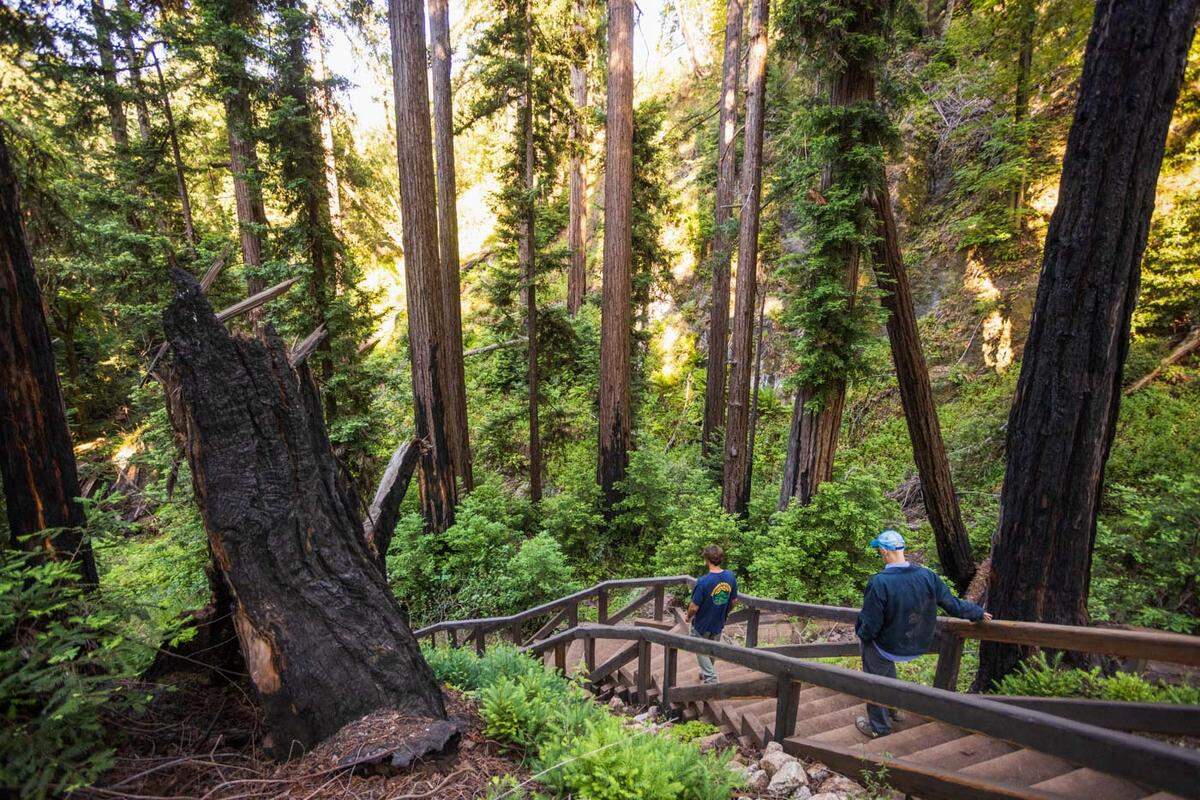
According to Doran, the Basin Complex Fire roared through Big Sur and Julia Pfeiffer Burns State Park in 2008. That inferno destroyed seven stream crossings and wooden bridges, torched area redwoods and obliterated much of the habitat around them.
A lightning strike ignited the wildfire, which forced the evacuation of much of Big Sur before the Fourth of July holiday. The blaze eventually grew to more than 161,800 acres, burning a lot of the Ventana Wilderness.
“We didn’t lose many redwoods, mainly just the understory, which is good for the redwoods so they don’t get choked out,” Doran said, “but fire makes it challenging to maintain the trail system.”
Why did it take so long to reopen the Pfeiffer Falls Trail, which links to the longer Valley View Trail to create a scenic, 1.5-mile loop featuring the falls and soaring vistas of the Big Sur River Valley, Point Sur and Andrew Molera State Park?
Doran said that, as State Parks, California Conservation Corps and American Conservation Experience crews began restoring the Pfeiffer Falls Trail, several disasters struck the area consecutively — diverting crew members from the trail project.
Those catastrophes included the Dolan Fire, which scorched nearly 125,000 acres of Big Sur in 2020, and and the massive January rainstorm that washed out part of Highway 1.
Staffing issues were also a challenge.
On any given day, Doran has “between five and 10 state park employees” for those kinds of repairs within the large Monterey district, he said, and maybe two or three of those employees can be assigned to work on a project at a time.
The two conservation nonprofits can provide 12-person crews, and the CCC was the “primary labor force” throughout the project, he said.
Using those crews “is a big part of all these projects that we do, not only getting a trail rebuilt and reopened,” Doran said, “but also introducing a lot of young people in the corps to the outdoors. It can really take them down a career path they never new existed. It’s a big part of why I like my job and want to do this, to help make a difference in their lives.”
Changes to Pfeiffer Falls Trail include new bridge
Jessica Inwood, who manages Save the Redwoods League’s parks program, explained that the Pfeiffer Falls Trail project provided “an opportunity to design an ecologically friendly trail in a new location.”
Doran said the old trail’s route, along the creek and in the riparian zone, was problematic.
There were multiple old wood bridges that were “hard to maintain,” he said. “They’d get washed out or burned in fires or trees would fall on them.”
The new trail design put the replacement bridge at about a half mile from the nearest road, Inwood said, so building it built supply issues and other challenges. All the construction had to be done by hand.
To relocate and build the new structure, she said, “they had to bring in the new bridge in pieces,” using “steel cables and pulleys to pull those pieces up the steep ravine.”
Those parts, Inwood said, included redwood lumber for the deck and handrails and ultra-strong fiberglass for the superstructure.
Using fiberglass was a boon in several ways, she said. First, it’s much lighter than wood, which is useful when the bridge is up to 50 feet above ground level.
Inwood added that the new structure “should last a lot longer than a wood bridge would. The new bridge probably has a 50-year lifespan,” although some of the redwood decking and railing may need to be replaced before that.
Hiking the renovated Pfeiffer Falls Trail is “a cool experience,” Inwood said. “You’re up above the creek, with a really neat view, looking down the ravine and at the creek.”
Some trails remain closed in the Big Sur area, Doran said, “some due to the Dolan Fire and the storm in January. Some date back a few more years.”
On the inland side of Julia Pfeiffer Burns Station Park, those include the main Ewoldsen Trail and the Waters Trail that connects to it, plus the trail system beyond the campground in Limekiln State Park.
Other Big Sur spots are permanently off limits.
In Julia Pfeiffer Burns State Park, for instance, “the McWay Falls Trail is partially open,” Doran said.
However, for safety reasons due to hazardous conditions on the trail, people are not allowed to go the rest of the way down to the beach. Doing so is a citable offense.
Who paid for renovation project?
Funding for the Pfeiffer Falls Trail restoration project included $909,000 from California State Parks deferred maintenance funding; a $500,000 grant from the California Natural Resources Agency’s California River Parkways Program with funds from Proposition 13 and a $406,000 donation from The Parker Foundation.
The project also used more than $55,000 in private donations to Save the Redwoods League, one of the nation’s longest-running conservation organizations.
“I’m so excited that this is part of the work that the league does,” she said. “It’s so wonderful to see the project completed.”
For details on Save the Redwoods League, go to www.SaveTheRedwoods.org.
This story was originally published June 15, 2021 at 2:16 PM.