Why do Big Sur Highway 1 cliffs slip, causing closures? Mudslide triggers memories
During the five decades I’ve lived on the North Coast, many things have changed here. Others have stayed the same.
Leading the latter category? Hillside segments sliding down onto Highway 1 between Cambria and Carmel, making the area impassable.
So, when part of the pavement near Rat Creek, 30 miles north of the line between Monterey and San Luis Obispo counties, gave way Jan. 28 under the onslaught of about a dozen inches of rain in one day, I wasn’t surprised.
For those of us who’ve lived for longer than a year or so anywhere around here, that closure of the scenic highway is another of those deja vu, “here we go again” moments.
We remember many shutdowns of the nearly 100-mile stretch of twisting, steep All-American Highway that’s on so many visitors’ bucket lists.
The heavy rain that caused the Rat Creek closure, and most of the others, turned the coastal Franciscan mélange soil matrix into extraordinarily slippery mud.
As the mud yields to the force of gravity, it slides, often carrying boulders, trees, even structures down steep hillsides, cliffs and bluffs. Sometimes the debris slips all the way to the sea.
In 2017, one slide even dislodged the major Pfeiffer Canyon Bridge; it had to be demolished and replaced.
The geological movement often blankets the highway with many tons of goo. And sometimes, the roadway’s now soggy foundation slides out from underneath the pavement.
At Rat Creek, the onslaught created a deep chasm through the pavement — one that will take expert engineering, hard work and time to repair.
Every time that stretch of Highway 1 shuts down, it impacts area business folks, the commercial entities that supply them, tourists who want to see the spectacular vistas and residents who work in those industries or who simply love to take that glorious ride up to Ragged Point or Big Sur or Carmel.
Highway blockages can cause disruptions in schooling, medical appointments and jobs, especially for those who live and work or attend school on opposite sides of a slide.
In some cases, multiple slides miles apart left entire communities cut off for months.
1983 mudslide kept Highway 1 closed for 13 months
I’ve spent 30-plus years as a reporter and columnist for The Cambrian and The Tribune. During that time, I’ve covered some significant road closures.
Some of the slides hitting Highway 1 were huge — like the 1983 slide that kept the route closed for 13 months.
According to reports in The Sun Bulletin’s 20-page “Slide Souvenir Section” on April 12, 1984, that slide “originated about 1,300 feet above the ocean and 1,050 feet above road level.
“An average of 45 men and women worked an average of 11 hours a day, seven days per week” for more than a year near Julia Pfeiffer Burns State Park,” the newspaper reported. “Workers ripped, blasted and pushed into the ocean more than 14 million cubic yards of mountain,” estimated to be enough to fill the Los Angeles Coliseum 11 times plus.
On that job, crews from Caltrans, Walter Construction and various subcontractors used equipment that consumed about 40,000 gallons of fuel a week, including 38 dozers.
Herb Filipponi, Caltrans maintenance engineer on the project, recalled a few years ago that Don Walter had begged, borrowed and bought the equipment for the job from all over the country.
Retired Caltrans senior climber Ralph Novoa of Big Sur remembers that job well.
“There was a strong stream of water coming out of that (drain) pipe,” he recalled in a phone interview. His boss said, “That’s it, the road’s closed.” Soon the pavement was “a giant washboard, and after that, it was gone,” Novoa said.
A similar situation made the 1998 Gorda slide equally awful, the 80-year-old said, with a huge whirlpool forming where the drain pipe should have been carrying runoff away.
The work was long, hard and sometimes miserable.
“Some of it was pure-ass torture,” Novoa said, thanks to “Mother Nature and the weather, kicking our butts. She was telling us, ‘You want to stand out there, I’m going to lay it on you.’ ”
He said those jobs are always a “race between safety and getting it done quick.”
What was Novoa’s favorite assignment? “I got on the scaling team,” he replied, which required workers to climb up to the top of the slide area, then rappel down, “kicking rocks off the side of the bank.”
He said then-resident geologist John Duffy had seen the technique in action in France, and brought the concept back to Caltrans.
Novoa rose to be the senior scaler on the team.
Since then, other advancements on several levels have made repairing those slides more precise and effective and a bit safer, and made weathering them on a business level a little bit easier.
For instance, since 1983, Caltrans has gotten much better at keeping community members and visitors up to date on the situation.
Technology has improved, too.
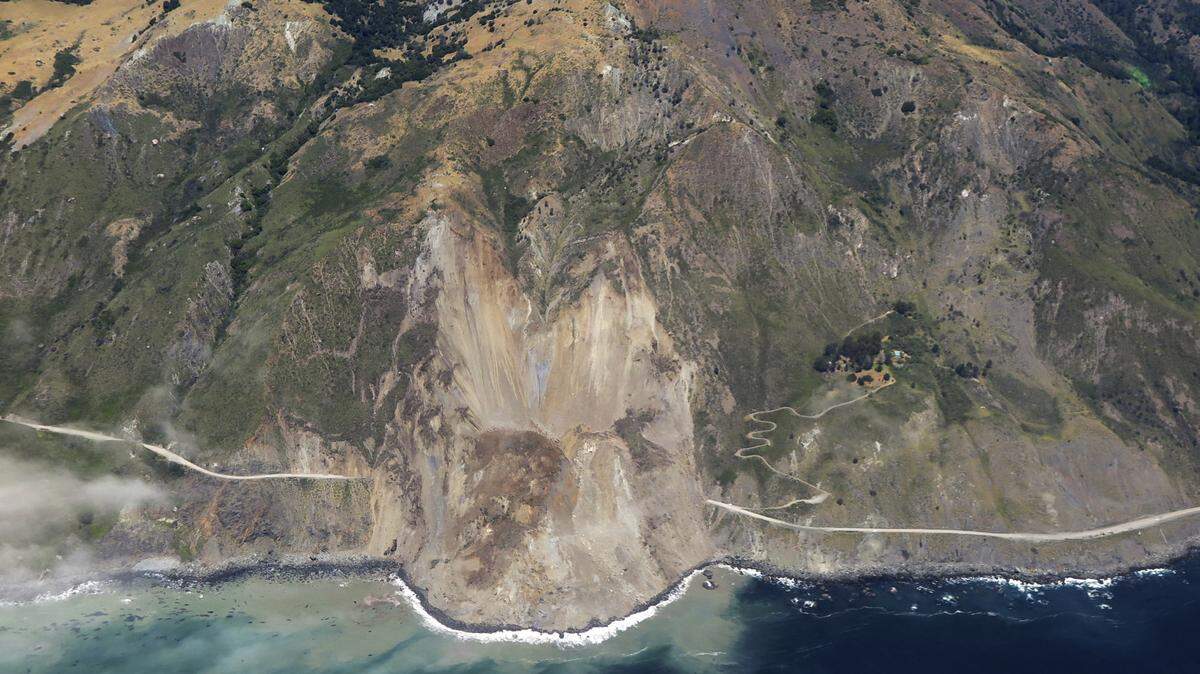
On May 20, 2017, after record winter rainfall of more than 100 inches, a massive landslide sent nearly 6 million cubic yards of material into the Pacific Ocean, displaced 50 acres of land, created 2,400 feet of new shoreline and buried a one-quarter mile section of roadway.
Ultimately, Caltrans and John Madonna Construction used ground radar, aerial LiDAR, GPS measurements, automated surveying equipment, extensometers and slope inclinometers to design a $54 million project that created a 2,000-foot long, 40-foot-tall rock revetment at the shoreline.
They used engineered embankment berms, catchments, culverts, netting and more to create a new roadway on top of the slide material.
Scenic roadway has long history of slides
A quick check of my story files also showed reports on Highway 1 closures in 2004, 2006, 2007, 2010, 2011, 2012, 2015 and 2018.
Some of those were less dramatic, less lengthy and therefore less impactful than the 1983 and 2017 slides.
Yes, I remember all those Highway 1 slides well — especially the 1983-1984 closure, because I lived through it as a businessperson and served as co-chair of the event reopening the highway.
I know there’ll be more slides and road closures in the future. The area’s geology, Mother Nature and climate change guarantee it.
As former San Luis Obispo County ounty supervisor Shirley Bianchi quipped, “It’s said that every time there’s a wet fog, the road falls off.”
Sorry, Caltrans! This time at Rat Creek, I won’t be able to provide a 52-foot-long cake for the reopening ribbon cutting.