Cambria students are growing Monterey pines from seed. Here’s where the trees could end up
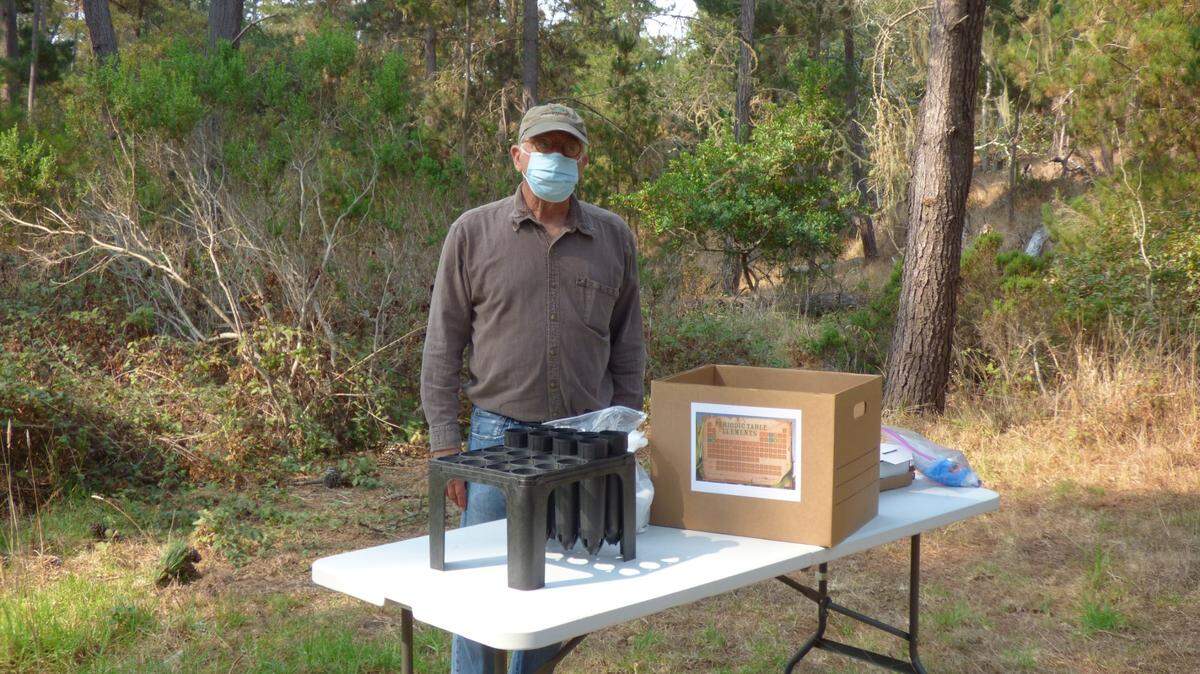
The Seeds to Seedlings Project at Cambria’s Santa Lucia Middle School has gone online.
In this COVID-19-restricted school year, Greenspace — The Cambria Land Trust and its financial partner, the Harold J. Miossi Charitable Trust, have taken what had been a hands-on project done individually in person and turned it into a virtual learning and sharing experience on Google Meet and Google Classroom for eighth-graders in Danielle Narzisi’s environmental education class.
Rick Hawley, Greenspace founder, board member and project manager, and Robert Chichowski, the nonprofit’s education program coordinator, have guided the program funded by a three-year Miossi grant of $13,000 a year.
Chichowski said this is the fifth time the trust has given Greenspace educational grants. Three years ago, the land trust’s in-person Seeds to Seedlings Project was done with fifth-grade students at Cambria Grammar School.
Cambria students get Monterey pine seed kits
Chichowski said that this year’s project provided each of the 20-plus students with a 20-pound seedling growing “kit that gives them all they need to propagate up to 20 Monterey pine seedlings.”
Greenspace assembled the kits, which included soil donated by Kellogg Gardens. The students picked up those kits from the middle school in late September.
“We have learned a lot in the last couple of months about this brave new world of distance learning,” Chichowski said.
He said that experience has made them appreciate even more “the accomplishments of our teachers in climbing the exponential technology learning curve.”
He speaks from 40 years of experience as a Cal Poly chemistry professor who also specialized in children’s science education.
“A large effort went into making the virtual experience an interactive one,” Chichowski said. “I converted Rick’s ‘Introduction to the Monterey Pine Forest’ Power Point presentation into a Google slide show.”
That conversion allowed “students not only to observe a screen but to extract data from the presentation and physically report it” to the teacher,” he said.
“We have created virtual experiences” on Dropbox, Chichowski said, videos and instructions that take students “step by step, class by class to grow seedlings and to understand the uniqueness and specialness of our native Monterey pine forest, one of only five native stands in the world.”
Class teaches students how to grow Monterey pine trees
The initial instruction and subsequent growing process happened from mid-September through October, Chichowski said.
Initial “class periods provided an introduction to the Monterey pine trees’ needles, cones and seeds,” he said.
Those introductions included topics such as pine cone cooking, and extracting, disinfecting and planting the seeds.
The Seeds to Seedlings Program “integrates art with science when the students use a nature journaling program to accompany the project,” Chichowski said, bringing “another tactile aspect to the experience.”
The journaling, he explained, which is part of the John Muir Laws Nature Journaling program, includes drawing, measurement and observation.
Next, he said, “the students will monitor and water their tray of 20 cells until mid-December.”
After that, the students will turn in their racks of seedlings, because the youngsters won’t be available to water the racks during the holidays. “By then,” Chichowski said, “some of the seedlings should have popped their heads out of the ground.”
What’s next for seedlings?
Hawley will babysit the plants until spring or later, when they will be planted at one of the Greenspace-selected and agency-approved sites, such as the land trust’s own Strawberry Canyon preserve, Hearst San Simeon State Park and Golden Gate Park in San Francisco.
It’s all part of a Greenspace initiative to plant 3,000 new Monterey pine trees.
Greenspace will then buy new racks and assemble new kits. “We have another 20 some kids to do this with in the spring,” Chichowski said.
For details on Greenspace, a nonprofit land and conservation trust that’s been active since 1988, go to www.greenspacecambria.org.