Cambria will finally get a new affordable housing complex after a 15-year battle
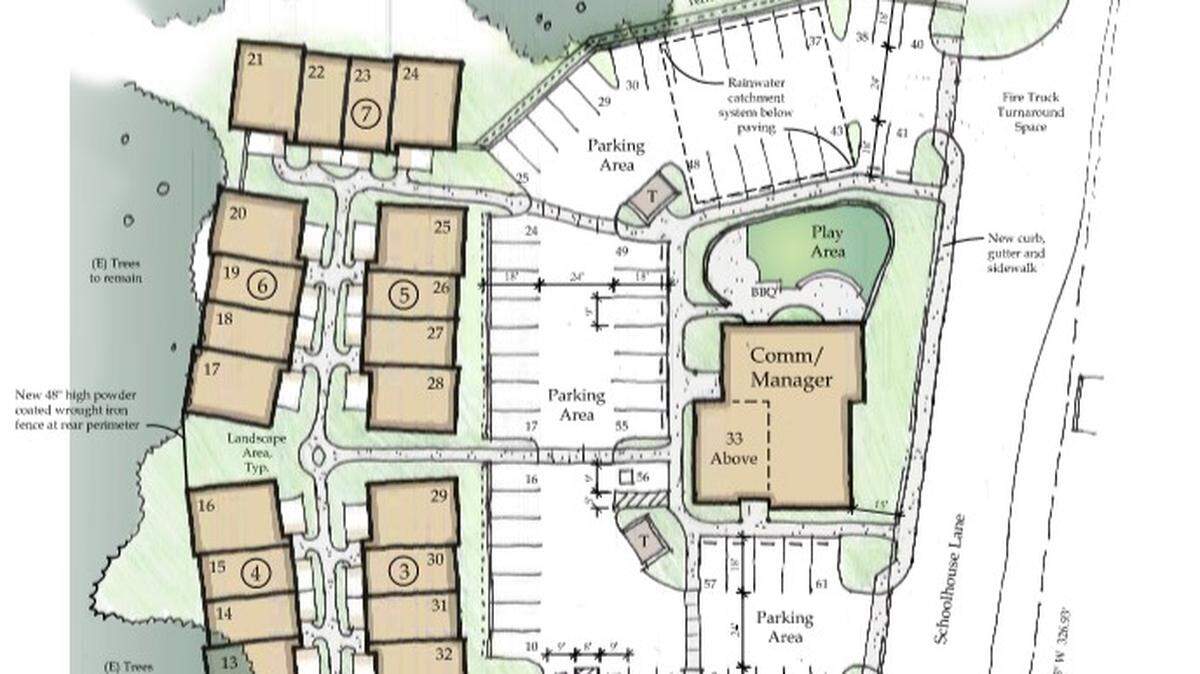
Peoples’ Self-Help Housing’s second apartment complex on Schoolhouse Lane in Cambria could be ready for low-income families to occupy within a few years, according to John Fowler, the nonprofit agency’s president and CEO.
He gave that estimate June 12, two days after California’s stark need for affordable housing won out over Cambria’s water-supply concerns.
On June 10, California Coastal Commission members denied appeals against the project and unanimously approved the Peoples’ Self-Help Housing (PSHH) plan for the second apartment complex near Santa Lucia Middle School.
According to the current working drawings and documents, the apartments, which for at least 55 years can only be rented to qualifying low-income families, will include 32 units of from one to three bedrooms, a one-bedroom manager’s unit, a common building, a 61-space parking lot, and associated improvements on a 5.88-acre meadow.
Former North Coast Advisory Council (NCAC) chairperson Susan McDonald wrote on Facebook after the hearing that the commissioners’ decision had made June 10 “a great day for 32 low-income families in our community” who can now plan ahead to have affordable places to live in Cambria.
Getting final approval has been a long haul: It’s been nine months since the commissioners, in a preliminary hearing, called for a full review before they decided for or against the appeals.
Fowler said the appeal process is now over, and the commissioners’ action was the last step in what has been a 15-year process, from property purchase in 2005 to the June 10 denial of the appeals.
During that time, there’s been a “recession, a severe drought, water issues” and other hurdles, he said, but People’s Self-Help Housing “waded through all that. We persevered.”
The nonprofit “has been here 50 years, and we’re not going anywhere,” Fowler said.
When PSHH bought the property, he added, “We knew Cambria would be a long road.”
“Now, we’re excited for the community of Cambria,” Fowler said, especially “the people waiting to live in the apartments, people who’ve been couch surfing, or commuting” to get to their mostly hospitality-industry jobs.
He reiterated that each prospective renter must qualify to live in the apartments, passing a stringent qualification process, including background checks and income verification, and that process must be repeated annually for each tenant.
Those certifications, done by a “full, in-house compliance team,” are required as part of the nonprofit’s funding. If PSHH doesn’t meet those requirements every year, he said, “we lose our funding” because those who provide the money would lose the tax credits they get from participating and PSHH would have to refund their investments.
“We’ve never had that happen,” he added.
The next steps are “completing and submitting drawings, getting the building permit and finding the funding source,” Fowler said.
In finishing the current working drawings, “we’ll share specifically how we’ll save water and fulfill the agreement,” he said. “We fully intend to do exactly what we promised the county, Coastal Commission, services district and the community that we’d do.”
The new project will be subject to the Cambria Community Services District’s conservation-retrofit measures, meaning the new complex cannot trigger a net increase in water demand. Self-Help agreed to comply with those requirements
If the permit process goes smoothly, Fowler said he estimates the apartments could be under construction “in one or two years. That’s our hope. We’re going forth with confidence, full steam ahead.”
Hearing on Cambria low-income housing project
Cambria resident Kathy Preciado wrote in her detailed observations about the one-hour commission hearing that, according to Ted Harris, a consultant to PSHH who spoke there, the project has 48 low-income families on the waiting list for the 32-new apartments. Presumably, there could be many more waiting in the wings.
The hearing was broadcast on Zoom.
Five people spoke against the project, citing concerns about water supply, fire protection and the selection of residents for the apartments. Those included the three women who had appealed previous county-level decisions to approve the project — Mary Webb, Christine Heinrichs and Leslie Richards.
Throughout the process, they’ve challenged staff conclusions and indicated they did not believe that the apartment complex would be able to save as much water through retrofitting as has been projected.
However, Fowler said June 12 that the appellants had expressed to him that “they love what we do,” and they wish they didn’t feel they needed to be “on the other side of this,” due to their concerns about Cambria’s water supply and other issues.
Three people spoke in favor of the PSHH project, including Ted Siegler, another former NCAC chairperson, who detailed his view of how the water retrofitting would work and would save water.
Brian O’Neill, planner for the commission’s Santa Cruz staff, called the proposal a “bona fide” affordable project and said the apartments would be for qualified applicants.
In their comments before the unanimous vote, some commissioners cited “social justice,” the affordable nature and community-character building to encourage diversity and community resiliency within Cambria. They said that PSHH should make accommodations within the project for charging electric vehicles.
“We want to be a great community neighbor and partner,” Fowler said, “building something beautiful that’s well maintained protects the resources and gets this much-needed housing done.”
For more about Peoples’ Self-Help Housing, go to www.pshhc.org.
This story was originally published June 19, 2020 at 11:33 AM.