
Cambria artist captures lush landscapes in Hawaii, California: ‘I paint what people want’
I am an artist and I’ve been working …
Most artists lack common sense. I realize this is a gross and inflammatory generalization, but it’s also mostly true.
That is why, when I interviewed an artist recently for this column, I was struck by his refreshingly grounded perspective.
Cambria artist Richard Moratin is both enthusiastic and sensible. He has enjoyed many years of success as a painter, possesses strong instinctive skills and sees clearly how to apply them.
“I paint what people want. Why would I paint what no one would ever want?” he said.
While this could be interpreted as blatant commercialization, his explanation would win me over.
Born in Honolulu, Hawaii, Richard appreciated his idyllic upbringing and a close relationship with his family. He was encouraged to develop his artistic skills from an early age.
After graduating from high school, he embarked upon a vocational life, but kept hearing and responding to the siren song of painting.
He found ways to earn money for supplies.
Beginning painting as a his hobby, he took the initiative to find objective responses — seeking a teacher’s critique, pinning his work on the fence of the Honolulu Zoo and selling art to a woman at a Zales jewelry store. All that provided the necessary support structure he would come to rely on to build his confidence and success.
“When I worked at a job I couldn’t wait to get home and paint, even if it was 1 a.m.,” he said. “It
brought me back to where I wanted my spirit to be.”
Richard’s stylistic approach to the traditional Hawaiian landscape caught the attention of exhibitors and buyers. He started with shows in malls and banks, learning both sides of the painter’ life: making and selling.
Eventually, he opened his own gallery in Honolulu and became one of the most popular Hawaiian artists in decades.
“Painting these scenes allows people to see what I see, and what they may have missed,” Richard said.
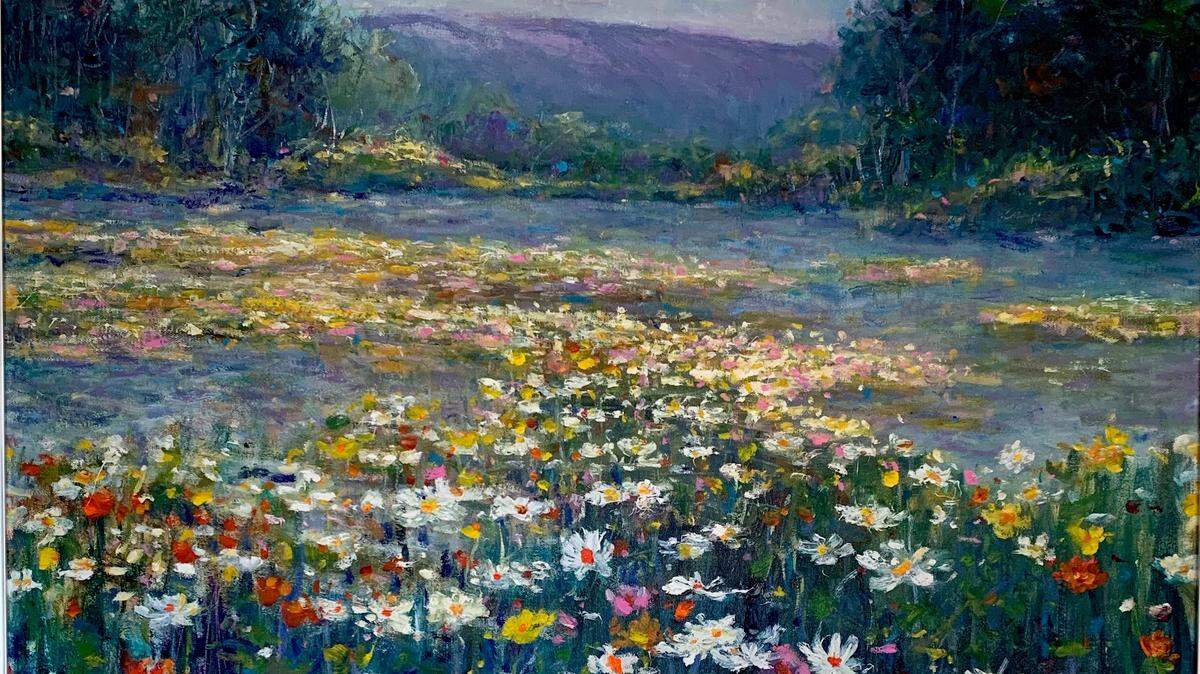
Richard commands the landscape with bold strokes and quiet contrast to capture the feel of a tamed jungle. His familiarity with painters’ tools is evident in the rendered textures from a palette knife and the fragile suggestions of a soft brush.
Richard’s conscious approach to impressionism breathes new life into poignant scenes with delicacy and determination.
When Richard moved to the mainland, he adopted the plein air-style popular among California artists, often completing a canvas in a single sitting.
While touring his studio, I was struck by one piece in particular, “Fiesta.”
This large abstract has a complex construction that made me think of the structure of Kandinsky but with Hilma Klint breathing on his neck. The density is relieved by a daring palette choice, leaving a path reminiscent of Manitou cliff dwellings.
As opposed to the more accessible artwork Richard has completed, this piece took months to finish and remains in his own collection. Whether rendering homage to his roots, a peaceful landscape or a layered abstraction, this artist knows exactly how to do what he does.
During our visit, I was struck by Richard’s stories of his transition from the islands to California. When he would go back to Hawaii, he said, he would stay with his parents and set up a painting studio on their patio. His father helped stretch the canvases.
Richard would often stay until he had enough work for a pop-up exhibit at a nearby bank.
This is a man who values the basics and, as a result, remains grounded and realistic. He paints what people want. Luckily, what we want is what he paints.
This story was originally published March 5, 2020 at 2:23 PM.