
Elephant seals aren’t affected by ‘Red Tide’ — but for sea lions, it’s a different story
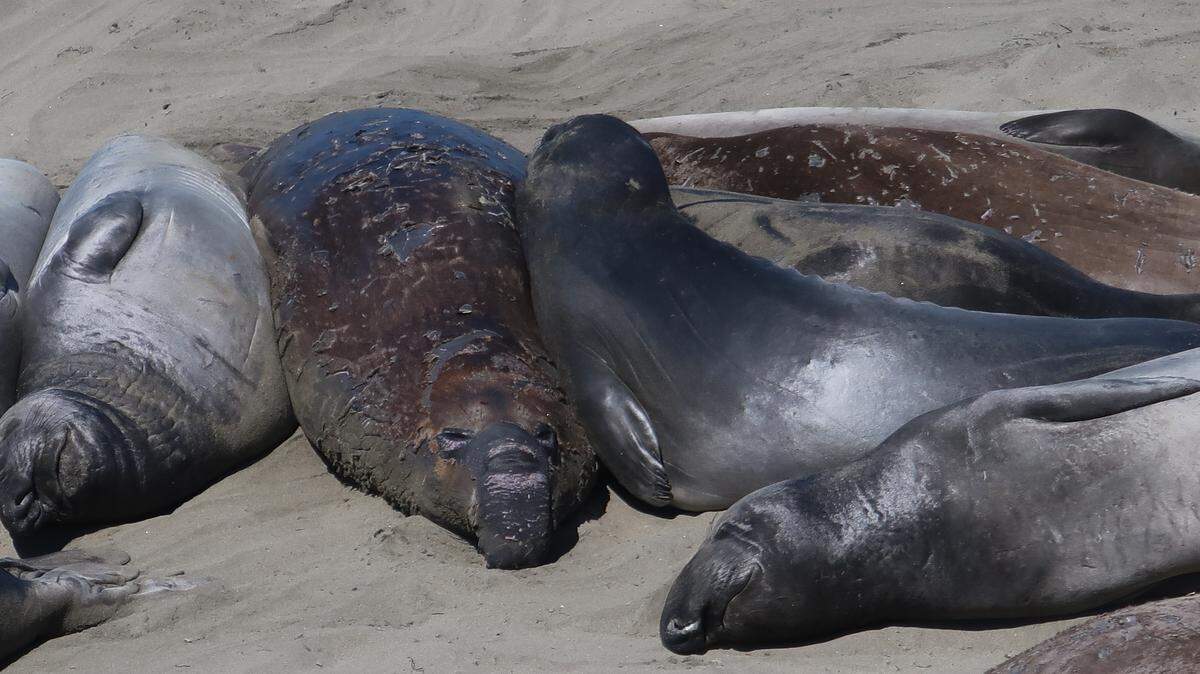
Summer brings lots of tourists to the elephant seal viewpoint at Piedras Blancas. With Highway 1 now open, the elephant seals are ready to impress the public.
Some of them are senior seals.
Bulls, some mature and some younger, with the flopping nose (technically, proboscis) that gives them their name, have taken over the beach for the summer. They are molting their skin. It peels off in bits and pieces once a year. Ask a blue-jacketed docents to let you touch some.
The length of that nose gives a general indication of age. It grows throughout the seal’s life, so longer is older. It starts growing when the seals are about 5 years old. Compare sizes to gauge relative age.
The chest shield, the pink, calloused skin on their chests, develops along with the nose. Mature bulls have chest shields that creep up above the level of their eyes. The development of the chest shield is another indicator of how old a seal is.
Elephant seals don’t eat while they are in the rookery. They are fasting, living off their blubber. Sea lions occupy a different ecological niche in the ocean food web. Elephant seals are deep-water feeders, on dives 20 to 30 minutes long to hunt at 1,000 feet and deeper. California sea lions feed on fish and squid near the ocean surface, diving three to five minutes, usually not deeper than 80 feet.
They eat different kinds of fish — that’s why sea lions are in conflict with fishermen and elephant seals are not. The fish sea lions prey on are the ones that are subject to the harmful algae that occasionally bloom in those relatively shallow waters.
The toxin that accumulates in those fish living close to the surface is domoic acid. It is produced naturally by a single-celled plant (phytoplankton) species called Pseudonitzschia australis. Popularly, it’s known as Red Tide. Scientists aren’t able to predict when a bloom will occur, but California’s Department of Public Health monitors coastal phytoplankton, to detect Pseudonitzschia before the bloom develops.
Their tests show low levels of Pseudonitzschia along the coast, but most of the phytoplankton and shellfish samples CDPH collects come from the nearshore environment, not the offshore places where the sea lions feed.
Crustaceans, fish and shellfish can accumulate high levels of domoic acid without getting sick themselves.
Fish don’t concentrate the toxin in high enough concentrations to hurt people, but shellfish can. The CDPH closes the market to shellfish when it isn’t safe to eat them. Currently, local seafood is safe for people to eat.
Sea lions eat those fish exclusively, though, and concentrate enough to make them very sick — even die. Domoic acid affects the brain. They get lethargic and disoriented. They may have seizures.
If you see a sea lion stranded on the beach, bobbing its head or having a seizure, back off to a safe distance of 150 feet or so. Call TMMC in Morro Bay at 805-771-8300. They will send a team to evaluate the situation and determine whether a rescue is justified and possible.
Friends of the Elephant Seal are recruiting new docents. The initial training class will be held Sept. 22. The final training classes will be held Oct. 6 and 20. Fill out an application before Sept. 10 on elephantseal.org.