
Back-in parking on Main Street in Cambria? North Coast advisors wonder if it could work
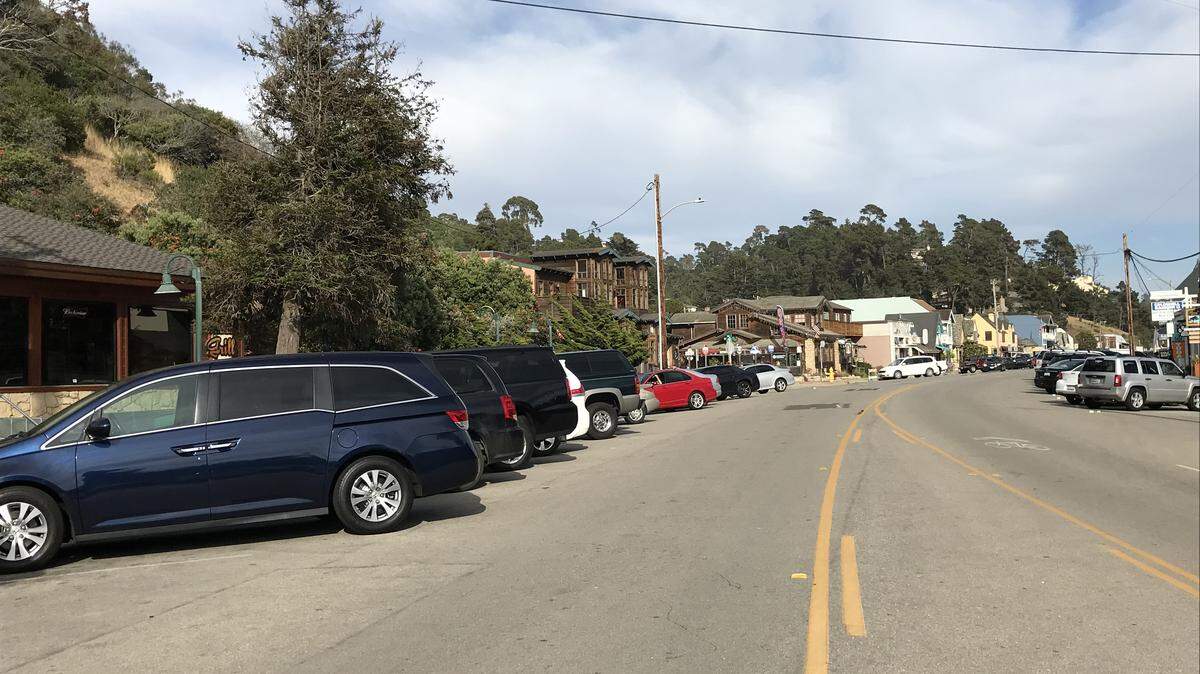
If you’re going to park in a diagonal space in Cambria, would you rather drive forward into it or back in; would you rather back out of the space — the norm in most places — or drive straight out into the traffic flow?
Those are questions that members of the North Coast Advisory Council will be asking of the public — and answering themselves — at a meeting that starts at 6:30 p.m. Wednesday, July 18.
The meeting is held at Rabobank’s community room, 1070 Main St.
Michael Britton, San Luis Obispo County road’s liaison with NCAC, is expected to be there to answer questions and explain the proposal.
The decision has some urgency. The county has proposed doing a pilot “reverse diagonal parking” project on both sides of the 600 block of Main Street, near Main Street Grill. The test project would re-stripe the area, reversing the direction of flow into and out of the spaces.
The new design would require drivers to back their vehicles into the realigned diagonal spaces, rather than driving forward into the spaces as they are configured now.
Why Main Street?
Meanwhile, after another delay due to a malfunctioning truck, an end-to-end Main Street seal-coating project is due to be completed as early as mid-July. Then county crews are to lay down a new center-line, parking and other striping.
Fortunately, county public works has decided that the crews won’t stripe West Village’s diagonal parking spaces until after the NCAC meeting, Joshua Roberts, the county’s transportation division manager, said in a July 10 phone interview.
Earlier, he’d said doing the striping before the decision would be “a risk-versus-reward situation. When the county comes in and stripes,” and there’s a problem later, “there’s no money to pull it up.”
The new material used for “striping is expensive stuff to put down, and it lasts a long time,” he said, so removing it is “like getting nail polish out of your pocket. We can do it” but it’s difficult and costly.
Alternatively, according to Dave Flynn, deputy director of Public Works, “a demonstration project can be done using temporary tape for the parking stalls, versus painting. If it doesn’t work, then we just take off the tape” and stripe it as usual.
The county tried it before in San Miguel.
"We did it in one block but found that almost all drivers went head first into the reverse angle … not good, and… we reverted to normal 45-degree angled parking," he said.
Roberts said July 10 striping in other sections of the newly seal-coated roadways will proceed as scheduled, which Project Manager Pete Newel anticipates should happen Friday through Monday or Tuesday, July 13-17.
How did the idea surface?
Flynn said “a gentleman called in about three weeks ago, asking if we would consider reverse angled parking” in the area.
“Since the work in West Village had not been completed, we saw an opportunity to discuss with NCAC about interest in proceeding with a ‘demonstration project,’” he said, “The area of the Main Street grill was suggested as the area with greater turnover in the parking and pedestrian activity, which may benefit from use. However, it (reverse angled parking) is likely better to do on a side street, rather than the main thoroughfare.”
Back-in parking in other cities
Britton explained the pilot project to North Coast advisors at their June 20 meeting. Council members deferred any formal decision until the Traffic Committee could discuss it in more detail at their July 3 meeting.
After hearing the pros and cons, committee members didn’t make a recommendation, tossing the reverse-diagonal parking concept back to the full council.
According to the committee’s follow-up report, the seven people present were “either neutral or against reverse diagonal parking.”
The report noted that Britton “did say that if his manager had come to him and asked from an engineering standpoint whether this (project) should be done, he would have advised against it.”
Several states and countries have back-in angle parking spaces, and officials cite increased safety because drivers pull forward out of the spaces into traffic, rather than backing out.
Local proponent Jim Bahringer readily shares documentation showing that communities such as Seattle, Austin, Texas, and Washington, D.C., use the concept, and there’ve been fewer parking-related accidents in those areas that have reverse diagonal parking.
Roberts noted in a previous interview that public works research in the Cambria pilot-project area found “in the last six years, there was only one issue that involved a moving car and car backing out of a parking stall.”
He said that, according to technical data on the concept, the Cambria test site “doesn’t really meet the unwritten criteria” for reverse diagonal parking.
“There are no rules for it, per se, just guidance. But if the community is all in favor of it,” public works will institute the pilot project.
Some opponents say there are other dangers in and lots of confusion about reverse diagonal parking. For instance, uninformed drivers are apt to pull forward immediately behind someone who’s preparing to back into a space, and some drivers may find it more difficult to back in between two vehicles, rather than pull in alongside them.
At the July 18 meeting, the council also will review a couple of requests for minor-use permits and discuss the county’s proposed general-plan amendments for lands with significant mineral resources and properties adjacent to existing mines and quarries.