
Growth of rentals around Cal Poly sends longtime residents fleeing
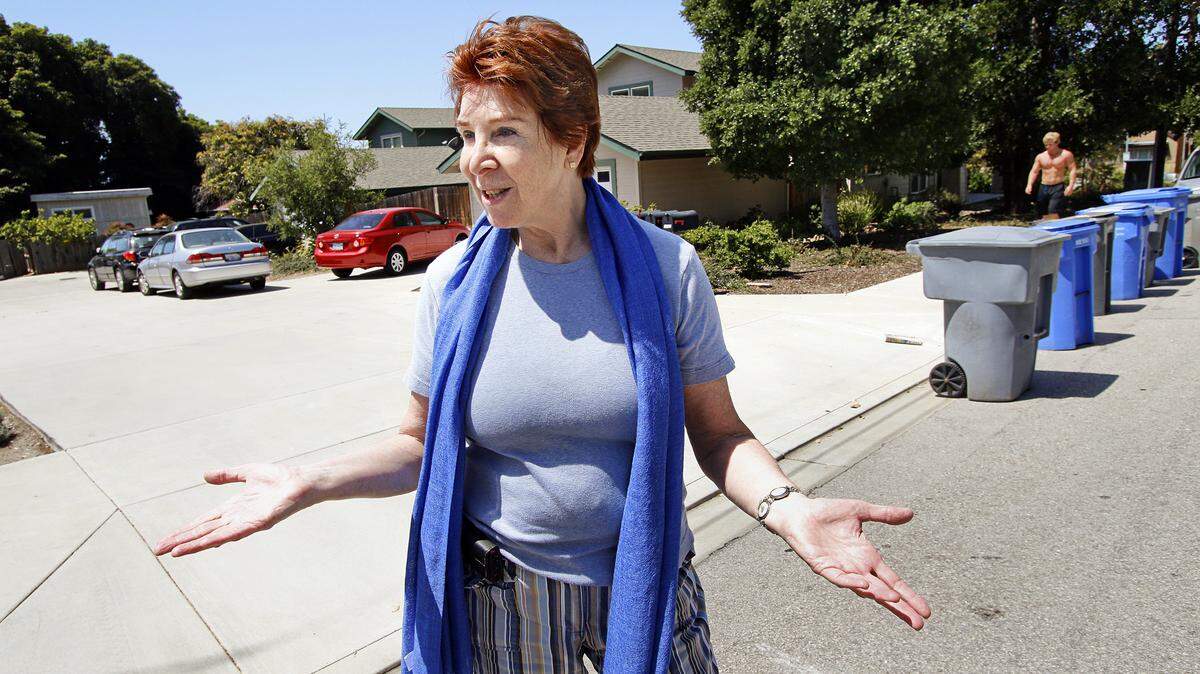
When Anne Walling and her husband moved in 1996 into the home her parents had built some 30 years before, the San Luis Obispo neighborhood near Cal Poly felt fairly quiet.
Walling and her husband, Joe, put a lot of work into the 1,500-square-foot house on McCollum Street with a beautiful view of the mountains: a new roof, stone fireplace, a wraparound deck and landscaping.
“We wanted to retire and relax,” Walling, 62, said recently.
But gradually, the neighborhood changed. As older residents moved away, the homes were bought by parents to house their students attending Cal Poly.
A new housing development in the early 2000s near the intersection of Grand Avenue brought more rentals and students to the neighborhood, Walling said.
“The whole area became rentals,” she said. “That started a party network that ballooned. The whole area just gets flooded with people walking with cell phones to see where the next party was.”
Walling and her family endured several years of noise, vandalism, parking problems, and offensive interactions with some of her student neighbors before they decided to sell the house in 2013 and move, first to Nipomo and then to Los Osos.
The Wallings aren’t the only longtime San Luis Obispo residents to pound a for-sale sign in their yard and leave town or move to another part of the city.
Over the past dozen or more years, the neighborhoods surrounding Cal Poly slowly transformed from homes occupied by owners to more and more homes housing students. Some longtime residents call it an exodus of permanent residents.
The reasons for leaving vary: Some elderly residents move into care facilities, for example. But others have moved because they’re fed up with the noise, parking and other problems that some students have brought.
“Many of our residents aren’t tolerating it anymore and they’re moving,” resident Carolyn Smith, secretary of Residents for Quality Neighborhoods, told the San Luis Obispo City Council on May 5. “Our residents deserve peace around their homes.”
Shifting landscape
The exact number of longtime residents moving for reasons related to the large number of student rentals is unknown.
But what is clear is that the number of rental homes in the city continues to outpace owner-occupied homes, which can contribute to some of the neighborhood issues. The change happened over many years, Realtor Steve Delmartini said.
“Over 20 years, I’ve certainly seen owners in those neighborhoods get out,” Delmartini said. In 2013 and 2014, though, he said the bulk of the sales in neighborhoods around the university have been rental owners unloading their properties.
He estimated about 58 homes sold in 2013 and 56 sold in 2014, and in both year about 15 or 16 of the sales were owner-occupied homes.
In San Luis Obispo, 62 percent of available homes are rentals, according to the 2010 census, well above the statewide average of 43 percent.
San Luis Obispo officials are developing a database to include all single-family and duplex rental properties in the city as part of a new rental inspection program approved by the council May 5.
City staff will use the database to determine which properties are rentals, and subject to inspections and fees, but it won’t distinguish between homes rented to students and homes rented to families or other tenants.
On Tuesday, the council will hear a report from a “civility group” of Cal Poly and Cuesta College administrators, city staff and students that’s been meeting since October 2013 to discuss ways to improve the town/gown relationship.
Some residents also point a finger at Cal Poly, saying the university is growing too fast and hasn’t done enough to house students on campus.
“I am not one to focus on the past,” Cal Poly President Jeff Armstrong said in a phone interview Tuesday. “I do agree that the problem was a long time in developing and one clear component of the solution is additional student housing.”
The university just released an updated Master Plan that calls for more dorms, with a goal of housing 65 percent of all students. Thirty-eight percent of Cal Poly students currently live on campus.
Armstrong said Cal Poly aims to grow student housing much faster than the university’s enrollment. Providing additional housing is not a one-size-fits-all solution, he said.
“I don’t think where a student lives is necessarily going to keep them away from parties or out of the neighborhoods,” Armstrong said.
Still, he said, Cal Poly officials are building on the university’s orientation programs and outreach efforts to get students to account for their actions.
“I think we’re starting to move in the right direction,” Armstrong said. “The students understand that behavior on and off campus is a concern to us, and we want to hold them accountable.
“Students also understand that issues like St. Fratty’s Day can not only have a negative impact on an individual student’s success, but it’s also damaging to the overall value of a Cal Poly degree.”
‘St. Fratty’s Day’
For some longtime residents, the problem peaked in the early morning hours of March 7, when about 3,000 people flocked to Hathway Avenue to celebrate “St. Fratty’s Day.”
At 6:20 a.m., a garage rooftop holding about 50 students caved in, injuring at least eight people. Police issued four noise citations in response to the party, but no unruly gathering citation has been issued to date.
At the council’s May 5 meeting, a few residents requested a review of the unruly gathering ordinance, which allows fines to hosts of parties of 20 or more people that involve “unlawful conduct that creates a substantial disturbance in a significant segment of a neighborhood.”
That could include noise, public drunkenness, serving alcohol to minors, fighting, urinating in public, or crowds overflowing into streets.
“This tool is rarely used,” said resident Linda White, co-chairman of Monterey Heights Neighbors. White lives on a street near Cal Poly where only four of the 13 homes are occupied by permanent residents. “Residents have a right to know whether this lack of enforcement is at the discretion of the council or at the discretion of police.”
Since 2010, 11 unruly gathering citations have been issued, and six citations were handed out to hosts of parties where minors were drinking, according to Neighborhood Outreach Manager Christine Wallace with the San Luis Obispo Police Department.
Residents had high hopes that the unruly gathering rules, passed in 2010, would curb large parties, but that hasn’t happened, Smith said. In the past five years, the group Residents for Quality Neighborhoods has tracked 530 parties with 40 or more people.
“If you’ve never experienced a large party in a neighborhood, it’s terribly disturbing to the neighbors,” Smith said.
The number of noise calls related to parties citywide dropped from 2009 to 2013, but increased slightly last year.
But city ordinances might only be one part of the solution.
Joi Sullivan, president of Cal Poly’s Associated Students, Inc., believes regular get-togethers and activities between students and longtime residents might go farther in building positive relations.
ASI held a “Pedal to Pancakes” event near Slack Street on Saturday morning and invited residents to bike over, eat pancakes and meet some student neighbors.
“When you get to know them on a personal level that makes permanent residents feel more comfortable walking over to say, ‘Hey, my 12-year-old is trying to sleep,’” said Sullivan, who has been involved in the civility group and co-chairs the Student-Community Liaison Committee, a regular meeting of city officials, residents, and Cuesta and Cal Poly students.
But the relationship-building efforts have to continue year after year as new students move into the neighborhoods.
“If you’re investing energy every year to make sure your community is safe and respected, that takes a lot of time and energy,” Sullivan said. “And in their minds (of permanent residents), that shouldn’t have to be their priority, but it helps.”
White’s neighborhood has started holding potlucks with their student neighbors, which she said has helped improve their relationship.
‘They didn’t get it’
Several longtime residents were quick to point out that not all students are partiers, and note the town wouldn’t be the same without them. But, they said, there are ongoing issues that need to be addressed.
Resident Chris Black said students keep the town young and vibrant — but he still decided to move to a quieter part of the city.
“The kids who lived on either side of us were nice, but they didn’t get it,” said Black, who moved to San Luis Obispo in 1975 to attend Cal Poly and later came back to retire. “They’re not homeowners, and they want to party and have a good time.”
Black and his wife bought a small house about 10 years ago on Cerro Romauldo, north of Foothill Boulevard. There were several owner-occupied homes in the neighborhood at the time, but things started to change after an elderly couple next door to Black moved to a nursing home.
Eventually, the home was rented to four college-age men; the house on the other side of Black’s home was rented to men as well.
“So we had five guys renting on one side and four on the other,” Black said. “Last summer we left San Luis on (Memorial Day) and came back in September and it felt like we were living in the dorms. It was a huge transformation.”
Traffic, parking and noise problems prompted Black and his wife to sell their house and move as quickly as possible to a new housing development off Prado Road in San Luis Obispo.
“We figured it’s not going to get any better,” Black said. “Cal Poly is going to continue to increase enrollment, and it’s just going to get worse.
Frank Kassak, vice chair of Residents for Quality Neighborhoods, lives in Black’s former neighborhood and said 12 of the 16 homes on his street are rentals.
“We lost five houses in our neighborhood between January and June who were people who just gave up,” Kassak said.
The last straw
Walling, her husband and daughter lived 17 years in their home on McCollum Street.
Toward the end, they put up with traffic problems and students trolling the street for parking spaces, noise from frequent parties, trash, vomit and vandalism.
“They’d take a potted plant off my wall and smash it on the street,” Walling recalled. “Our mailbox got destroyed I don’t know how many times. We called the police all the time, but we stopped because they’d give out our name.”
Walling believes members from a fraternity house lived next door. The college-age men seemed nice at first, stopping by to say hello.
But frequent events at the home, noise and parking issues soured the relationship, which took a turn for the worse in mid-2013 when Walling came outside on a Sunday morning to find that someone had smashed the lights on her husband’s motorbike with golf clubs. The next week, the couple decided to move.
“We said, ‘we can’t live here,’” she recalled. “I don’t want to sit guard on my house.” The hardest thing she’s ever had to do, Walling said, was lock the front door for the last time and walk away — but she believes her father, who came to San Luis Obispo to teach at Cal Poly, would have understood.
She said the only buyers looking at the home were people interested in rental properties. “We wish we could have picked up our house and moved it to another spot,” Walling said. “We’re very happy (now), but it would have been a lot easier to stay put.”
NOISE COMPLAINTS
From 2009 to 2013, calls complaining of noise related to parties citywide dropped from 2,584 to 1,672.
In 2014, the number increased to 1,729.
In 2014, police issued 549 warnings and 253 citations in response to the 1,729 calls.
NEXT CITY COUNCIL MEETING
On Tuesday at 6 p.m., the San Luis Obispo City Council will hear a report from a “civility group” of Cal Poly and Cuesta College administrators, city staff, residents and students who have been brainstorming ways to improve resident-student neighborhood relations.
The civility working group’s report was released last week. Among its suggestions:
- Adding enforcement actions such as a noise ordinance in public spaces for gatherings of more than 50 people;
See the city staff report for more information.
This story was originally published May 16, 2015 at 9:22 PM with the headline "Growth of rentals around Cal Poly sends longtime residents fleeing."