
Drought pushes residents, cities to seek water-saving strategies
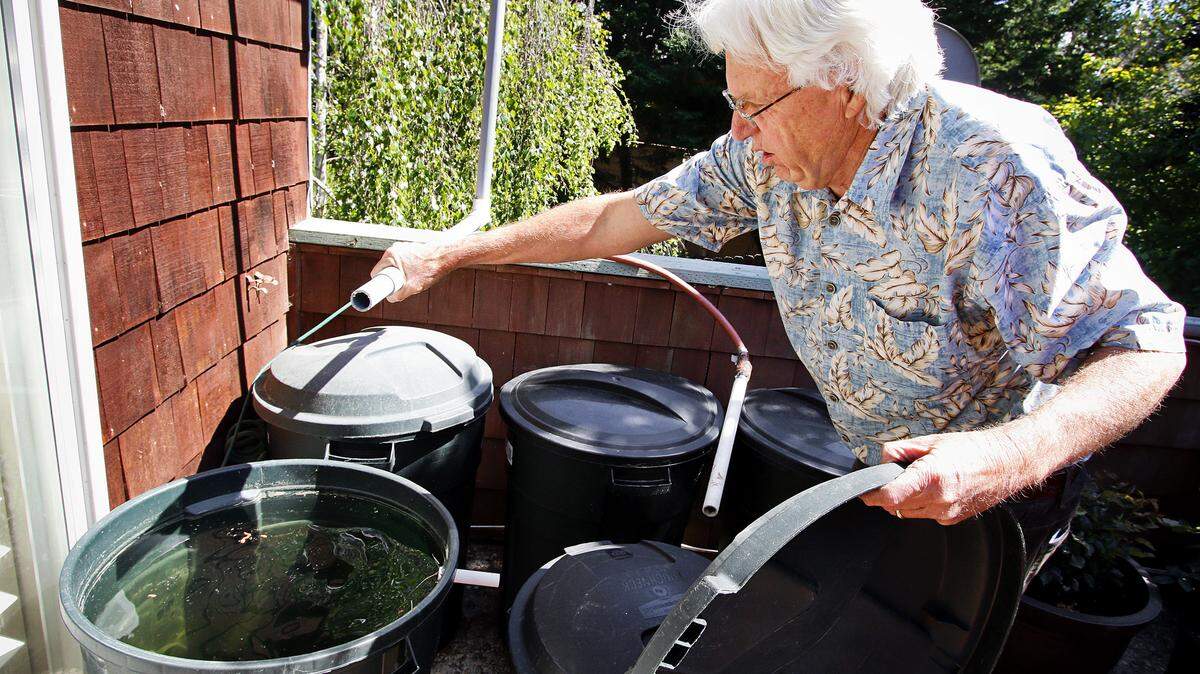
Cambria resident Bill Seavey has turned conserving water into a science.
He has installed a rainwater harvesting system on both his home and vacation rental to catch and store more than 2,000 gallons of rain to water his landscaping. Typical of many Cambrians, he takes a bucket into the shower with him to collect water that can be used to flush toilets.
He even uses bottled water when he brushes his teeth to save a couple of extra gallons. All of these efforts have paid off. Seavey keeps water usage to less than 50 gallons per person per day.
He’s become such an expert on water conservation that he has given three workshops in recent years to teach Cambrians how to minimize their water usage. He estimates that some 100 people have attended the workshops.
“We are the super water-conservers here in Cambria,” he said. “Lots of people want to help but I think many people in the state do not understand the severity of our water crisis.”
Many communities in San Luis Obispo County haven’t come close to saving as much water as Seavey and his fellow Cambria residents.
Data released by state water regulators this week shows that Cambria residents used 40 gallons of water per person per day last September.
By comparison, water use that month ranged from 52 gallons per person per day in Grover Beach to 154.6 gallons per person per day in Atascadero to 111.6 gallons per person a day in Pismo Beach.
As San Luis Obispo County suffers through its fourth year of exceptional drought, the state is requiring residents cut back on water use. State water regulators earlier this week proposed mandatory cuts of 10 percent to 35 percent compared to 2013.
Communities that have already achieved their proposed cut wouldn’t have to cut further. Cambria and Grover Beach, for example, have already cut water use well over their proposed 10 percent reduction.
But Cambrians still need to continue to conserve because the town has been on the front lines of California’s drought crisis. It nearly ran out of water last fall.
An emergency water-reclamation plant that processes groundwater, brackish water and treated effluent went on line in January on a trial basis, but that has only averted the immediate crisis.
Cambrians are acutely aware that strict conservation remains their new normal. “Everybody has to keep helping out,” said George Kostyrko, director of the state water board’s Office of Public Affairs. “Basically, Cambrians have been real leaders about how to make good judicious choices about using precious water. Other communities can learn from your examples.”
He added: “Other communities need to stop watering outdoors.”
Small water agencies with fewer than 3,000 water connections, such as water suppliers in Los Osos and other unincorporated communities in the county, will have to work toward a 25 percent reduction in water use, according to Gov. Jerry Brown’s recent order.
The proposed cuts still have to be approved by the state water board.
City rebate programs
So what can residents do to conserve water and avoid potential fines if water conservation goals aren’t met?
The most important step: Take advantage of retrofit and rebate programs. Most cities have programs to pay individual households to become more water efficient.
The most common rebate programs pay residents to replace grass with drought-tolerant plants; replace older, less-efficient washing machines and toilets; and install rainwater harvesting systems.
“We have a very active rebate program,” said Bob Perrault, public works director for the city of Grover Beach. “All total, we have spent approximately $60,000 thus far in this fiscal year and expect to spend an additional $35,000 before the end of the year.”
Arroyo Grande plans to spend more than $1.5 million over the next five years on water conservation efforts. Most of the money — $410,000 — will be spent on a public education program.
That city and Pismo Beach recently partnered on a “Think H2O” campaign that offers rebate programs and water-saving tips for residents.
The Nipomo Community Services District offers a $50 rebate for installing a high-efficiency washing machine.
District General Manager Michael LeBrun said the district doesn’t have many rebate programs or issue fines for water conservation violations because doing so actually increases costs to the district.
Instead, the district is doing water-savings outreach to customers while relying on tiered water rates that penalize high water users, to encourage conservation.
Unlike its neighbors, San Luis Obispo doesn’t offer rebate programs. The city offered a slew of incentive programs from 1990 to 2009, utilities services manager Ron Munds said.
“We did all of that for so many years that the city made the decision that now it was up to residents to do their share,” Munds said.
San Luis Obispo’s water rate structure also penalizes higher water users, and the city limits outdoor watering to three days a week, he said.
“It surprises me when I see green lawns around town,” he said.
Ripping out lawns
Several local officials across the county said targeting outdoor irrigation is key to reducing water use. Many cities have programs that pay homeowners to remove water-thirsty grass.
For some residents, that means changing long-held views that a home needs a lush green lawn, and recognizing that drought-tolerant plants can provide a pleasing landscape.
“People think it’s just rock and cactus, which it’s not,” Paso Robles Water Resources Manager Christopher Alakel said.
The Nipomo district is working with the homeowners association in Blacklake Golf Resort — which has fined people in the past for not having a green lawn — to encourage drought-tolerant landscaping, LeBrun said.
Arroyo Grande estimates that 60 percent of its water is used to irrigate turf-grass areas. Gabriel Frank, owner of Gardens by Gabriel Inc., which specializes in water-wise landscapes, said he’s seen more people converting their yards in the past two years. But calls to his business have spiked since Brown’s announcement of mandatory water cuts on April 1.
“People are tearing out lawns left and right,” Frank said. “It’s provided that extra stimulus to people who were holding onto lawns for years and they just didn’t know what to do.”
Frank said he hasn’t watered a demonstration garden at his home since Halloween. “If you choose Mediterranean-adaptive plants, in the winter you don’t need to water,” he said.
Such plants come from the four other Mediterranean regions of the world that share California’s dry climate: Chile, Australia, South Africa and the Mediterranean basin, said Todd Davidson, general manager of Sage Ecological Landscapes & Nursery in Los Osos. Keep in mind, he said, that drought-resistant plants will need some water to become established.
Davidson and Frank estimated the cost to replace a lawn at $7,000 to $15,000, depending on the size. That includes lawn removal, planting, mulching, labor and irrigation. A motivated homeowner might be able to do the job on their own for a few thousand dollars, Frank said.
“It’s like an investment, like solar,” Frank added. “You pay upfront but your maintenance costs will be much lower in the long haul, your water costs will be lower and your ecological footprint will be much lower.”
Still, not all homeowners have been won over. His company has installed two lawns this year, he said.
Fining water wasters
Because the drought is so severe and cities are facing such ambitious water conservation goals, some cities have implemented fines to property owners who waste water or fail to meet conservation goals.
In Grover Beach, an average of 25 customers per month or about 1 percent of total customers are penalized for failing to conserve the mandatory 10 percent. This penalty amounts to 100 percent of the water charge for the first offense and 200 percent for the second offense, Perrault said.
Arroyo Grande is considering a similar penalty program, although the details are still being worked out, said Geoff English, public works director.
“We have not issued any citations or fined any water-restriction violators, however we have issued multiple warning notices,” he said. “We are tracking the issuance of warning notices and will be issuing fines in the future for repeat offenders.”
Paso Robles has issued fines since 2009 to customers who fail to follow the city’s mandatory water measures, which include restricting outdoor watering to three days a week.
The warnings and fines peaked in 2009, with 1,080 warnings and 25 fines totaling $2,800. Hundreds of warnings were issued but no fines were given in 2013; only two fines totaling $200 were issued last year.
Two notices are given before fines are issued, Alakel said.
“Most of our customers are doing a pretty good job, but we have some pretty big water users, too, and those people have the money and … they’ll pay the fines,” he said.
“I don’t know if you’re going to reach everyone with penalties and pricing, but you hope there’s enough peer pressure out there to eventually convince these people to change their ways.”
This story was originally published April 11, 2015 at 7:31 PM with the headline "Drought pushes residents, cities to seek water-saving strategies."