
SLO County pediatricians respond to measles outbreak
Correction: An earlier version of this story incorrectly said that Dr. Tamara Battle at Central Coast Pediatrics has decided not to see any patients who don’t vaccinate. The information came from a practice partner. However, Battle said she will see those patients.
Galvanized by the recent outbreak of measles — a disease that had been declared eliminated from the U.S. 15 years ago — a group of pediatricians in Atascadero announced last week they would no longer see patients whose parents refuse to have their children vaccinated for the disease.
Patterson & Tedford Pediatrics announced the decision in a two-page letter posted on its Facebook page Wednesday evening.
“This is not just for new patients,” Dr. Brian Patterson said. “We’re going to ask our current patients who don’t want to get their children vaccinated for measles to find other providers.”
Calling the decision “a defining moment for our practice and for us as children’s health experts,” the letter says the practice made the decision so that it could protect babies too young to be vaccinated, “our most vulnerable patients,” from exposure to children who could be carrying measles.
Patterson & Tedford, which has three physicians in the group, appears to be the only practice in San Luis Obispo County to drop families who won’t vaccinate for measles.
Patterson & Tedford is contacting all patient families that aren’t up to date on some or all vaccinations to notify them of the new policy, office manager Cassie Foster said. About 290 patients are on the list, she said. Parents of 50 patients, she said, have refused the measles-mumps-rubella (MMR) vaccine that is given at 12-15 months and again at 4-6 years.
Patterson said the measles outbreak linked to Disneyland triggered the policy change, but the increasing number of non-vaccinating families was a long-standing concern.
The U.S. Centers for Disease Control and Prevention had declared in 2000 that measles was eliminated in the United States, but the disease has since returned. Last year, the CDC reported 644 cases in 27 states.
The Disneyland outbreak that began showing up Dec. 17 has spread to seven states. As of Friday, 113 cases in 12 counties have been confirmed just in California, according to the state Department of Public Health. No cases have been found in San Luis Obispo County.
Based on the strain of measles, CDC officials believe the outbreak at Disneyland started with someone who became infected overseas and visited the park.
“Is it just dumb luck that it happened at Disneyland instead of Hearst Castle? We get international visitors here, too,” Patterson said. “You can expect we will have measles if our numbers of non-vaccinators continue to increase.”
Patterson doesn’t mince words to describe what he sees as a public health threat and a breakdown of the social contract.
“Honestly, I see this as a type of child endangerment,” he said.
In his letter to parents, he writes, “Scientific denialists, irresponsible media and celebrities, self-proclaimed graduates of the University of Google, non-vaccinating parents and their susceptible, unimmunized children threaten the health of our children.
“The overwhelming majority of our parents and public health officials understand this, vaccinate with all AAP (American Academy of Pediatrics) recommended immunizations and are anxious for change.”
Patterson said his group’s new policy is focused solely on measles immunizations.
“We decided to do measles simply because it is incredibly contagious, it’s airborne and it is potentially fatal,” he said. “It’s a significant disease and completely preventable.”
Patterson reels off the CDC statistics: 90 percent of people not immune to measles will get it if they come into contact with someone with the disease; measles lives on surfaces and in the air for up to two hours after someone has coughed or sneezed; 1 out of 1,000 cases will develop encephalitis; 1 out of 1,000 people with measles will die.
Pediatricians across the country have struggled over the past decade with how to deal with the increasing number of parents refusing to immunize their children, with increasing numbers making similar choices as Patterson & Tedford.
A decade ago, the American Academy of Pediatrics’ bioethics committee published a paper offering guidance to doctors, “Responding to Parental Refusals of Immunization of Children.”
The paper recommended pediatricians talk with parents at every visit about immunizations and offered detailed guidance for those conversations. In the case of an epidemic that might put children at risk, the paper notes that state agencies could become involved. But dropping patients was seen as a last resort, in part because “a continuing relationship allows additional opportunity to discuss the issue of immunization over time.”
Patterson agreed, which is one more reason why the practice is limiting its policy to just the measles vaccine, so physicians have the first year to talk to parents before the first MMR vaccine is due. At that point, parents will need to take a hard look at whether their resistance to vaccination is strong enough to make them change doctors, he said.
“We decided there is a clear and present danger and that there was an opportunity to create some awareness locally,” he said. “And for our existing patients, it does make a decision necessary.”
At Central Coast Pediatrics, Coryell said the medical group’s policy is that children should be immunized and follow vaccination schedules set out by the AAP and the CDC.
The physicians have not talked about whether the practice should stop seeing patients who refuse vaccines, Coryell said.
Coryell also called non-vaccinating a “public health hazard” but that he would not stop seeing patients because it would eliminate the chance to give them accurate information.
“My role is to support and educate parents,” he said. “I can’t be an advocate for vaccines if I don’t talk to parents. I certainly recommend a full range of vaccinations for all my kids. That’s the message I send.
“I understand why physicians would make that choice, though,” he said. “They don’t want patients in their office who can expose other patients to dangerous illnesses. Measles is extraordinarily contagious. Your only strategy for beating it is to get vaccinated.”
Ironically, both Coryell and Patterson point out, most vaccines have been so effective that parents haven’t seen how devastating the diseases can be. Non-vaccinating families also have benefited from herd immunity, which protects the unvaccinated in populations with high vaccination rates.
In San Luis Obispo County, that protection may be waning. Researchers say that an immunization rate of about 94 percent is needed for measles to reach a herd immunity threshold. In fall 2014, just 89 percent of incoming kindergarteners were fully immunized for measles, according to data collected by state health officials.
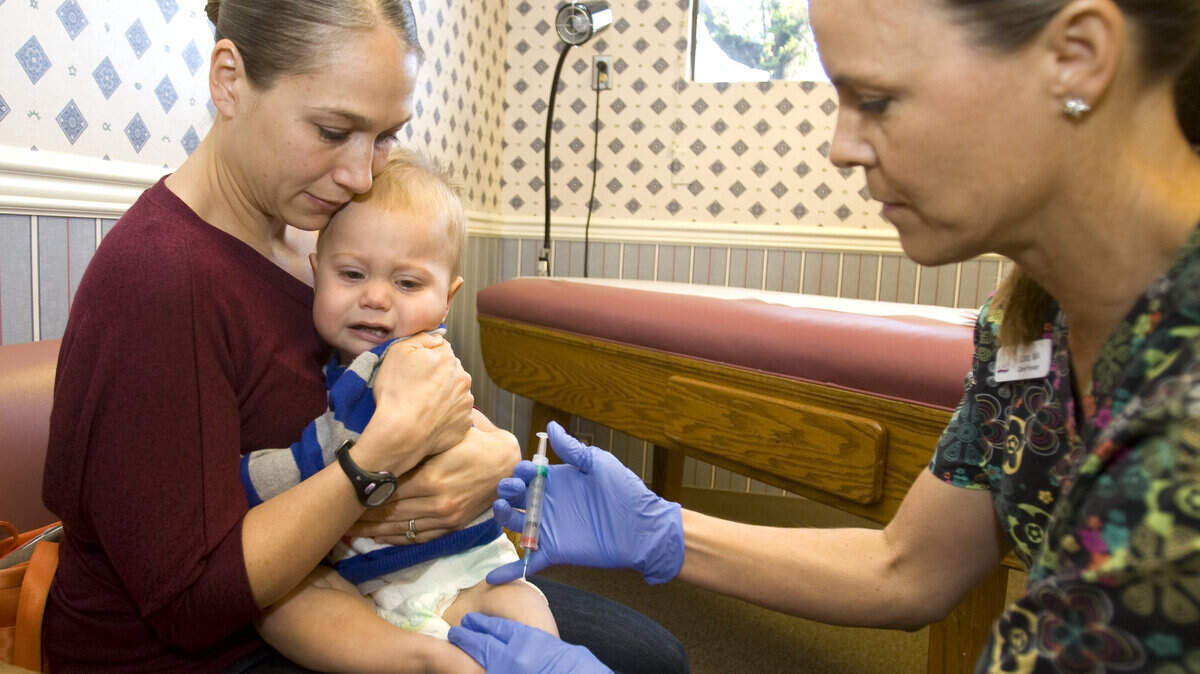
On Friday, Atascadero resident Megan Perhach brought her 15-month-old son, Brennan, into the Patterson & Tedford office for his first MMR vaccine.
She said she supported the new policy, although she thought the practice might lose business.
“But from the moral and ethical standpoint, I do agree with them,” she said. “I could have brought my son in three months ago and if there were a child there with measles, he could have gotten it.”
This story was originally published February 16, 2015 at 12:26 AM.