
Charles Paddock Zoo showing its age
Beginning in 1956 as one county park ranger’s quirky collection of critters, Atascadero’s Charles Paddock Zoo has evolved into a family destination and local hub for scientific conservation.
But the years have taken their toll.
The zoo’s infrastructure is so dated that the staff uses extension cords in winter because there’s not enough electricity. More importantly, while exhibits have been modified, they’re still old and limit the types of animals and projects on site.
“There’s really no way to take a black-and-white TV and make it a flat-screen plasma,” zoo Director Alan Baker said.
Without an estimated $30 million modernization over the next 20 years the zoo may lose its accreditation and suffer a slow death, supporters say.
The city — which has paid 51 percent to 73 percent of the annual cost to operate the zoo after accounting for admission revenue — says upgrades are increasingly difficult to fund.
And though city leaders aren’t backing out, they say if the economy continues to decline, the zoo could be sacrificed to save core services.
“It’s definitely an important, well-liked attraction, but it’s not putting pavement on the road,” City Manager Wade McKinney said.
The latest idea, by the Central Coast Zoo Society, is to seek a $20 a year tax assessment on property owners countywide to generate $2.7 million a year. That’s far more than the $624,101 — including admission and other revenue — that it cost to run the zoo last year. The society, the zoo’s nonprofit fundraising arm, pays for exhibit improvements.
The zoo hopes to undertake an estimated $30 million master plan to build multispecies exhibits in five-year increments over 25 years.But whether this will happen remains to be seen.
History of the facility
The zoo traces its start to 1956, when Charles Paddock caught and kept an opossum one night while irrigating the grounds at Atascadero Lake Park.
Soon people started bringing him other animals. A Camp Roberts soldier sold Paddock an organ grinder-type monkey named Josephine for $25, Paddock got a black bear named Baby confiscated by the state from an illegal bear-wrestling act, and a Las Vegas woman donated a leopard cub when it became too big for her to handle.
By 1959, Paddock had more than 125 wild birds and mammals in the collection. He bankrolled the entire operation for several years.
In the early 1960s, a group of women formed a zoo society to raise money for exhibits. That eventually became the Central Coast Zoo Society.
The exhibits grew through both animal and financial donations. By 1967, news reports said 100,000 people visited the zoo.
The attention led it to become an official San Luis Obispo County-funded operation.
But in the 1970s, people began criticizing the small size of the animal enclosures.
From the start, Paddock said he caged the animals to keep the people out, not the animals in. He was clearly upset by the characterizations.
“It bothers me,” Paddock said in 1971. “People look at the animals through people’s eyes. But they’re not like us. If they worked with these animals, they would learn a heck of a lot more than they know now about what it takes to make them content.”
Despite public concerns, news reports from the U.S. Department of Agriculture said that surprise inspections at the zoo over nearly two decades never once gave it a bad mark.
In 1978, Paddock resigned. Two years later, after an illness, he committed suicide at his Atascadero home. He was 57. With Paddock gone, things changed.
When the city of Atascadero formed in 1979, it took over the zoo’s operation and renamed it the Charles Paddock Zoo a year later.
In 1982, the U.S. Humane Society directed the city to either close the zoo or upgrade it after an inspection found that though the zoo was up to legal standards, its concrete floors and chain-link fences gave a negative message to the public.
In response, the late Marjorie Mackey, then Atascadero’s mayor, questioned whether the city could even afford the zoo. A committee was formed and found that the zoo was a key attraction and the city should find ways to upgrade it with community help.
The zoo society again stepped up, and the city began charging admission in the mid-1980s.
By 1991, the zoo underwent one of its biggest changes, becoming one of the smallest accredited zoos in the nation and part of the national nonprofit Association of Zoos and Aquariums. Among other things, that gives it access to exchanging marquee animals within the association with the goal of breeding endangered species.
Without that, the zoo would lose its core mission of conservation.
“And if we’re not doing that, we don’t have much of a zoo,” Baker said.
But accreditation also brings a new set of rules — almost all of which require the zoo to upgrade its policies and operations, and these are expensive.
Current problems
Most of the zoo’s structural problems are out of the public eye, but they greatly limit what can be done.
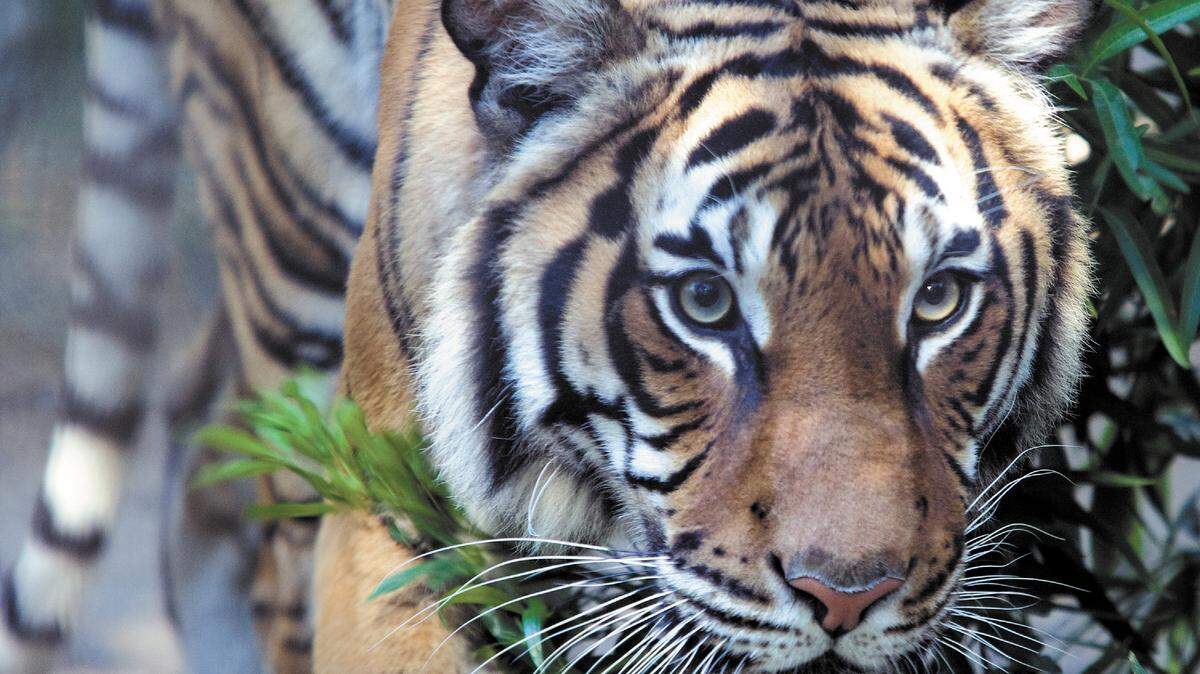
Menderu, the zoo’s tiger, illustrates this. His rear holding cage, out of view of visitors, was designed by community groups and doesn’t provide modern mechanisms that zookeepers need to breed him. So he will be leaving soon for another zoo where he can be bred.
Other exhibits have similar situations, Baker said, and could result in the loss of all the key animals.
In fact, it has already begun. When the zoo’s bear died about five years ago from old age, the zoo couldn’t replace her because the exhibit was too old. It now has owls in that space.
The problems stem from how the zoo evolved, which Baker characterizes as structures being “hodge-podged” over time as Paddock built enclosures with volunteer help.
Besides lacking adequate facilities for breeding — a key requirement for accreditation — the zoo has other problems.
In the winter, its red-foot tortoises can’t be shown because their exhibit is one of many lacking power for a heat lamp. Its water systems are old, so the zoo can’t have certain animals that need filtered ponds.
Drains were built in the middle of cages, so the animals have to be moved when there’s a clog — which Baker said occurs often with 4-inch pipes from the 1970s.
The zoo also lacks temperature controls, like air conditioning or heat, so it can’t have certain animals.
Improvement needs come at the same time the city is hurting financially.
To help close the city’s $2.1 million budget gap, Atascadero’s employees and department heads in June cut their cost-of-living raises and reduced salary and their paychecks by paying more toward pension contributions through 2013.
In 2010, the city paid an extra $701,700 with redevelopment money for a new zoo bathroom and entrance project. New bathrooms were one of many items required for the zoo to stay accredited through 2014. Before, it had a single unisex stall.
The bathroom project happened only because the city could use redevelopment money, which has limited uses — it couldn’t be used to improve exhibits or pay salaries, for example.
“We’re really at that place where there’s no just keeping pace,” McKinney said. “Improvements are constantly needed to get the zoo into where it needs to be, and it’s become increasingly difficult.”
Possible solutions
Many think the zoo is a regional asset — it averages about 70,000 visitors a year.
Last year, 79 percent of visitors came from outside Atascadero, according to the society.
Those visitors “stop for a soda, they stop for gas and they stop in Atascadero, which is a huge benefit for our town and our business community,” said Linda Hendy, executive director of the Atascadero Chamber of Commerce.
Hoping that visitors think the zoo is worth supporting, the society hired a Southern California research firm to scientifically poll countywide voters in the summer asking if they’d favor an assessment district.
About 400 randomly selected voters took the 25-minute telephone survey, which had a 4 to 5 percent margin of error.
Coastal communities and Atascadero favored the tax idea more than those polled in Paso Robles, San Luis Obispo, Nipomo and Grover Beach. The majority of people in favor said they’d support a tax to help strengthen the zoo while those who objected opposed any new tax, despite what it would be used for.
The results will help society members know where to strengthen their campaign when they decide to put a tax measure on the ballot, zoo society treasurer George Dodge said.
Once it’s on a ballot, then it would be up to voters in the district to approve of the tax, which would need two-thirds approval to pass.The poll showed voters were 55 to 60 percent in favor, depending on their location.
“That’s why it’s important to know where the support is and isn’t, because when starting campaigning we need to know where the strengths and weaknesses are,” Dodge said.
The society now plans to promote the idea more and try to inform groups on the issues before polling the public again next year. The society will place it on the ballot when polls show at least 66 percent of those are in support, Dodge said.
The measure could propose creating the assessment district from areas most in favor of the tax. It also could be countywide.
Grants, bonds, donors and community fundraisers could also help generate more revenue. Organizers are still in the early stages of finding solutions.
But supporters say the momentum for change is growing.
“Instead of patching things over and over and over, we want something to take us through the next 30 years,” Baker said. “We don’t want to wait until the zoo will close. We wanted to get out there and gather information — be proactive and think about (our) future now.”
Visitors’ origins
Top zoo visitors within county in 2010:
Atascadero: 9,062
Paso Robles: 5,942
San Luis Obispo: 3,051
Templeton: 1,556
Arroyo Grande: 1,259
Los Osos: 1,092
Morro Bay: 908
Top zoo visitors outside county in 2010
Santa Maria: 1,809
Bakersfield: 1,193
Kern County: 650
Los Angeles County: 987
Fresno: 304
Charles Paddock Zoo
Who runs it: Maintained and operated by the city of Atascadero.
Location: 9100 Morro Road, Atascadero Lake Park.
Animals: 52 mammals, 87 reptiles, 44 birds, 20 amphibians and 130 insects.
Mission: To educate people about conservation and combat extinction of specific rare animals.
Cost: $624,101 in 2010: $184,908 from admissions and other revenues; $59,656 from zoo grants and donations; and $379,537 from the city’s general fund, placing it in competition with essential services such as police and fire. The city pays for the zoo’s operations including employee payroll, utilities, animal food and maintenance.
Since 1987, when expenses were first broken out, the city has spent about $9.3 million to operate the zoo while admissions have generated about $3.3 million since 1988.
Nonprofit support: The Central Coast Zoo Society raises money through fundraisers, private donations and memberships to expand and improve anything that benefits the animals. Donations vary by year. In 2010, the group raised $112,440.
Accreditation: The zoo is accredited through 2014 by the nonprofit Association of Zoos and Aquariums. The process occurs every five years.
This story was originally published October 29, 2011 at 11:36 PM with the headline "Charles Paddock Zoo showing its age."