
County coroner's team faces death every day
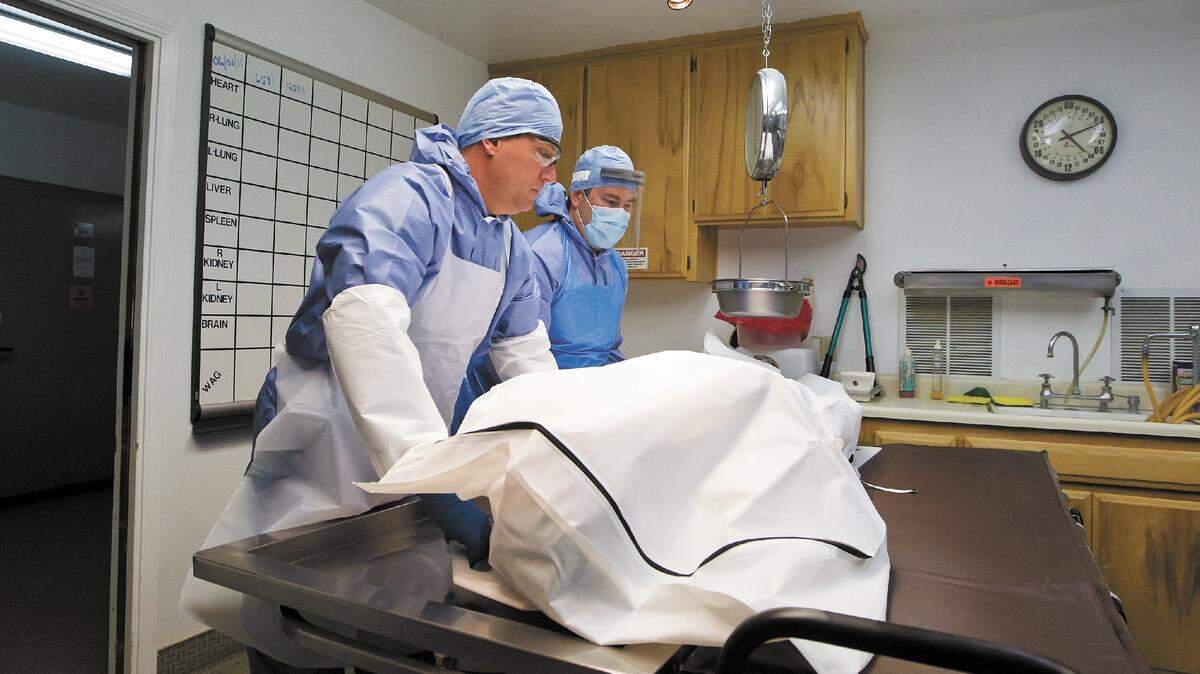
A white sheet was draped over the body of a 53-year-old woman. She was alone but for a sheriff’s deputy.
County coroner investigator Jeff Nichols walked into the room at Arroyo Grande Community Hospital one afternoon in spring 2008.
First, Nichols took a photo of the sheet-covered body. Then, with gloved hands, he removed the sheet. Sand was everywhere — on the sheets and even sprinkled on the floor.
Her shirt had been cut away by hospital staff. She wore shorts and no shoes. Her shoulder length brown hair was a mess. She was cold to the touch. Rigor mortis hadn’t set in. Sand was embedded in the woman’s eyes, ears, teeth and gums.
“That doesn’t just happen,” Nichols said later. “There was no way sand could have got in those orifices without someone putting it there.”
The deputy told Nichols the woman was found unresponsive at Oceano Dunes. Her friends gave the deputies conflicting statements. That’s when Nichols was called; he guessed her death was no accident.
That 2008 case is one example of the day-to-day life of the county’s three-man coroner team — Nichols, 45, detective Stuart MacDonald, 41, and detective Dave Kenitz.
“We do it all,” Nichols said. “We tell kids who watch ‘CSI,’ ‘Bones’ and ‘NCIS,’ we’re all three in one.”
This little-known group is legally responsible for signing off on every death certificate in the county, investigating all suspicious deaths — about 300 a year on average — overseeing autopsies and testifying on the cause and manner of death in court.
Their investigations — which run parallel to any criminal investigation — are intimately involved in every part of a death investigation, from inspecting decomposed bodies to clipping the ribs during an autopsy. Their determination has legal ramifications.
“If we sign that death certificate as a homicide, then it’s a homicide,” Nichols said.
They’re often the first to notify the families.
While the coroner-investigators aren’t doctors, they’ve gone through 80 hours of training. Their tools are many and their skills must be honed to recognize small details — incongruities, holes in a suspect’s story, even a piece of debris found in an unusual place.
While their counterparts in the Sheriff’s Department are chasing down live criminals, these men spend much of their time with dead bodies and grieving families, searching for answers.
‘CSI’ expertise
A typical day at the cramped coroner’s office on Highway 1 begins with the fax machine, which they check to see if new death notifications have piled up.
For the majority of deaths, no investigation is needed.
“There is no reason to autopsy a 78-year-old with a medical history,” Nichols said.
When they do investigate, though, much of their work goes on in the field before the body is cut open by the pathologist.
Pictures are taken at every stage of their investigation. They document marks on the skin, scratches, bruises, lesions — everything and anything that might give them clues about how someone died.
The scene is scored for forensic evidence, including hair fibers, dirt, debris, grease, soil, and — if the scene is violent — they’ll examine blood splattering. They swab for DNA.
“If we find a hair that’s out of place, we will collect and preserve it,” MacDonald said.
The coroner investigators take samples from the body, which include fingerprints, blood, urine and vitreous fluid from the eyes. The samples are sent to a lab to check for the presence of drugs, blood alcohol levels and sometimes electrolytes.
They also determine roughly the time of death.
“We can’t get it down to the minute,” MacDonald said.
High-tech tools
Once the initial investigation is done, they bag the body and take it to the morgue.
At the morgue, they may use a laser light, which can sometimes reveal bruises beneath the surface of the skin. Sometimes, even handprints can show up, Nichols said.
In some cases, a body gets a CT scan. They said the scan can capture 1,400 3-D images of the body, from the skin to the bones. It can show hairline fractures in bones, fluid in the lungs, trauma to organs and plaque in arteries.
In the case of the woman found at the Oceano Dunes three years ago, a CT scan showed what had happened in detail.
The scan showed the woman had sand in her lungs, indicating she’d suffocated.
The woman’s friends admitted they’d covered her with sand.
“She was literally breathing sand to get it so far down in her lungs,” Nichols said.
The three men whose prank led to the woman’s death were convicted of involuntary manslaughter in two cases and being an accessory to a crime in the third.
The autopsy
On a bright, clear morning in April, MacDonald, dressed all in blue — even his shoes were wrapped in blue plastic baggies — poked his head out of a nondescript building.
Nichols and the county’s pathologist were waiting inside a small, low-ceilinged room where the county’s autopsies are conducted. The autopsies used to be performed in mortuaries around the county. Now, they’re done in one location, albeit a small and inadequate private facility, they said.
Inside, coroner’s investigators stood next to two stainless steel examination tables, which were pitched so that fluids could drain into what resembled a urinal.
As the pathologist did paperwork at a nearby desk, a pungent, ill-defined scent wafted through the room, despite an open window and a fan.
The day’s work began — six bodies were to be examined — when a male body was wheeled from a nearby refrigeration unit into the room in a blue plastic body bag. Nichols and MacDonald slid it from a gurney onto the examination table.
They unzipped the bag, revealing a fit man with several tattoos on his arm and chest. His arms were crossed firmly across his chest. The man’s ear was smeared with dried blood. A thin, crimson mark ran from under the man’s ears across his neck, like a neck-strap on a helmet.
He used a sheet to hang himself from an air vent in his cell at California Men’s Colony, MacDonald said, pointing to what he called the “furrow mark” on his neck.
“Moderate,” said MacDonald, noting the level of rigor mortis as he pulled the man’s arms to the side.
Nichols examined the thin, red line across the man’s neck, commenting that it’s indicative of self-strangulation.
As they worked, two CMC guards entered the room, nodding to the men in the room. “We represent the state here,” one remarked.
Nichols pointed out small red dots on the man’s eyes, called petechial hemorrhage, pulling on the man’s eyelids with forceps to reveal them. The dots are a sign of increased blood pressure in the man’s brain during his death and are common in hangings.
Nichols stuck a syringe in one of the man’s eyeballs and took a sample of vitreous fluid. He also pierced the man’s bladder with a syringe for a urine sample.
“Turns out, taking samples from a dead person is a lot easier than a live person,” MacDonald said.
He looked up at the clock and said, “And this is nine o’clock.”
After MacDonald noted the time, the pathologist, Gary Walters, who’s contracted with the county for six years, approached the body, placing his gloved hands on the man’s chest. This would be one of the nearly 6,000 autopsies he’s performed in 27 years.
Walters wielded a scalpel, cutting a V-shaped incision across the man’s chest, from his collarbone to his sternum. Once the skin had been cut away, Walters pulled the triangular flap of skin over the man’s face.
He deftly sliced away the man’s muscle, revealing his ribs. Nichols grabbed a large pair of gardening shears — purchased at Orchard Supply Hardware — and snapped each with a spongy crunch. Nichols passed MacDonald the shears, who did the same to the other side of the body.
“There’s nothing delicate about it,” MacDonald said.
They removed the breastplate to get at the organs. Walters first located and removed the heart, and placed it in a red bucket hanging on a scale above the dead man’s feet. Three hundred grams, one of the investigators noted on a dry-erase board.
Walters did the same with each shiny organ: lungs, liver, spleen, bladder. All were then placed on a white towel and sliced open.
If the lungs had been full of fluid, it would have been a sign of an opiate overdose. A thickening of the heart muscle is a sign of drug addiction.
Finally, Walters slashed an arc across the man’s scalp and folded it back to look for evidence of bruising that couldn’t be seen on the surface.
Walters didn’t find any evidence of trauma. Cause of death: asphyxiation due to ligature strangulation. Manner of death: suicide.
“When we get back to the office, I’ll fill out the death certificate,” Nichols said, “and check the box that says suicide.”
The organs were placed in a red biohazard bag and stuffed back into the body before the man was zipped back into the blue bag and wheeled into the freezer.
In the workaday atmosphere of the autopsy room, the coroners knew it was one down, five to go.
By the numbers
In 2010, 1,441 deaths were reported to the coroner’s office in San Luis Obispo County, but only 281 resulted in a formal investigation. Most of the other deaths were determined to be of natural causes or the cause of death was obvious and no further investigation was needed. Of the 281 deaths investigated, 186 underwent autopsies.
What remains: Tools of the investigation
These signs aid the coroners in their investigation:
- Vitreous fluid: A fluid in the eyes that is a purer sample than blood because it’s isolated from the rest of the body. It is removed with a needle and sent to a lab to test for drugs, blood-alcohol level and electrolytes, among other things.
- Blood pooling: After someone’s heart stops, blood ceases to circulate and pools. If someone dies on their back, and then is moved several hours later, the coroner investigators can tell. This can help them determine the approximate time of death within a few hours and if the body has been moved.
- Time of death: Decomposition, rigor mortis and body temperature help the coroners determine the time of death within a few hours.
This story was originally published July 9, 2011 at 11:13 PM.