
Disease can’t stifle love of life
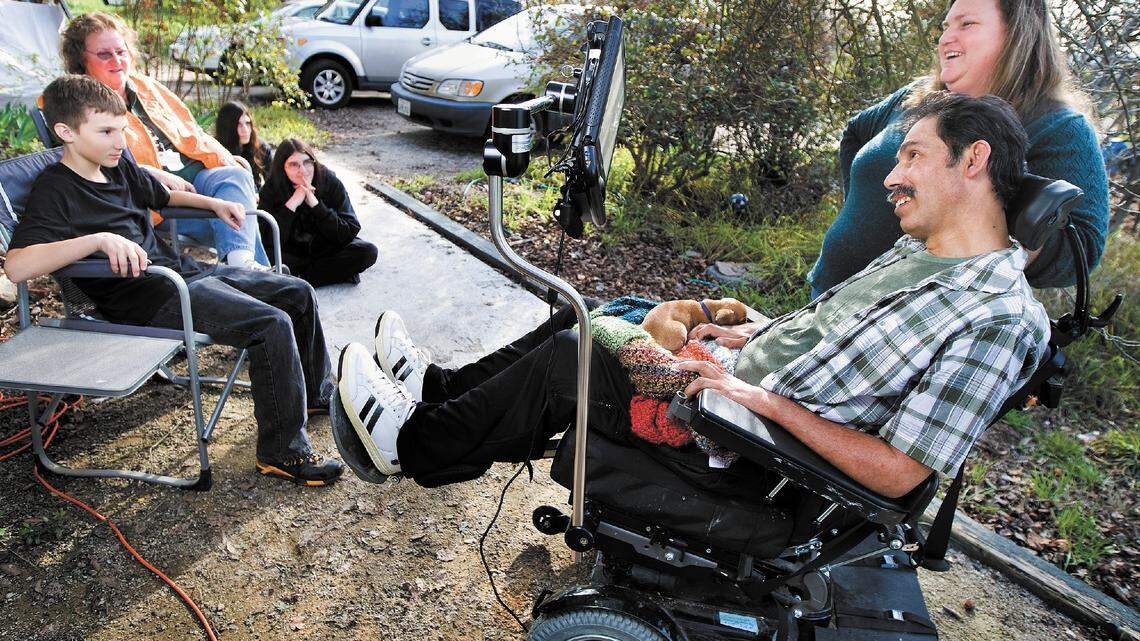
Hector René Rodriguez of Paso Robles moved his eyes across the screen of his electronic speaking device and made quick but distinct blinks to select his words.
“I think she is a wonderful woman,” a computerized voice said about five minutes later through the device.
“She is my hero.”
Rodriguez, newly paralyzed, was describing his partner of 20 years, Phyllis Dodge.
Dodge’s eyes welled up with tears as she playfully patted her husband’s arm.
“You’re going to make me cry,” she told him, smiling. “You’re supposed to be telling jokes.”
Rodriguez, 52, was diagnosed in January 2009 with amyotrophic lateral sclerosis, also known as Lou Gehrig’s disease.
ALS attacks the motor neurons in the brain and spinal cord and leads to eventual paralysis of all voluntary muscles. Feeling and thought remain intact in patients as their bodies begin to fail.
Most survive an average of two to five years. But famous theoretical physicist Stephen Hawking, 69, has lived with the disease the majority of his adult life.
Ever since Rodriguez’s diagnosis, his family of five has striven to remain positive.
The incurable degenerative disease with no proven cause has left him with only slight head, eye and facial movements.
“It’s just a horrible, horrible disease that completely robs you of every muscle group,” said his sister-in-law, Hily Greene, also of Paso Robles.
His speaking device, attached to his wheelchair, tracks his eye movements as they span across a digital keyboard.
Several messages, such as “I love you” are programmed in. He can also type in new messages, as he did for this interview.
When asked what he looks forward to, Rodriguez replied:
“Being alive.”
His days are spent mostly at home with his wife and three children: twin 16-year-old daughters, Elizabeth and Aurora Dodge; and 11-year-old son, Renato.
When asked what he wishes he didn’t have to deal with, Rodriguez replied: “Everything.”
He needs help in and out of bed and has a feeding tube.
“One day, I woke up and my voice was gone,” he said. That was in the summer of 2010. It was a hard blow because with his voice, he lost his thick Guatemalan accent.
“He’s so proud of it,” Dodge said of her husband’s heritage. He moved to California in 1989.
His journey with ALS began in mid-2008 with what Rodriguez thought was a sprain in his leg.
By the fall, he lost the grip in his left hand. He then began tripping and falling.
Thinking he had had a stroke, his family saw a doctor.
The first diagnosis came. The family sought two more opinions.
“I kept telling myself, ‘I’m not sick,’ ” Rodriguez said.
But by April 2009, he was using a walker. And, by that fall, the once-active handyman who loved playing soccer and basketball was bound to a wheelchair.
Now, Rodriguez soaks in life.
On a recent winter day, he sat outside in his wheelchair under the branches of an apple tree in his front yard. Birds chirped. A crisp breeze rolled through.
Rodriguez remained there for hours, insisting he wasn’t cold.
“This is his favorite spot,” Dodge said.
He enjoys visits from family. He appreciates when people place his hand in theirs to greet him.
“When I see a friend or family member, I wonder if it will be the last time,” he said.
Rodriguez is looking forward to April 3, when he, his wife and Renato head to Los Angeles to see the Lakers play against the Denver Nuggets at the Staples Center.
Greene recently rallied the community together to raise money for game tickets, a hospital bed, hotel room and transportation for her brother-in-law’s trip.
Rodriguez says the disease makes it difficult to get around.
“But we sure have fun trying,” Greene chimed in.
The family smiled.
This story was originally published March 19, 2011 at 9:19 PM with the headline "Disease can’t stifle love of life."