
Here's how much water is wasted when a car hits a fire hydrant in SLO
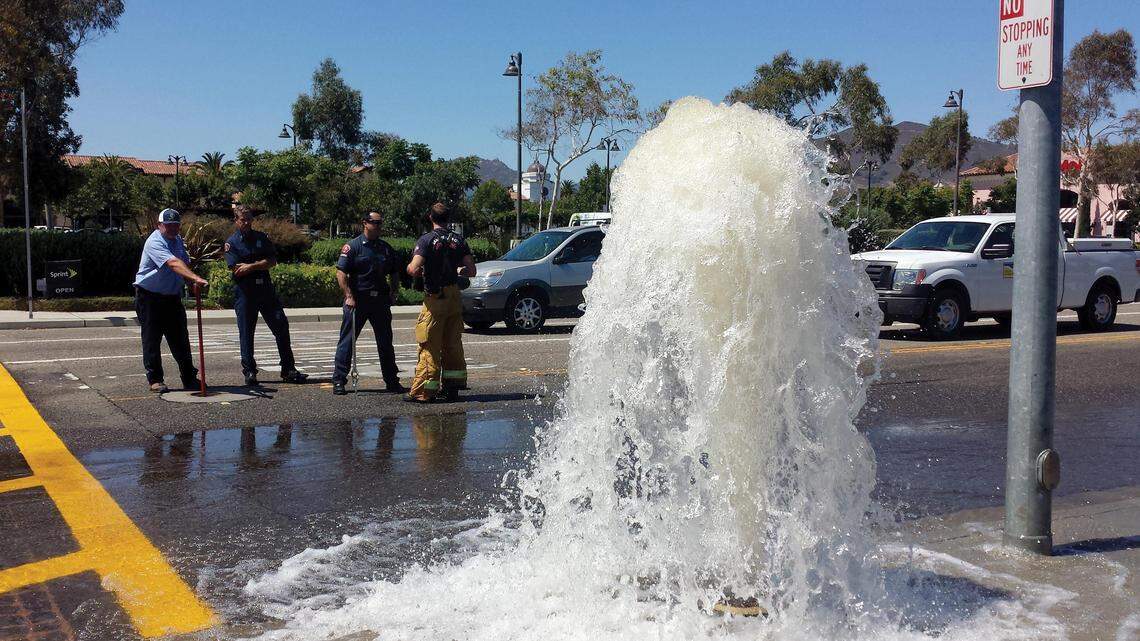
San Luis Obispo utilities technician Mychal Boerman was driving across town with a colleague on June 9, 2014, when they saw water spraying out of a fire hydrant on South Higuera St.
Boerman didn’t see the crash itself, in which a delivery truck driver had appeared to back into the hydrant. But he saw water shooting into the air, and then his co-worker, Casey Nance, exclaimed: “That guy just hit the hydrant.”
They pulled over and set out cones while other drivers slowed down to watch water gush out of the hydrant. After removing a metal lid to access the valve, Boerman recalled, he and Nance slowly shut it down, a process that took about five minutes.
An estimated 8,000 gallons of water was lost in that incident. The city would later bill the driver for the cost of the water plus labor and materials to fix the hydrant.
As Californians sweat through another hot, dry summer and devour reports of a possible “Godzilla” El Niño, many local residents are sensitive to any sign of water waste. A damaged fire hydrant shooting water into the air can be a dramatic sight, prompting drivers to slow down, take photos and bemoan the amount of water lost.
“People are more sensitive to it right now,” Boerman said. “Generally, when they see it get hit it’s like, ‘Wow, it’s a lot of water.’ And if it’s in a high-pressure zone, that water is shooting really high — 50, 60 feet in the air — and it can be overwhelming when you see it for the first time.”
From January 2014 through July 2015, there were 22 vehicle-versus-hydrant crashes in San Luis Obispo, resulting in an estimated 917,000 gallons of water lost, according to information provided by the city. That number doesn’t include an Aug. 11 crash that sent about 75,000 gallons of water gushing onto Hind Lane.
The crashes cost $38,424.33 total for the city to repair, including the cost of labor, materials and the estimated cost of the water.
How much water is actually lost depends on three factors, Boerman said: response time, hydrant type and system pressure.
If a hydrant is damaged late at night on a weekend, for example, it might take more time for someone to notice and alert the city, and for staff to respond. If the fire department beats the utilities staff to the scene, they’ll partially shut the hydrant but wait for utilities employees to arrive to turn it off completely.
A hydrant must be shut off slowly so the water pressure can stabilize throughout the system and avoid a “water hammer,” where a surge in pressure can break water lines.
The most water lost in a single incident happened April 14, 2014, on Madonna Road, where an estimated 180,000 gallons was lost. But in three other incidents, no water was lost, and only an estimated 5,000 gallons gushed out in two other crashes.
By comparison, the entire city used more than 133 million gallons of water in July.
“All of the hydrants with zero gallons lost were dry barrel hydrants that don’t leak when hit or damaged,” Boerman said. “A few of the hydrants that had low gallons lost were not completely knocked off so they were only leaking.”
All of the city’s hydrants have breakaway bolts or spools to allow the hydrant to break off and make repair easier and prevent costly damage to the water main. But the cost to repair them can vary widely, depending on the amount of damage done to the hydrant.
While utilities staff focus on repairing the hydrant, police officers take a report and forward a case number to the utilities department so it can send a bill to the responsible party for repairs and the cost of the estimated water loss.
“The three most common causes of our hydrants getting knocked down seem to be people backing their vehicles up into hydrants, vehicles towing trailers taking corners too sharply, and intoxicated drivers hitting hydrants,” Boerman said.
For the crashes that happened between January 2014 and July 2015, the cost to repair the hydrants and pay for the lost water varied from $106.61 to a stunning $7,633.25, according to information provided by the city.
That high amount resulted from a March 24 crash on Johnson Avenue where the hydrant bury, or base, was damaged. Not only did the hydrant need to be dug up and replaced, but the sidewalk had to be fixed and a new curb and gutter poured, Boerman said.
“When they break the hydrant and bury, and we’re out there for a week putting in a $2,000 hydrant, it can get pretty expensive,” he said.
This story was originally published September 15, 2015 at 2:31 PM with the headline "Here's how much water is wasted when a car hits a fire hydrant in SLO."