
Drought cuts into recreation as low water levels plague reservoirs
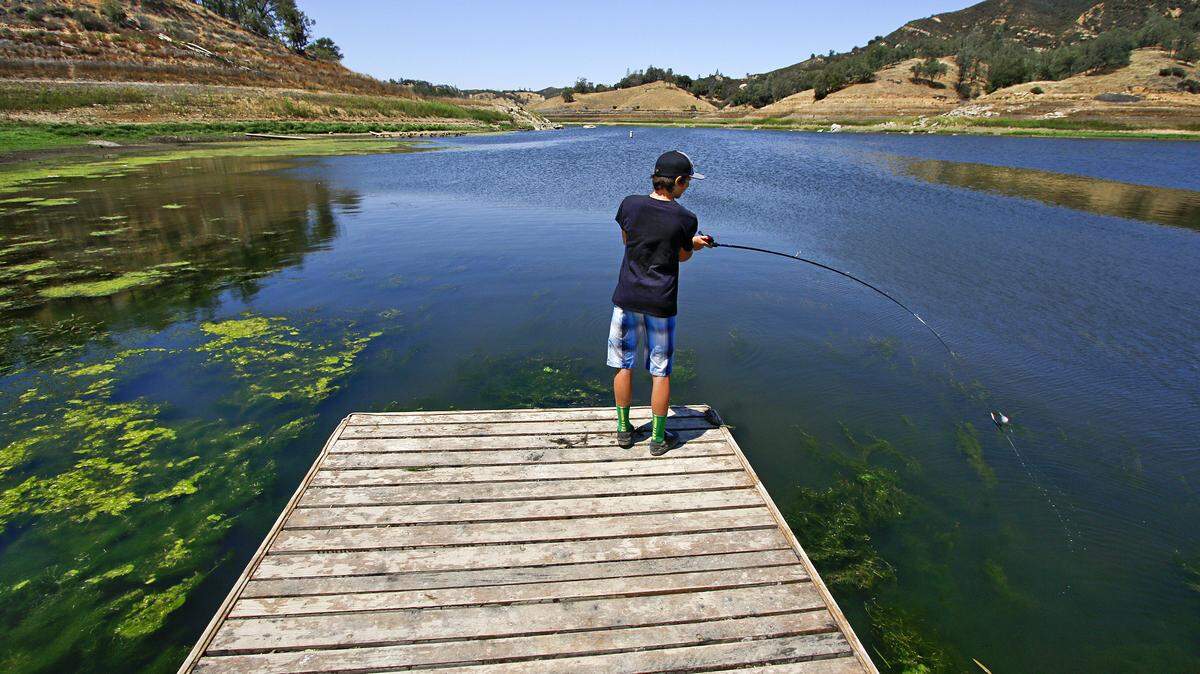
Santa Margarita Lake was bright and quiet as Thomas Kohl relaxed outside the Marina Point store Tuesday afternoon, taking a break from his job as a self-described dock hand.
In the lake below him, several paddleboats, kayaks and pontoon boats were tied up to the dock, bobbing in the low water. A 12-year-old boy and his mother waited at the dock, fishing rods in hand, to board a paddleboat.
“I’ve got a lot of customers who call and ask if there’s any lake,” Kohl said. “And I say, ‘Heck yeah.’
“We still have rental boats — kayak boats, paddleboats, pontoons,” he added. “Our prices are reasonable on everything.”
Despite Kohl’s cheery comments, some recreational opportunities at local lakes are suffering as San Luis Obispo County endures the fourth year of one of California’s most severe droughts on record. In some areas, visitors gaze at mud flats, exposed rocks and brown hills.
Both launch ramps are closed at Santa Margarita Lake, though it is possible to launch kayaks, small aluminum boats and other watercraft from shore. That lake is 14.5 percent full.
The launch ramps are open at Lopez Lake near Arroyo Grande — at 35.3 percent of capacity — but the swimming areas are not.
Lake San Antonio, at 4 percent capacity, was closed to the public July 1, with no set date for reopening.
At nearby Lake Nacimieno, however, visitors can still launch boats, camp and fish. That lake, located in northern San Luis Obispo County, is 24 percent full, according to Monterey County Water Resources Agency, which manages the reservoir.
“Lake Nacimiento will be the place to recreate this summer,” reads the San Antonio Resort website, noting the lake’s 2,700 acres of surface area, 13 miles of lake and beaches, camping, rental boats and a full-service marina.
Nacimiento pipeline
The levels at the two lakes managed by San Luis Obispo County have dropped significantly in about 18 months.
In February 2014, Lopez Lake was 56 percent full and Santa Margarita Lake stood at 38.5 percent.
San Luis Obispo, which relies on Santa Margarita Lake — also known as the Salinas reservoir — as one of its water supplies, is still drawing a small amount of drinking water periodically from the reservoir, said Aaron Floyd, deputy director of water for the city’s utilities department.
But city use has tapered off since the Nacimiento pipeline came back online in the spring. The 45-mile pipeline, which provides water to San Luis Obispo and three North County communities, was shut down for 10 months last year to fix leaks.
As a result of the shutdown, San Luis Obispo pumped more water from Santa Margarita Lake, contributing to its dropping water level.
San Luis Obispo is entitled to 3,380 acre-feet of water from Nacimiento a year.
“With Nacimiento down, the city had to rely on its two other water sources to make up the difference,” Floyd said.
The city drew about 2,250 acre-feet of water from the lake from June 2014 through March 2015, he said. The entire city uses about 5,500 acre-feet a year.
In contrast to the other three lakes, water levels at Lake Nacimiento rose in the past 18 months, to 24 percent from 21 percent capacity.
Robert Johnson, assistant general manager for Monterey County Water Resources Agency, said the increase was due to 50,000 acre-feet of water added during a December storm and a reduction in the amount of water released from the lake.
At capacity, the lake holds 377,900 acre-feet (an acre-foot is about 325,850 gallons, or enough to serve about three residential homes in the city of San Luis Obispo for a year).
Under an agreement between the two counties, San Luis Obispo County can draw 17,500 acre-feet from Nacimiento each year, with 10 percent of that left in the lake for lakeside users.
Among the participants, 9,655 acre-feet are spoken for, with the rest in reserve.
“You don’t take that much, frankly,” Johnson said.
One up, one down
Lake Nacimiento has seen a slight uptick in the number of visitors compared with last year, though revenues fell. Both visitors and revenue dropped at Lake San Antonio.
In the 2013-14 fiscal year, Lake Nacimiento drew more than $3 million in revenue, while San Antonio received $1.4 million. Those amounts fell in the 2014-15 year to an estimated $2 million and $698,400, respectively, said Nina DeMello, finance manager for Monterey County Parks.
In the first half of the 2013-14 fiscal year, 185,162 people visited Lake Nacimiento, while 64,498 visited San Antonio. Visitors increased in the first half of 2014-15 at Nacimiento to 197,676 but dropped drastically at San Antonio to 12,798.
While Nacimiento has seen more visitors, Monterey County Parks Director Mark Mariscal said the county could do more to get the word out.
“I think we haven’t told a good enough story to let people know that Nacimiento has 12 to 13 miles of water,” he said. “You can water ski from the marina and stay on that Jet Ski for 20 minutes.”
Lake San Antonio was closed this month for budget-related reasons, Mariscal said, after Monterey County had to dip into its reserves to keep the lake operating as revenues dropped and a planned layoff of 14 employees did not take place.
The closure saves about $75,000 a month. As of July 1, two of those employees retired, two were laid off and the rest were moved to other positions.
One person remains at Lake San Antonio for maintenance needs, so that it would be easier to reopen if the reservoir receives enough rain next winter and spring.
Triathlon still scheduled
Despite the closure, organizers of the popular Wildflower Triathlon are moving ahead with plans for the 2016 event, scheduled for April 29-May 1.
Terry Davis, CEO and founder of Tri-California Events Inc., said the company is working with Monterey County to assume a little more of the maintenance work needed to host the annual triathlon.
“There’s still 2.5 miles of lake left,” Davis said, noting that for the past two years the long course’s 1.2-mile swim, normally held at the Lynch launch ramp area, has been moved to Harris Creek.
Participation in the 2015 event fell over last year, in large part because of the drought, Davis said. At its peak in 2007 or 2008, Wildflower drew 8,000 participants (and more than 30,000 spectators).
In 2014, about 5,000 people participated. That fell to 2,500 participants this past May. “For it to drop off like that, it’s almost all to do with the water,” said Davis, who hopes to attract 5,000 participants in 2016.
In the meantime, Tri-California Events is also hosting Scott Tinley’s Triathlon at Lopez Lake from Oct. 2 to 4.
“There’s plenty of water out there,” Davis said of that lake.
Still plenty to do
Lopez Lake has been busy even though it’s only a third full, San Luis Obispo County Parks Superintendent Larry Iaquinto said.
The lake is still stocked with trout, he said. Visitors are still able to launch boats, or visit the Mustang Waterpark or the Vista Lago Adventure Park. The new owners of the waterpark, Nick and Allison Duggan, have seen a 30 percent increase in ticket sales over last year.
The waterpark offers slides, a children’s zone and other features in a three-acre area separate from the lake.
Nick Duggan said the waterpark has had about 3,000 visitors a week. He hopes to add more amenities later, but this year the couple made some basic changes to improve the experience for visitors: clean bathrooms, resurfaced slides, paint and new shade areas.
While visitors can still get in the lake, the designated swimming areas are closed. Those who walk from the shore to dip their toes in the lake may encounter sticky mud.
Revenues at Lopez and Santa Margarita lakes have fallen in the first six months of the year compared with 2014, which Iaquinto attributed to the drought.
For example, camping and day-use fees at Lopez Lake netted $202,146 in June, compared at $231,948 in June 2014.
At Santa Margarita Lake, revenues fell this past June to $19,545 from $27,372 in June 2014.
Kohl and his boss, Marina Point general manager Ken Hemer, stressed that there’s still water in Santa Margarita Lake to enjoy. While Kohl was talking, a 12-year-old boy caught a 14-inch bass.
“We want people to be aware that there’s a drought, but we want people to know that the lake’s open too,” Hemer said. “If we don’t get rain next winter then we’ll be in trouble, I think.”
This story was originally published July 25, 2015 at 7:15 PM with the headline "Drought cuts into recreation as low water levels plague reservoirs."