
Where San Luis Obispo's recycled wastewater goes
Every day, millions of gallons of treated sewage flows out of San Luis Obispo’s Water Resource Recovery Facility off Prado Road.
Most of the treated water — between 1.6 million and 5 million gallons a day — heads down San Luis Creek, where it helps sustain a flourishing habitat for endangered steelhead trout before eventually flowing into the ocean at Avila Beach.
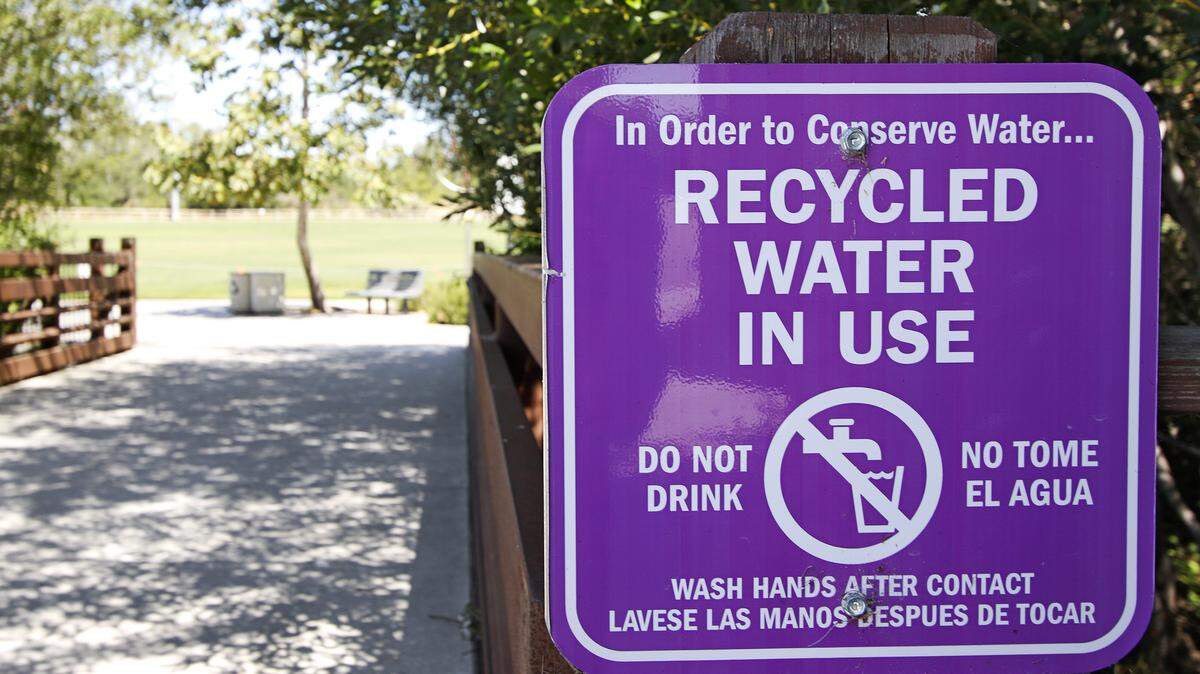
But up to several hundred thousand gallons of that treated wastewater is recycled, flowing from the treatment plant through a series of purple pipes to irrigate landscaping — lawns, plants, street medians, sports fields and a golf course — around the southern end of the city.
The recycled wastewater is the reason the Damon-Garcia Sports Fields and Laguna Lake Golf Course remain green while landscaping at other parks turns brown.
In all, 27 sites receive recycled water, including public and private customers: Islay, Laguna Lake, Laguna Hills and French parks; Caltrans; Laguna Middle School; Irish Hills Plaza; Costco; Olive Garden; and several other retail shops and residential developments.
The city uses about 180 acre-feet a year of recycled water for landscape irrigation and 1,800 acre-feet per year to augment flows in San Luis Creek. (An acre-foot of water is about 325,850 gallons.)
During a city drought forum in May, some residents asked whether the recycled water system could be expanded to cut down on the amount of drinking water used for irrigation.
The city plans to study the issue.
One challenge: The more water residents conserve, the less wastewater flows into the sewage plant to turn into recycled water.
In addition, demand for water grows during the summer when people water their yards, but flows to the wastewater plant are usually lower.
“That’s where our conundrum is — during the hottest months of the year, when they really need the water, is when we have less water,” said Pam Ouellette, chief operator at the Water Resource Recovery Facility. “The schools are out, people are on vacation. Conversely, in the winter when we have storms, people aren’t using the water.”
The city also has to balance the demand for the recycled water with a mandate to send at least 1.6 million gallons a day to San Luis Creek, as required by the National Oceanic and Atmospheric Administration.
“We essentially created a habitat for the steelhead,” said Aaron Floyd, deputy director of water at the city’s public utilities department, “and now we have to keep it.”

Costly purple pipe
A review of the city’s available recycled water supply from January 2013 through May 2015 shows that demand spikes during the summer and fall, to more than 410,000 gallons a day.
But that demand falls drastically during the winter, and thousands more gallons are sent down San Luis Creek.
Besides balancing supply and demand, the city and customers will run up against another potential barrier: cost. Laying purple pipe to transport recycled water can cost $1 million per mile, said Ron Munds, the city’s utilities services manager.
That’s why recycled water use has been clustered on the south side of the city, where the treatment plant is located. Future developments in the Airport, Margarita and Orcutt areas also are expected to get recycled water once they’re built.
$10.5 million system
The city’s recycled water, available beginning in 2006, was the first major addition to the city’s water supply beyond conservation efforts since the city tapped Whale Rock Reservoir above Cayucos in 1962, according to Tribune archives.
The city started construction on the $10.5 million recycled water system in 2003, adding a chlorination tank, a 600,000-gallon underground storage tank and pumps to deliver the water.
About 8 miles of pipes, which are purple in color to distinguish them from potable water pipes, were installed from the eastern city limits on Tank Farm Road to the western city limits on Los Osos Valley Road.
One pipeline was installed in summer 2001 on South Higuera Street from Prado to Los Osos Valley roads.
The plant can treat 5.1 million gallons of sewage a day but currently treats about 2.5 million to 3.5 million gallons a day, Ouellette said.
More work ahead
The city plans to start construction in 2017 on a $90 million upgrade to the treatment plant.
The project aims to meet new permit requirements, address odor problems, replace aging equipment, incorporate educational features for the public and maximize production of recycled water, according to the city.
The treatment plant can now store about 600,000 gallons of recycled water at a time. The upgrades won’t change the storage capacity. But they will streamline the disinfection process for recycled water and give city staff more flexibility in delivering it to customers, said Dave Hix, deputy director of wastewater in the city’s utilities department.
The report mentions the possibility of supplying recycled water to some vineyard owners in the Edna Valley, who have indicated an interest in using it for irrigation to offset their groundwater use.
But such future possibilities need to be studied to identify customers and evaluate the infrastructure and costs needed to move water from the treatment plant to final users, including pumping facilities, pipelines and storage.
Hix said city staff will submit a grant application in a few weeks to pay for part of a study examining future uses of recycled water in the city.
This story was originally published July 8, 2015 at 5:16 PM with the headline "Where San Luis Obispo's recycled wastewater goes."