Police surveillance cameras are scattered around SLO County. Some want them gone
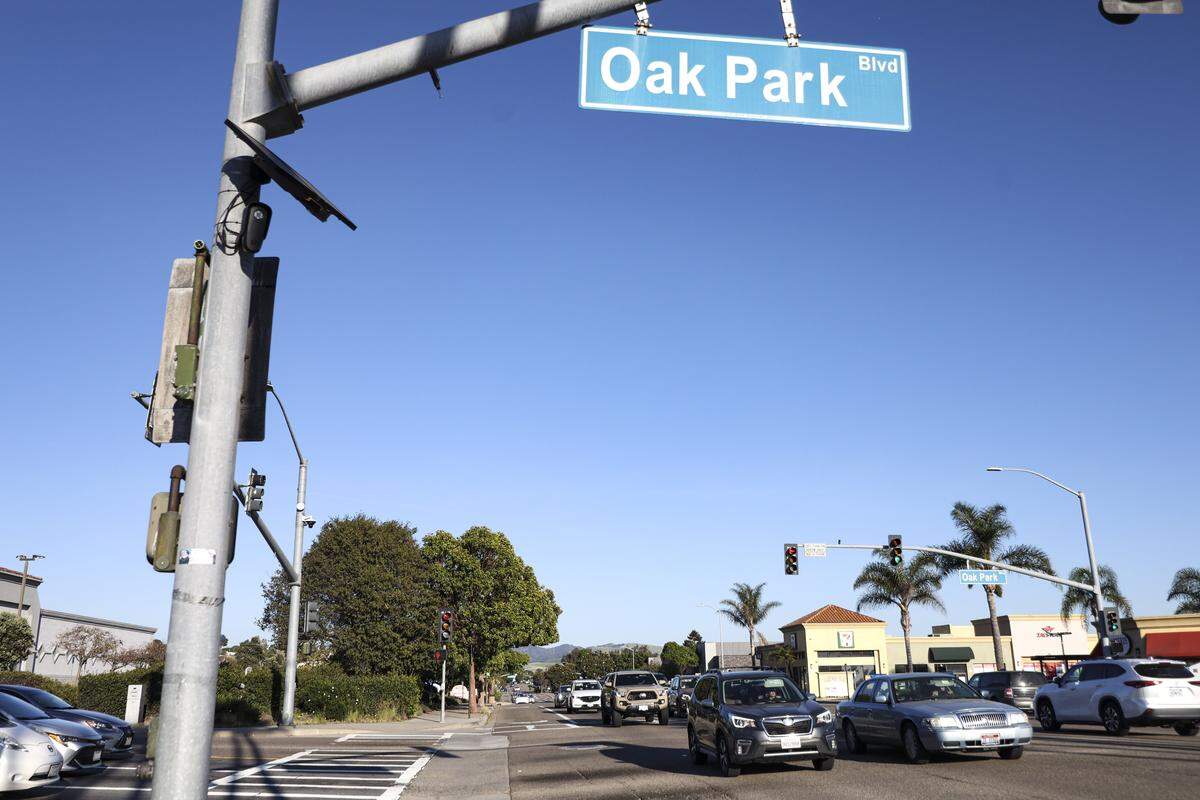
At a major thoroughfare in Grover Beach, a solar-powered camera mounted to a traffic pole silently records the license plate, color and model of every vehicle that zips through the intersection.
Flock Safety, a controversial brand of surveillance technology, is the maker behind the devices that sit at 17 strategic locations across the San Luis Obispo County beach city.
Grover Beach Police Department Chief Jim Munro said the automated license plate readers have quickly become essential public safety equipment since they were installed in a large circle around the city in 2022.
“They’ve been instrumental since day one in helping us solve crime, recover stolen vehicles, recover missing persons … helping in investigations for homicide suspects, for shooting suspects,” he told The Tribune. “It’s just an excellent tool to help us do our job. And without them, it would be much, much harder.”
But local activists at DeFlockCentralCoast, a newly formed organization attempting to abolish Flock technology across six California counties, claim the cameras are a downright dangerous form of mass surveillance that put immigrants at extreme risk.
“I think everyone has a right to feel scared knowing their whereabouts are being tracked at all times,” DeFlock organizer Giada Brose said.
Founded in 2017, Flock Safety provides automated license plate readers — or ALPRs — and other surveillance equipment to thousands of law enforcement agencies. Now, more than 80,000 Flock cameras are recording license plates on city streets and highways and in parking lots across the United States.
While Flock says its cameras and their data have never been hacked and are “customer-owned,” contracts with the company have been contested — and even suspended — across California and the country.
Flock has been at the center of allegations regarding nonconsensual and unlawful data-sharing with outside law enforcement, causing outcries from cities and community members that license plate reader data could be weaponized to fuel the Trump administration’s mass deportation efforts.

Flock cameras spark controversy across California
Flock Safety has recently come under fire in California cities due to allegations that law enforcement agencies’ data was shared illegally — and sometimes, without their consent.
In June, CalMatters reported that law enforcement across Southern California had illegally shared data with immigration enforcement agencies, with officers reportedly conducting searches in the system on behalf of ICE and with Border Patrol.
The Modesto Bee recently reported that the Modesto Police Department discovered that Border Patrol and several other federal agencies had access to information from its Flock cameras.
Under a 2015 law, California agencies are prohibited from sharing data from automatic license plate readers with out-of-state law enforcement and federal agencies, according to a 2023 law enforcement memo from the California Department of Justice.
But some agencies say audits revealed their data was accessed by outside agencies, despite measures taken to prevent that from happening.
In January, the city of Mountain View claimed that federal and state law enforcement agencies accessed data captured by the city’s Flock cameras without permission, ABC 7 reported.
According to the report, police discovered that the cameras were not operating within the parameters set by the city, allowing law enforcement agencies around California to access data from all but one of Mountain View’s cameras.
Recently, Flock Safety notified some California law enforcement agencies that a system issue had caused nationwide information-sharing settings to be turned on without agency awareness. The Santa Barbara County Sheriff’s Office and the Grover Beach Police Department said they were among the affected parties.
Both agencies said they immediately conducted internal audits to determine whether their cameras had been accessed by out-of-state or federal agencies, even though the settings are restricted to share only with in-state agencies.
Grover Beach’s audit initially detected no external access, according to Munro, but a separate audit by Flock located two inquires from the Altoona Police Department in Iowa and the Village of Goshen Police Department in New York in 2023.
He confirmed there were no inquires from federal agencies but said it’s still unknown what Grover Beach records were retrieved from these out-of-state searches.
“Flock has taken full responsibility for this error in their system allowing these out-of-state inquiries,” Munro told The Tribune.
After reviewing system settings and audit logs, the Santa Barbara County Sheriff’s Office said in a news release that its data was never shared outside of California.
The concerns about data privacy have had ripple effects, causing some cities to cut their contracts with the surveillance company.
Officials in Los Altos Hills decided in January to remove 31 Flock cameras due to privacy concerns, the Los Altos Town Crier reported.
The city of Santa Cruz also recently cut its contract, the Santa Cruz Local news site reported in January. Santa Clara County officials also cut ties with Flock in February, according to KQED.
Similarly, the Oxnard Police Department suspended its operation of Flock cameras in February after an audit found “unauthorized access” to a federal law enforcement agency. The data searches were related to criminal investigations, not immigration enforcement, according to a department news release.
Which SLO County law enforcement agencies use Flock cameras?
A few SLO County law enforcement agencies, including Cal Poly, San Luis Obispo and Grover Beach police departments, have acquired Flock cameras over the past decade.
Law enforcement at the city and county levels choose camera locations based on common, high-volume traffic routes, according to Tony Cipolla, a spokesperson from the Sheriff’s Office.
The Grover Beach and SLO police departments said the number of devices they bought was based on available funding. Both departments said they are constantly searching for new technologies — like ALPRs — to help with everyday crime fighting, the agencies told The Tribune.
Cal Poly has 10 of Flock’s ALPR cameras stationed at campus entrances and exits, according to university spokesperson Keegan Koberl, who said the university Police Department uses license plate readers to enhance campus security.
The university also has five “Condor” livestream surveillance cameras bundled with the ALPRs, plus two more on campus at the beach volleyball court, according to spokesperson Matt Lazier. He said the cameras do not have AI capabilities enabled and are audited weekly.
Condor cameras have also undergone scrutiny after several of the livestreams were left exposed to internet users, 404 Media reported in December 2025.
The data captured by the cameras is stored for 30 days and then deleted, Koberl previously told The Tribune.
Lazier said for the first year, Cal Poly paid Flock $49,300 for all of the cameras, with a $46,500 ongoing charge for the second year. In total, the cameras cost $95,800.
Since 2023, San Luis Obispo has had four Flock cameras that each cost approximately $2,500 per year. The city has no plans to add any more Flock surveillance to its fleet, police spokesperson Christine Wallace told The Tribune.
“The city also has an inventory of other cameras used throughout the city that include fixed surveillance and LPR cameras that are not made by Flock,” she said in a statement.
The city owns the data, which is stored for 30 days and then overwritten. However, if video contains evidence of a crime, the SLO Police Department will download and save the evidence, retaining it “for as long as necessary,” Wallace said.
She said license plate reader technology has been used as critical evidence in some criminal investigations, pointing to a recent suspect involved in a felony hit-and-run incident that resulted in life-threatening injuries to two people who was caught due to the surveillance technology.
The SLO Police Department never gives Flock data to federal law enforcement agencies, Wallace confirmed, but it does share data with hand-picked California law enforcement agencies if they submit a request and agree to share data in return.
The Grover Beach Police Department has a similar data policy to SLO. Munro said they keep Flock data for 30 days and do share data with dozens of law enforcement agencies across the state but never with federal agencies like Border Patrol or U.S. Immigration and Customs Enforcement.
The department first started using Flock technology in 2022, Munro said. He said he sees the license plate readers as an indispensable tool that every police agency should have in its arsenal.
“The Grover Beach Police Department enjoys technology that is going to make us more efficient, a safer city, and kind of improve our workflows,” he told The Tribune.
Several other law enforcement agencies across San Luis Obispo County use comparable technology but do not have contracts with Flock Safety.
The San Luis Obispo County Sheriff’s Office, as well as the Arroyo Grande, Morro Bay, Paso Robles and Pismo Beach police departments all possess Motorola Solutions cameras. The Atascadero Police Department does not have any license plate reader technology, but the agency is “actively evaluating” implementing and investing in license plate readers in the future, Cmdr. Matt Chesson said in an email.
The SLO County Sheriff’s Office owns 21 Motorola cameras that are fixed at various locations around the county, including rural Arroyo Grande, Avila Beach, Oceano, Nipomo, Templeton and Shandon, Cipolla said.
The data is stored for one year and then purged from the system. It’s only shared with California agencies, according to Cipolla, and the Sheriff’s Office has applied settings that automatically prohibit out-of-state agencies from requesting license plate reader data.
The cameras and its data have helped “to solve and investigate crimes on a weekly if not daily basis,” he said.
Where are ALPR cameras in SLO County?
The license plate readers tend to be located at major intersections and busy thoroughfares across San Luis Obispo County.
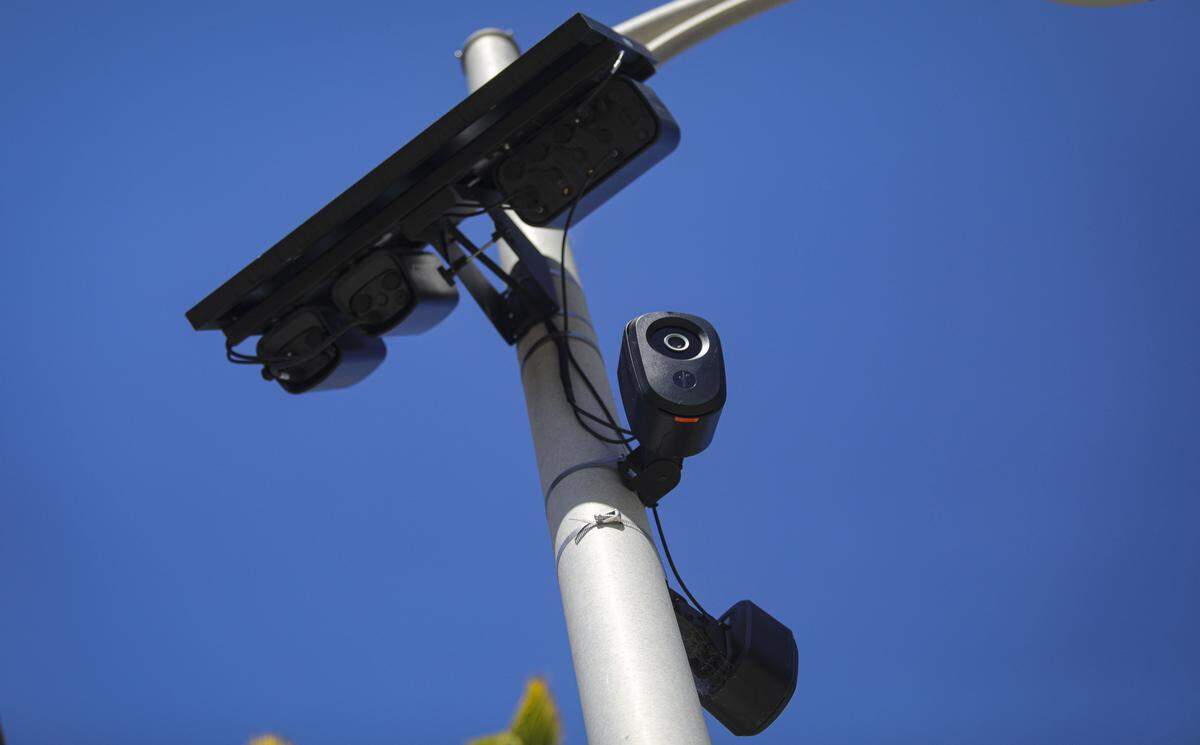
The always-on, black, oval-shaped devices are typically attached to poles and are propped beneath its power source — a rectangular solar panel.
When a car passes by a license plate reader, the device first determines whether the object is a vehicle. Then, the ALPR snaps a picture of the license plate.
Along with the license plate number, it can determine the type and color of the vehicle. But unlike red-light or speed cameras, which capture photos of the car, motorist and license plate, ALPRs have no facial recognition capacity, Munro told The Tribune.
Here’s how many fixed-location Flock cameras are used by law enforcement agencies in SLO County:
- Cal Poly: 10 Flock cameras
- Grover Beach Police Department: 17 Flock cameras
- San Luis Obispo Police Department: Four Flock cameras, along with other ALPR cameras.
Motorola Solutions cameras are the most popular brand of fixed license plate readers in SLO County:
- Arroyo Grande Police Department: Two Motorola cameras
- Paso Robles Police Department: Seven Motorola cameras
- Morro Bay Police Department: 10 Motorola cameras
- SLO County Sheriff’s Office: 21 Motorola cameras
The Pismo Beach Police Department also uses Motorola ALPRs, but it did not disclose the specific number of devices to The Tribune.
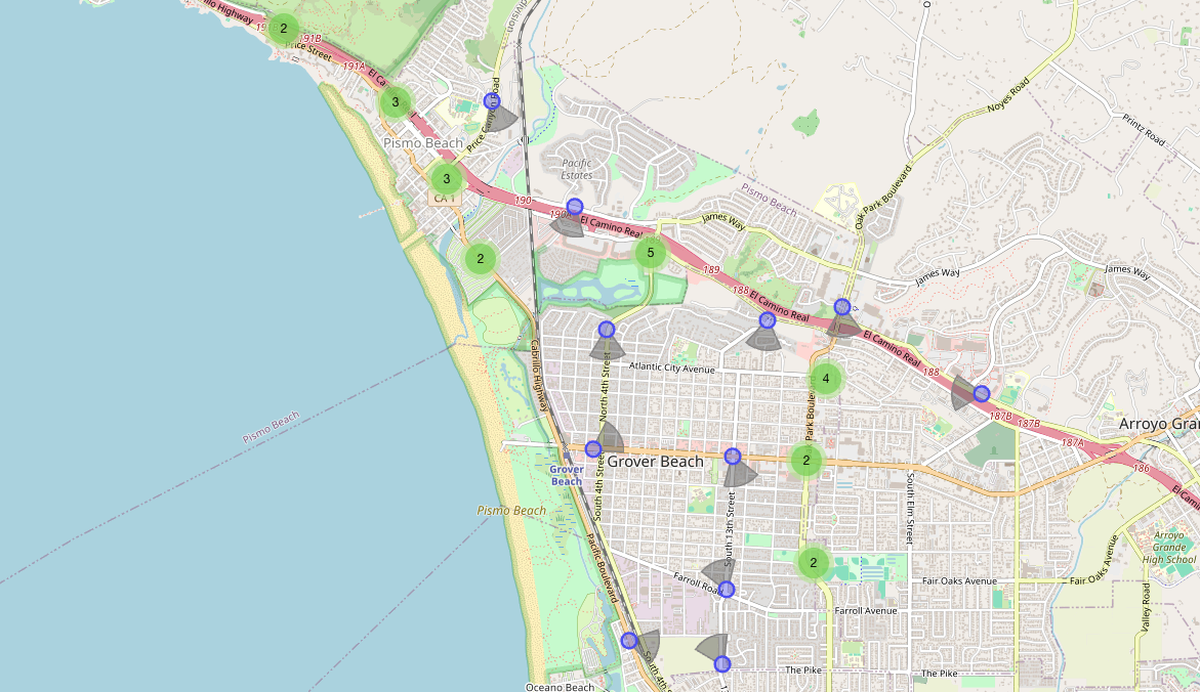
DeFlock, a national movement, seeking to spread public awareness about ALPR technology and “the threats it poses to personal privacy and civil liberties,” has been tracking camera locations across the country since 2024, charting coordinates, capturing photos and identifying the creators behind the devices.
Its detailed map pinpoints the locations of cameras in communities all across the nation and world, while showing the direction they’re facing and the span of their view.
Locally, DeFlock’s volunteer network of mappers has identified 39 license plate readers in southern San Luis Obispo County, 18 cameras around SLO, 10 near Morro Bay and two in Atascadero as of March 20.
According to the map, two Flock cameras are stationed at the corner of South and Broad streets in SLO, while another couple are situated at Grand Avenue and Oak Park Boulevard in Grover Beach. Nearly a dozen ALPRs are placed along Highway 101 between Shell Beach and Arroyo Grande.
The map also shows that private companies have taken advantage of the technology, including Home Depot, which has two Flock cameras at its Atascadero location and four more at its SLO site.
Central Coast activists aim to abolish controversial surveillance cameras
Amid the widespread use, San Luis Obispo County activists see the cameras as a privacy threat at best and a hostile tool to surveil immigrant communities at worst.
Debrose believes there are issues with all license plate reader technology, not just Flock cameras.
“I think all ALPRs are bad,” they said. “I just don’t believe in mass surveillance point blank.”
DeFlockCentralCoast recently launched an online toolkit of resources, called “how to start de-Flocking,” that contains email templates to send to local officials, a list of ALPR companies and relevant laws, a guide on how to submit public record requests and instructions on how to contact a secure tipline run by the group.
Over the course of a few weeks, the group has accumulated nearly 500 followers on Instagram.
Debrose said DeFlock’s tracker map of ALPR cameras across the country can help vulnerable communities find routes that avoid this type of surveillance.
“Publicizing information is important. I think that’s one of the main things that we’re doing here,” Debrose said. “We need to make our place of living safer for everyone.”