New cabin village for homeless residents is taking shape in SLO. Here’s a look
The long-awaited Welcome Home Village homeless re-housing project is set to open this year — and the project is shaping up into the community promised by its name.
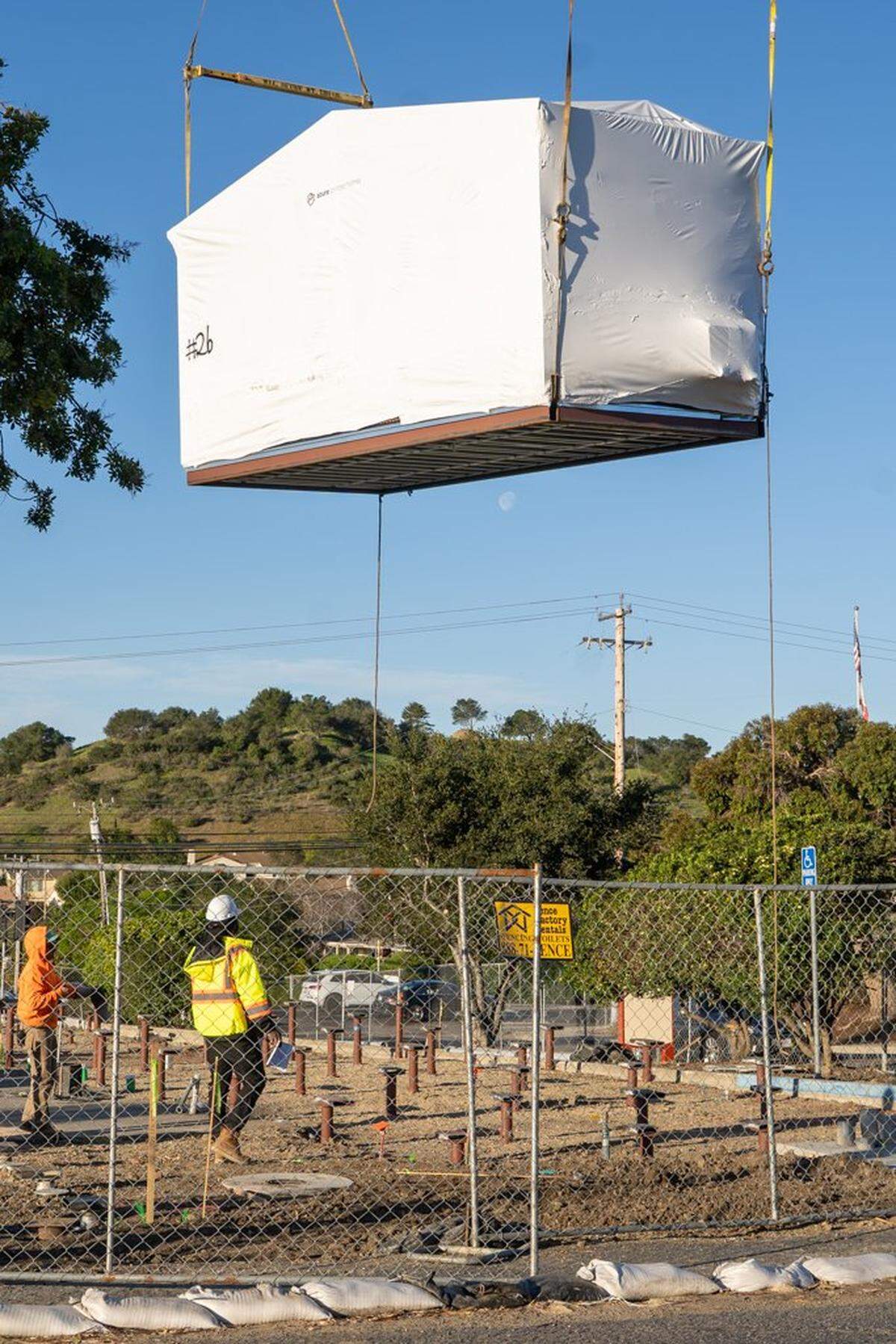
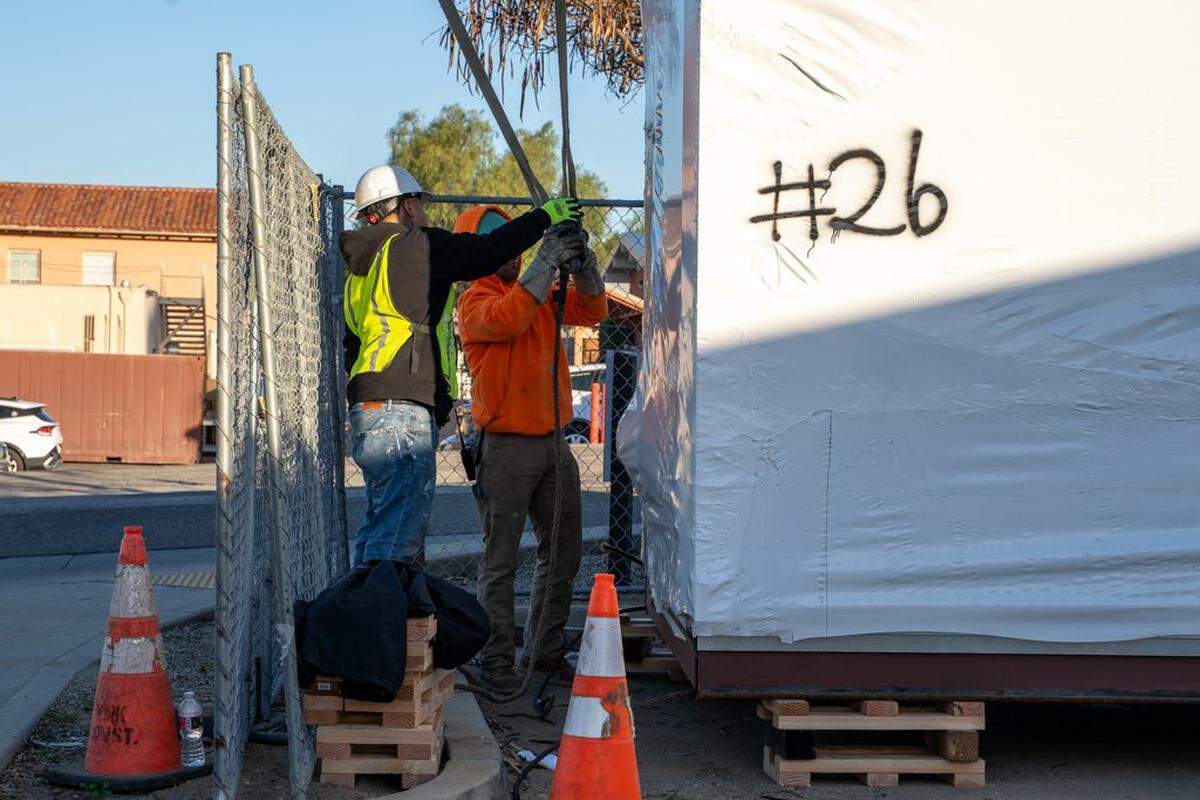
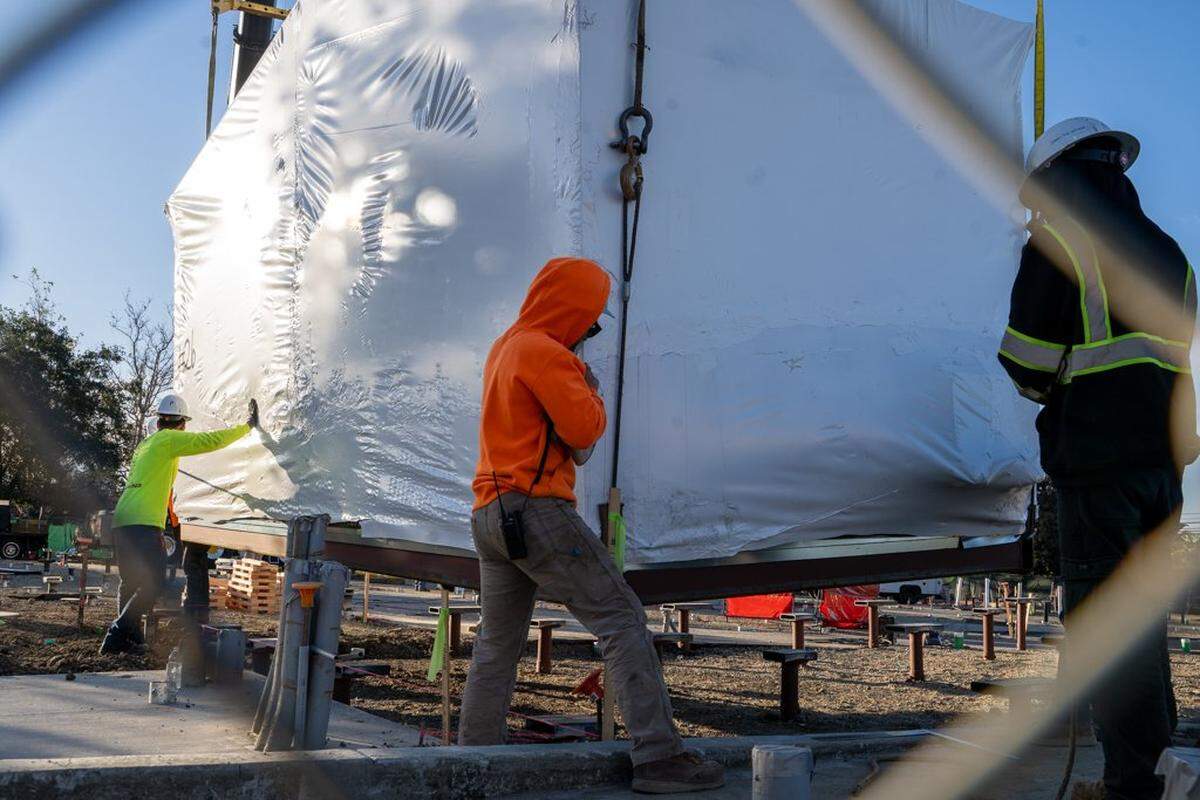
On Thursday morning, the project took another step toward opening when the village’s first signature tiny homes were installed by a large crane at the project site on the corner of Bishop Street and Johnson Avenue.
Welcome Home Village, a 54-cabin transitional housing project located on the parking lot of Bishop Medical Center, broke ground in August ahead of the homes themselves arriving onsite starting in November.
Welcome Home Village project manager Margaret Shepard-Moore said she’s hoping the community can serve as a model for future homeless relief efforts.
“I’m hoping that these types of projects can be replicated throughout California,” Shepard-Moore said. “With the ground screws and the printed homes, this opens up more opportunities for land that may have been considered unusable, such as sloped land or uneven land that normally would cost a lot to grade.”
Welcome Home Village opening in sight after delays
Though the San Luis Obispo County Board of Supervisors voted 3-1 to approve the Welcome Home Village project in May 2024, it was forced to reconsider the project’s scope due to financial issues.
Initial plans introduced in April 2024 called for an 80-unit cabin-style village for homeless individuals on the San Luis Obispo County Health Agency parking lot on Johnson Avenue. The current plan cut that number down to a total of 54 cabins.
The project went through several changes in its initial proposals, switching locations from the Department of Social Services lot at the corner of South Higuera Street and Prado Road to its current location near the corner of Johnson Avenue and Bishop Street.
Billed as a missing link between unsheltered homelessness and getting homeless individuals reintegrated into housing, the $13.4 million village was supposed to start construction in the fall of 2024.
The village will include interim units intended to stabilize clients over a 90-day period and permanent supportive cabins that are for long-term clients.
In its final form, the Welcome Home Village’s original 34 interim and 46 permanent beds have been reduced to 14 interim and 40 permanent beds, nearly halving the project’s overall footprint along Bishop Street, according to the staff report.

People who have endured homelessness the longest at locations such as the Bob Jones Trail will be prioritized, with more spots opening as individuals move through the program and are matched with longer-term supportive housing.
Shepard-Moore said the homes would have been installed in December, but issues with the ground screw system — the metal pillars seated several feet into the ground that form the foundation for the prefabricated units — prevented the work from moving forward.
But now, with the delays resolved, Welcome Home Village is on track to start onboarding its residents in May, she said.
“We’re still on track,” Shepard-Moore said. “Doing the site work and the units separately, and then being able to put them on site instead of having to build them on the site has kept the timeline down.”
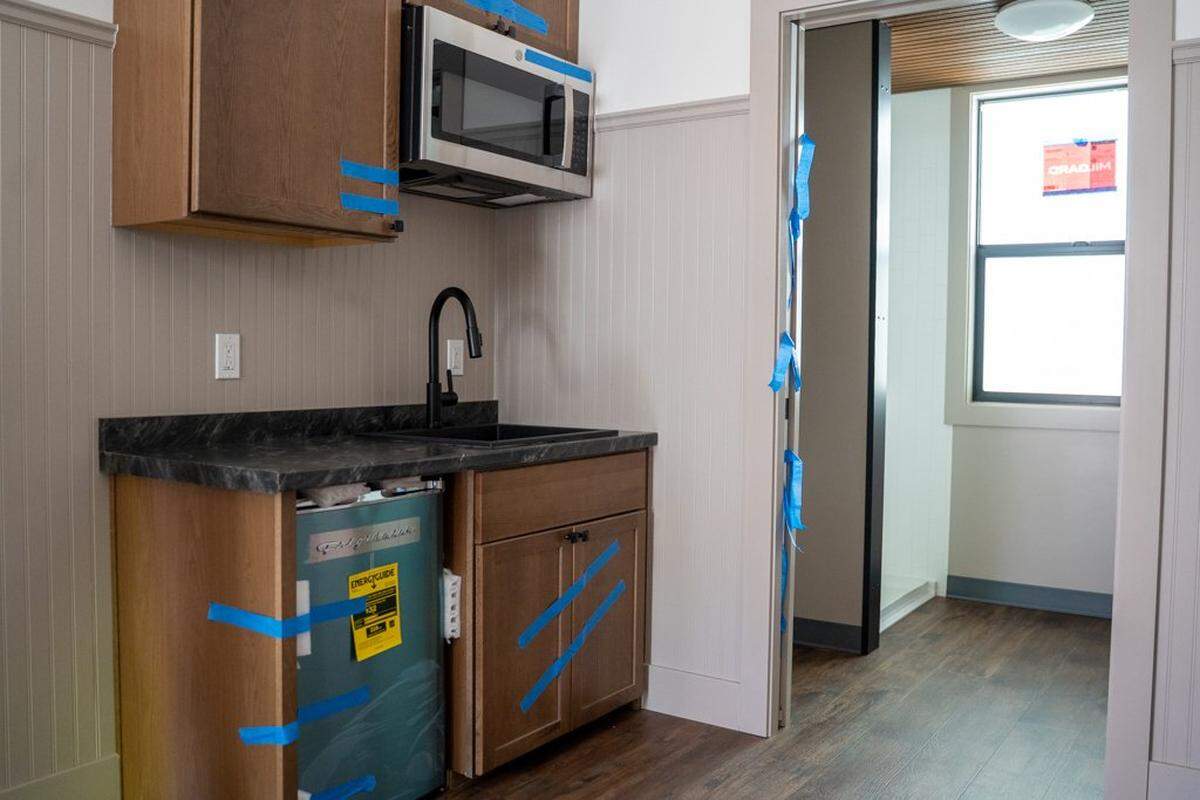
3D-printed homes feature full suite of amenities
Once complete, Welcome Home Village will be the largest 3D-printed community in California — a measure that saves time and manpower, Azure Printed Homes CEO Ross Maguire said.
All 54 homes were printed and finished with electrical wiring and plumbing at Azure’s Gardena factory and will rest on a set of 12 ground screws, he said.
The modules — 63 in total, counting outbuildings, shared spaces and administration — were all manufactured in 12 weeks, making their way up to San Luis Obispo via flatbed trailer fresh off the printer, Maguire said.

The first half of the units are already on-site and being installed, with a second batch coming along as space allows, he said.
“It’s a challenge getting in just because the space is so tight and the streets are tight,” Maguire said. “To be honest, when you have such a tight site, it’s better to do as much as you can away from the site as well, so that you’re restricting the amount of traffic that has to generally get onto a site for a more traditional build.”
Shepard-Moore said she’s excited to start bringing clients onto the site.
With the homes in place, the Welcome Home Village team will turn its attention to landscaping, obtaining PG&E power hookups, building a privacy fence around the village and assembling furniture with the help of interfaith partners.
Already, an outreach worker from Good Samaritan Shelter has made contact with more than enough clients currently residing on the Bob Jones Trail to fill the 54 cabins, Shepard-Moore said.
“I’d love to get a mural painted on the inside of the sea train that’s going to be going in here in the entry, to the village,” Shepard-Moore said. “We’re getting heads in beds by May.”


This story was originally published February 5, 2026 at 2:59 PM.