Morro Bay roundabout project may be back from the dead. What to know
The Morro Bay City Council halted the city’s work on a roundabout proposed for the intersection of Main Street, Highway 1 and Highway 41 — but the controversial project may still get a second life.
On Tuesday, the City Council voted 4-1 to ask the San Luis Obispo Council of Governments to complete the environmental review of the project, which was nearly complete.
Ultimately, the city still has the final say over whether the roundabout is built — as the Morro Bay Planning Commission will vote on a coastal development permit for the project’s construction. If that decision is appealed, the City Council will have the chance to vote on the permit, too.
Until then, the San Luis Obispo Council of Governments has the opportunity to complete the project’s environmental review, and Caltrans will manage the design and construction of the roundabout.
Councilmember Zara Landrum cast the lone dissenting vote. She worried that the roundabout wouldn’t adequately protect pedestrians, she said.
“I value residents in Morro Bay, and I value our community,” she said. “I think that we deserve the best kind of best intersection we can have. If it is a roundabout, great, but I think that it should include a pedestrian bridge.”
The rest of the council, however, supported transferring the environmental phase of the project to the San Luis Obispo Council of Governments.
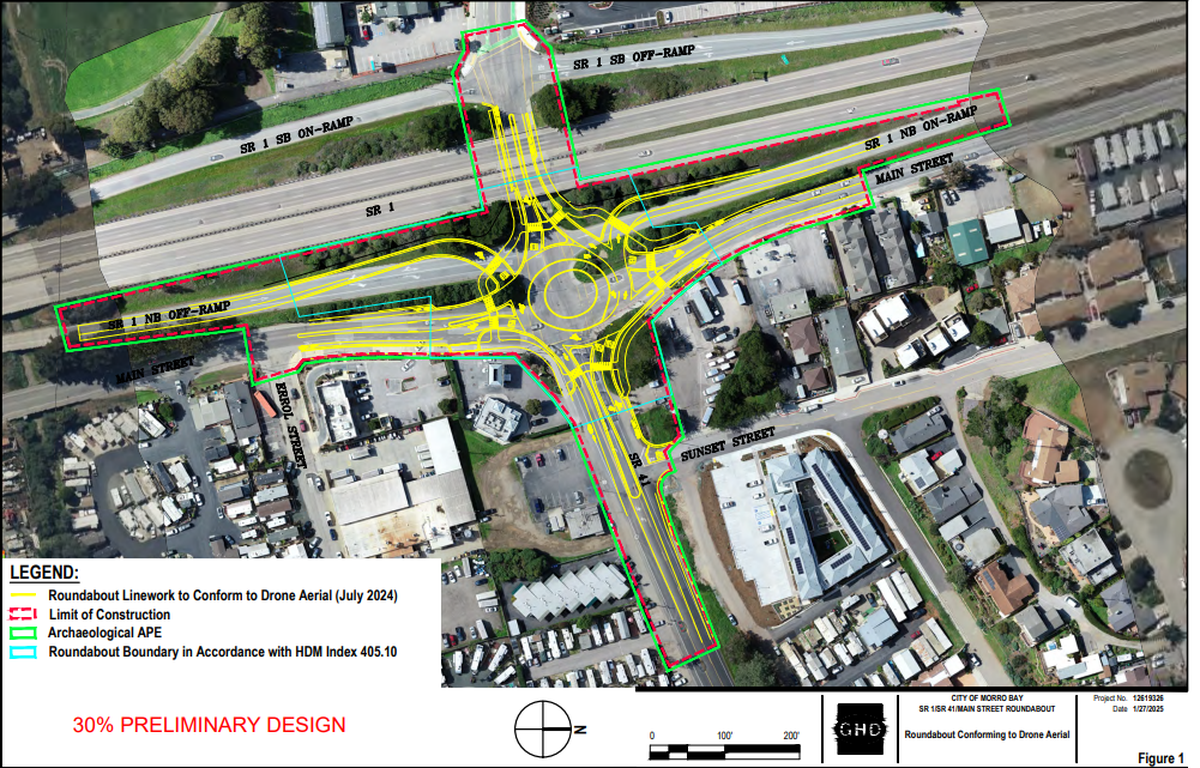
As of Tuesday, the roundabout design was only 30% complete and didn’t yet include pedestrian safety enhancements, Morro Bay public works director Greg Kwolek said.
Such safety features will be presented to the City Council in about two years when the design is 60% complete, he said.
Councilmember Jeff Eckles said he supported “moving the process forward so that we can give this a proper evaluation.”
“Because we’re not in the design phase, we don’t have the design to pick apart at this point,” he said.
Councilmember Cyndee Edwards also supported continuing the project. She said the roundabout would improve the flow of traffic and safety in the intersection.
“We have the money to do this — an infrastructure project that’s been on the books for over 20 years,” Edwards said. “I think, based on the amount of money that we’ve already spent, the very least we can do is get through this EIS.”
Caltrans to design, build the roundabout
On April 22, the City Council voted 3-2 to stop work on the project’s environmental impact study — which was 96% done.
The council majority voted to halt the project because it didn’t think the roundabout would be safe for pedestrians or adequately improve the flow of traffic on the west side of the highway.
On Tuesday, the City Council asked the San Luis Obispo Council of Governments to complete the study.
The city hired a consultant to complete 11 environmental studies for the roundabout, Kwolek told The Tribune.
Caltrans reviewed drafts of the studies, sent them back to the city for edits and now is in the process of completing a final review of the reports, he said.
The city spent about $350,000 on the study, and as of Tuesday, finishing it would cost about $60,000, Kwolek said.
The city will give SLOCOG up to $60,000 in development impact fees to fund the rest of the study.
Those fees were paid by developers to mitigate the impact of projects they built in Morro Bay. The funding can only be used for capacity improvements, which are initiatives that allow for more pedestrians or vehicles to move through an area — like a roundabout.
The $60,000 of funding promised to the roundabout is project specific and can be spent on one of three initiatives: he roundabout, capacity improvements on Main Street or capacity improvements in the Main Street, Highway 1 and Highway 41 intersection.
SLOCOG’s Board of Directors must vote to finish the environmental studies for the transfer to be official. This is a likely outcome, Kwolek said, as the board’s staff advised it to take on the project at a May 14 meeting.
Caltrans volunteered to design and build the roundabout at no cost to the city as part of its Capital Maintenance Program.
During this construction effort, Caltrans will improve all infrastructure in its right-of-way along Highway 1 from San Luisito Creek Road to southern Cayucos from 2028 to 2029.
Additionally, SLOCOG pledged $8.3 million to the design and construction phase of the project.
Is a roundabout safe for the intersection?
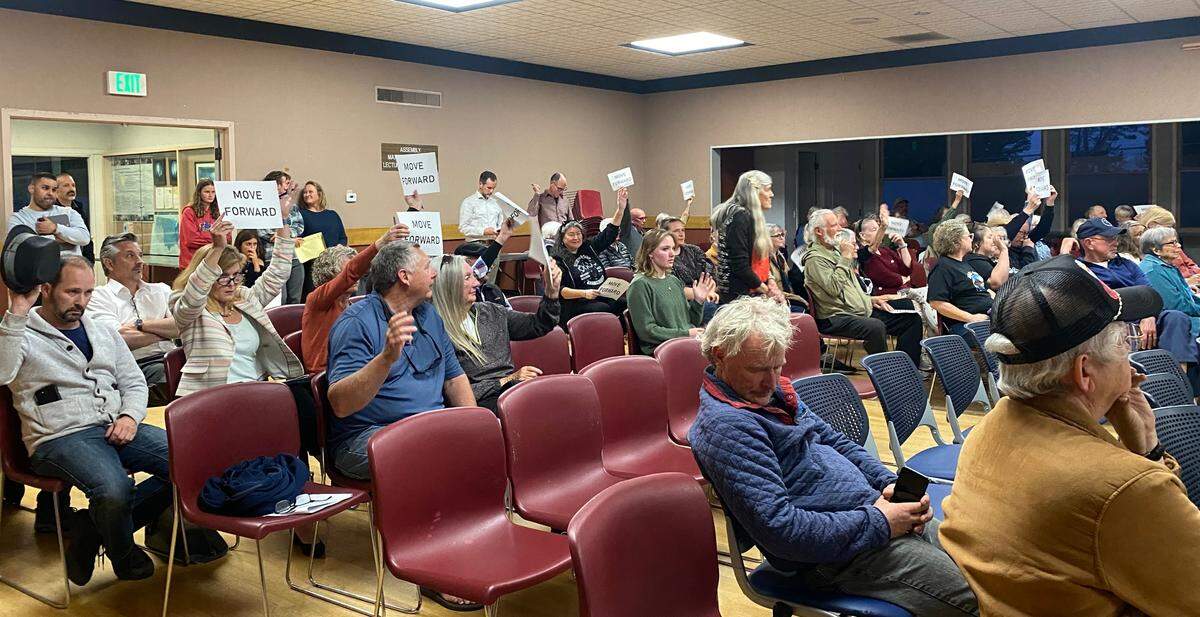
People of all ages crammed into the Morro Bay Veterans Hall to comment on the roundabout. Some waved signs that said “move forward,” while others raised their hands in a silent cheer when they agreed with a speaker.
Numerous speakers at public comment thought a roundabout would be dangerous for pedestrians.
Morro Bay resident Nicole Dorfman said she was especially concerned for the students of Morro Bay High School.
“They don’t always cross the streets where they’re supposed to or the direction that they’re supposed to, and they are often doing unsafe dropoff and pickup,” she said.
Right now, cars must halt at the stop signs and allow pedestrians to pass. In a roundabout, the vehicles would move continuously, and Dorfman worried that teenagers texting or wearing head phones could be hit by a car.
“It’s questionable whether the roundabout will be safe, because the students might not be paying attention as much as they should,” she said.
Other speakers, however, said that the roundabout would be safer for pedestrians — noting they would only have to look one way for oncoming traffic while crossing the street.
The U.S. Department of Transportation’s Federal Highway Administration said roundabouts reduce roadway fatalities and serious injuries because they “promote lower speeds and traffic calming,” “reduce conflict points” and “lead to improved operational performance,” the website said.
In Minnesota, there was an 86% reduction in the fatal crash rate and a 42% reduction in the injury crash rate at intersections where roundabouts were built, a report from the Minnesota Department of Transportation said.
A handful of Morro Bay High School students spoke in support of the roundabout at the meeting.
Morro Bay High School senior Antonella Salemi said she’s had a few close calls while running through the intersection with the cross country team.
“I can speak to the fear of not just driving through the intersection, but also almost getting hit while running through the pedestrian walk on the four-way stop,” she said.
She asked the City Council to support the project, and reassured them that students could safely use the roundabout.
“Teenagers will be able to adjust to this change and are not too stupid to have a roundabout,” she said, drawing laughter from the audience.
Morro Bay High School senior Sofia Steen agreed with Salemi — noting that a semi-truck almost hit her in the intersection.
Steen asked the City Council to support the roundabout to enhance safety, but also to reduce greenhouse gas emissions, as vehicles driving continuously through a roundabout emit less carbon monoxide than vehicles idling at a stop sign or stop light, she said.
City gets a say on roundabout construction
When the roundabout design is 60% complete, the Morro Bay Planning Commission will vote on whether to award a coastal development permit to the project.
By then, the design will also include pedestrian and bicycle safety improvements, Kwolek said.
The design would be ready for a vote in about two years, he said.
No matter how the Planning Commission votes, Kwolek expects the decision to be appealed to the City Council — which will then vote on whether to award the permit.
If the City Council’s decision is appealed, the California Coastal Commission would have the final say on the project.
This story was originally published May 28, 2025 at 12:55 PM.