Bob Jones Trail faces final hurdle this week — with one property owner still fighting it
The last chance for San Luis Obispo County to gain approval to complete the 4.5-mile gap in the Bob Jones Trail comes this week, but one local rancher still has a bone to pick with the plans.
The county’s mission to connect the Bob Jones Trail from the city of San Luis Obispo to the sea at Avila Beach has been long-fought for by the county and community.
But after more than a decade of negotiations with the rancher and a redesign of the bike path to avoid his property as requested, Ray Bunnell still isn’t pleased with the trail as it stands.
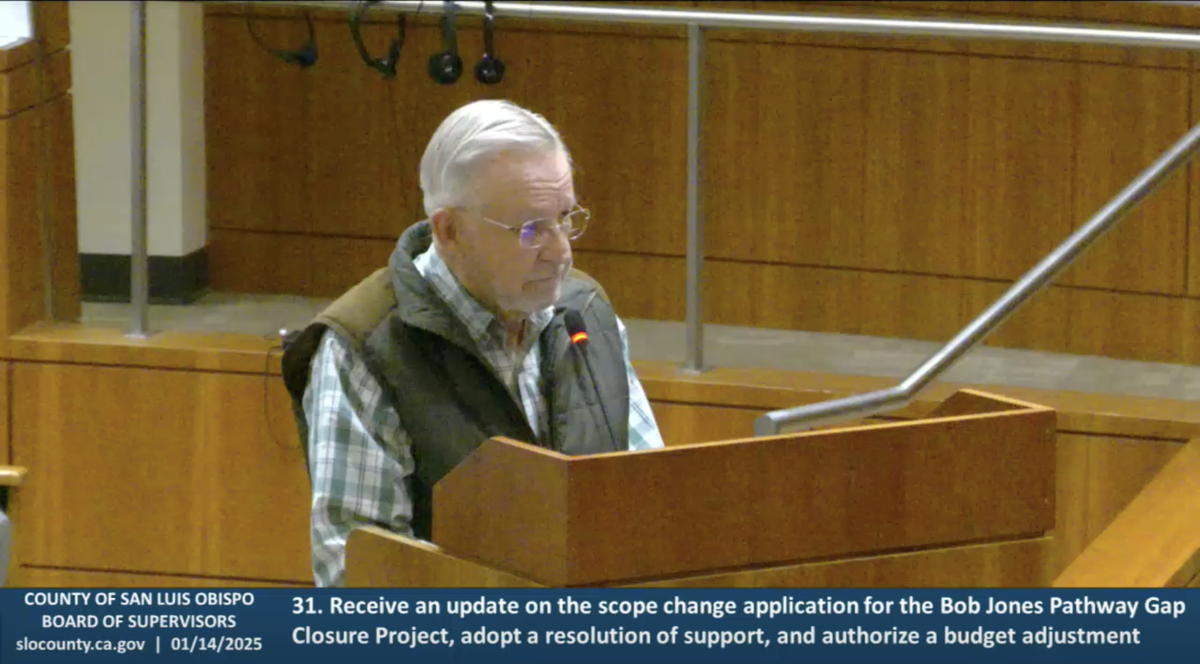
Now, Bunnell has promised to send a legal team to appear at a two-day California Transportation Commission meeting on his behalf on Thursday and Friday to air his grievances to the committee that will decide the fate of the $48 million Bob Jones Trail project, SLO County Public Works Director John Diodati previously told The Tribune.
The transportation commission’s approval is the last hurdle the project must pass in order for construction to start in early 2026. Without it, a major source of funding will lapse, essentially killing the project.
During the meeting, county representatives will ask the transportation commission to approve the changes made to the trail design at Bunnell’s previous request. Bunnell’s legal representatives meanwhile will present the rancher’s case as to why he still has concerns about the new alignment — and why the commission should, too.
Neighboring property owners Robert Kruse, Edward Pollard, James Warren and the owners of Baron Canyon hold the same or similar concerns as the rancher, Bunnell’s lawyer Edwin Rambuski told The Tribune.
Rambuski said the property owners are “not opposed to the project on the new alignment.”
Rather, “the goal is to make the project as constructed consistent with the grant application, the grant award and safe,” he said.
In recent recorded negotiations obtained by The Tribune through a Public Records Act request, Rambuski made a number of requests from the county in exchange for legal settlement — included redesigning part of the trail again and paying Bunnell $200,000.
The county denied most of the requests.
The Bob Jones Trail is expected to be heard on day two of the two-day meeting. On Friday, Bunnell’s lawyers will present to the transportation commission what their client sees as safety concerns and “misrepresentations” of the trail design. The county holds that there is nothing unsafe about the pathway, nor is there anything about the trail design the commission doesn’t already know.
“Edwin, please stop it with the absurd accusations,” SLO County Counsel Jon Ansolbehere said to Rambuski in an email on March 3 obtained by The Tribune. “There are no ‘outright misrepresentation(s)‘ about the trail.”
Transportation commission staff has recommended the commission approve the project, but it is ultimately up to the commission itself in the vote on Friday.
What are property owners’ concerns with the Bob Jones Trail?
For months, Rambuski and Ansolbehere have been tied up in negotiations, firing back and forth over email.
The Tribune obtained those negotiation emails in a Public Records Act request, receiving over 100 pages of email exchanges between the two attorneys.
Rambuski represents three other property owners with concerns over the Bob Jones Trail, not including Baron Canyon, but most of his negotiations revolved around Bunnell.
Among the rancher’s chief concerns were the bike path merging with Clover Ridge Lane, a dead-end road next to his property, for a 600-foot stretch — potentially endangering trail users and encumbering his and his tenants ability to access their agricultural land, Rambuski said.
“From what we understand from the county’s current plan with Clover Ridge … there won’t be much of a public street left,” Rambuski told The Tribune.
As currently planned, the Bob Jones Trail will share 16 feet of the approximately 28-foot-wide Clover Ridge Lane between Venado Trail — leading into Bunnell’s property — and the south end of the road, county Public Works Department project manager Aaron Yonker told The Tribune.
According to Rambuski, the road serves two agricultural properties, one for “large-scale, intense row cropping,” which Bunnell leases out to Talley Farms, another property where Bunnell’s own home is located, as well as long-term residential rentals, vacation rentals, agricultural operations in the fields and a horse boarding facility with about 25 clients.
“There’s a fair amount of traffic on Clover Ridge just on a daily basis,” Rambuski said. “The concern is that there will be a lot of vehicle traffic on Clover Ridge that will be sharing the street with the trail users, including ag equipment, farm workers and harvest vehicles.”
Ryan Talley, the farmer who leases Bunnell’s land next to Clover Ridge Lane, agreed.
“We use it quite often,” Talley told The Tribune.
The gate on Clover Ridge Lane that leads into the property is “kind of our main entrance,” Talley said. From May to mid-October, he drives large agricultural equipment and tractors — some up to 18 feet wide — down the road multiple times a day, he said.
If half of the roadway was shared with a bike path full of pedestrians and bikers, he would expect it to encumber his operations, he said.
The county, however, does not agree.
Ansolbehere told The Tribune there is “no through traffic or related safety concerns along Clover Ridge,” and that Rambuski’s argument that it would be unsafe to have the bike path on Clover Ridge doesn’t “comport with reality.”
“It’s a short, dead-end road with very limited traffic on there,” he said. “It operates functionally as his driveway.”
In negotiations, Rambuski asked the county to change the trail design again to move the path off the road.
He also asked for security fencing along Bunnell’s and the Baron Canyon property, an underpass on Clover Ridge for public safety and $200,000 to pay his legal fees for his multiple lawsuits against the county.
In a Feb. 25 email obtained by The Tribune, the county plainly responded “no” to most of the requests — including paying his legal fees.
According to a Feb. 18 email from Ansolbehere, Rambuski took a “moving target approach” to negotiations that wasn’t “conducive to settlement.”
“First, your client does it with the Caltrans alignment. He said use that and it was fine and now it is not. He wants more,” Ansolbehere said to Rambuski. “Then he asks for $200k and now you are telling me that that might change.”
In the last decade or so, Bunnell has filed two lawsuits against the county — one to refute the county’s failed attempt to use a vote of eminent domain to take a needed corner of the rancher’s land and another related to environmental concerns, which was filed alongside Warren, Pollard and Kruse.
The first lawsuit was essentially dismissed, while a stay was placed on the second, essentially pausing it indefinitely.
Now, a judge removed the stay at Bunnell’s request, re-opening the environmental lawsuit.
In the county’s eyes, they finished negotiations with Bunnell when they redesigned the Bob Jones Trail plans in October to avoid his property. Instead of cutting across a corner of Bunnell’s land, the trail now re-routes onto a Caltrans right-of-way immediately adjacent to the highway.
“The county moved the proposed alignment of the Bob Jones Trail project so that it no longer needs to use Mr. Bunnell’s land,” Ansolbehere told The Tribune. “While the county was willing to entertain some additional design features that Mr. Bunnell was requesting, paying him additional compensation for his attorney’s fees or whatever was off the table.”
As for Bunnell’s other concerns, the county has agreed to move the trail as far to the side of Clover Ridge Lane as possible and put up “no parking” signs along the road — but denied requests to add fencing along the length of the trail, build a tunnel under Clover Ridge and move the path entirely off the road.
Will the Bob Jones Trail get the approvals it needs?
By Friday morning, the California Transportation Commission will act on two items related to the Bob Jones Trail brought forward by the county: a request to amend the previously approved project scope and a request to construct the project in two segments under two separate timelines and funding sources, Yonker told The Tribune.
If approved, the pathway will be built in phases using funds from an $18 million California Transportation Commission state grant, $15 million in contributions from the San Luis Obispo Council of Governments, $5 million from SLO County and $270,000 in private donations. Construction would start in early 2026, Yonker said.
If denied, the county will have to return what remains unspent of the $18 million grant to the state, and any hopes of the project being complete would disappear.
According to Yonker, Caltrans staff recommended the commission “approve a project scope amendment and segmenting amendment” for the Bob Jones Trail — but Rambuski thinks the information Bunnell’s legal team is prepared to present may sway the commission.
Rambuski said that Bunnell is not against the project being completed and has even offered to help the county construct a trail “consistent with the original plans.”
No matter what, the fate of the long-awaited Bob Jones Trail will be decided soon — with or without Bunnell’s full support.
This story was originally published March 20, 2025 at 3:08 PM.
CORRECTION: This story has been updated to reflect that the tunnel Ray Bunnell requested would have been under Clover Ridge Lane.