Flu cases spike in SLO County. What’s behind the worst influenza season in years?
San Luis Obispo County is dealing with its worst flu season in years, according to public health officials.
County data from wastewaster samples and test positivity rates show a dramatic uptick in influenza cases this winter.
“We’re definitely seeing higher numbers of flu that we identify through our laboratory and also through our wastewater surveillance system,” San Luis Obispo County Health Officer Penny Borenstein said. “It’s definitely higher than we’ve seen in recent years.”
This year, the Influenza A strain is primarily infecting SLO County residents, she said.
According to county data, influenza test rates have been surging since mid-December and peaked on Feb. 8 when 38% of Influenza A tests came back positive.
In comparison, SLO County’s 2023-2024 flu season peaked at a 10% test positivity rate in December 2023.
SLO County data showed an uptick in the presence of the influenza virus in wastewater samples in Paso Robles, San Luis Obispo, Los Osos and Cambria this winter.
The largest spike occurred in the city of Paso Robles in January.
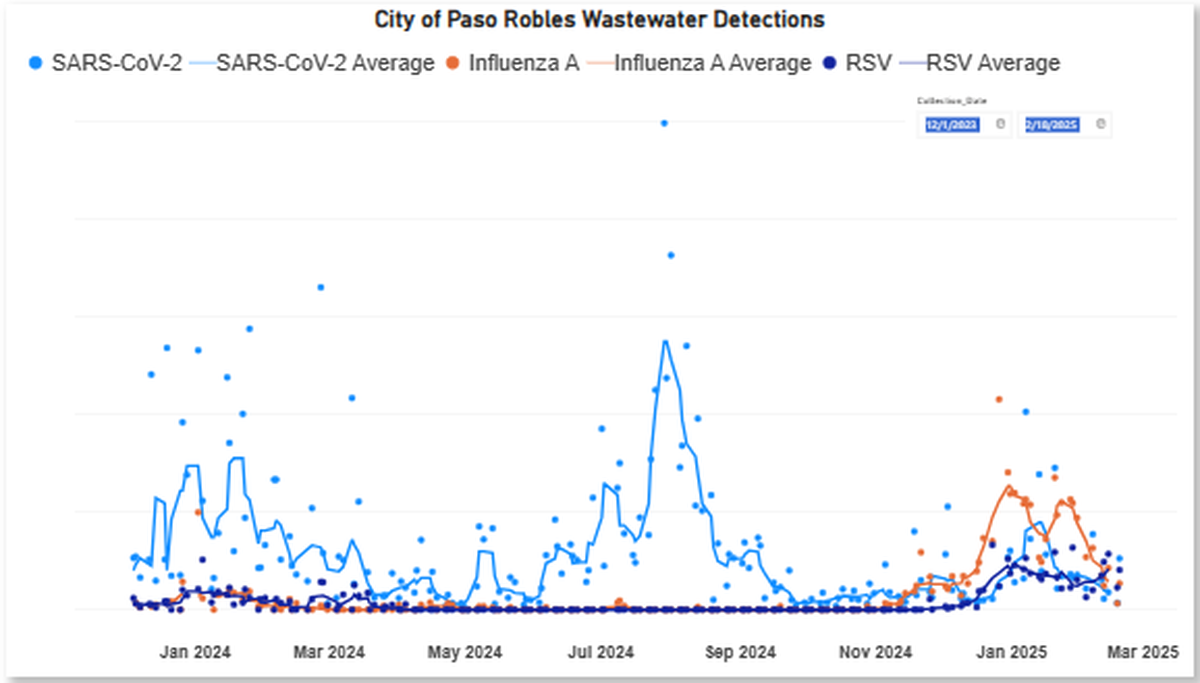
Flu cases increase in SLO County
Medical facilities in SLO County have also experienced an increase in flu patients this season.
Emergency room visits and hospitalizations due to influenza at San Luis Obispo’s French Hospital Medical Center were “slightly worse” than in 2024, according to Dr. Thomas Vendegna, the hospital’s chief medical officer.
Amid a heavy flu season, the medical center will typically have around three patients hospitalized due to influenza at any one time, Vendegna said.
In late January, during the height of the 2024-25 flu season, up to five people with severe influenza cases were being treated at French Hospital Medical Center at once, he said.
“When we see someone hospitalized with flu, it’s usually because they are advanced age or have other medical complications that put them at risk,” Vendegna said.
So far, no influenza deaths have been reported in San Luis Obispo County this season.
“Flu is one of the top killers of people in the United States, but we have not seen any (deaths) in our county,” Borenstein said.
Why is influenza so severe this year?
It’s difficult to pinpoint why the flu has been raging across the county this winter, health officials said.
Flu season typically extends from Nov. 1 through April 30.
“You always look back at the vaccine,” Vendegna said. “Was it as effective? Also, did less people get the vaccine? That’s the two things we always look at when we have a slightly worse flu season.”
Borenstein said that influenza could be infecting more residents due to decreased immunization rates.
As of Feb. 20, nearly 67,000 people had been vaccinated, which represents about 24% of the county’s population, according to data from the public health department.
During the prior flu season, data showed a total of 74,187 people received the flu vaccine, or about 26% of SLO County.
Borenstein said influenza immunization rates for school children had also dipped this season, although she could not provide The Tribune with any specific data.
“Flu is pretty erratic, and one of the main reasons is if less people get immunized, we will see more disease because they’re not protected,” she said.
Vaccine efficacy could be a factor as well, she said.
The influenza shot is created based on the strain circulating in the southern hemisphere, in places including Australia and New Zealand, during its winter season.
It’s impossible to predict with certainty if a flu vaccine will be a good match to fight the influenza strain that eventually spreads across the United States, according to the federal Centers for Disease Control and Prevention.
The CDC is expected to release an assessment on the effectiveness of this year’s flu vaccine toward the end of the influenza season.
How bad is flu season throughout California?
Across California, more people are dying from the flu in California than from COVID-19, according to the California Department of Public Health.
The state is experiencing an unusually high number of influenza cases during the 2024-2025 respiratory season, state health agency data shows, leading to a rise in flu-related deaths.
As of Feb. 15, more than 900 Californians, including 16 children, had died from the flu this season, according to a report from the state’s public health department.
“This year’s respiratory virus season has been dominated by seasonal influenza,” the report said.
What are common flu symptoms?
Symptoms usually appear suddenly for those who contract influenza, the CDC said, compared to COVID-19 symptoms which tend to appear two to 14 days after exposure to the virus.
“Flu comes on like a freight train, usually with a severe headache,” Vendegna said.
That’s usually followed by upper respiratory symptoms such as sniffles, a runny nose, a cough, fever and muscle aches and not feeling well at all,” the doctor said. “It’s not subtle. It’s something that comes on within hours and you feel really poor.”
Here are common flu symptoms to look out for, according to the CDC:
- Fever, chills or feeling feverish
- Cough
- Sore throat
- Runny or stuffy nose
- Muscles or body aches
- Headaches
- Fatigue
Who should get flu vaccine?
“It’s not too late to get a vaccination,” Borenstein said.
She said the influenza vaccine is still the best way to prevent against flu infections.
According to the CDC, everyone 6 months and older in the United States should get a flu vaccine every season.
“Even though there are some breakthrough cases among people who have been vaccinated, they tend to be less severe,” Borenstein said. “People without vaccination represent a much higher percentage of people who will wind up in the hospital or even succumb to the disease.”
In addition to getting vaccinated, she advised staying away from people who appear to be ill and wearing a face mask when entering crowded public settings.

How long will flu levels stay high?
Flu infections will not be going away anytime soon as long as a majority of the population remains unvaccinated, Borenstein said.
“We will probably continue to see flu cases through the season,” she said.
However, severe flu cases have dropped off at French Hospital Medical Center after a late January surge, according to Vendegna.
“Now we’re back to ones and twos that are being hospitalized for influenza,” after a peak of four or five patients at once, he told The Tribune on Friday.
Flu activity throughout California remains high but is trending downwards, the California Department of Public Health said.
According to state data, only a “small percentage” of Californians had been vaccinated against respiratory viruses as recommended by health officials, including influenza, COVID-19 and respiratory syncytial virus.
This story was originally published February 25, 2025 at 5:00 AM.