Paso Robles calls out councilman, says he ‘explicitly refused’ to comply with public records law
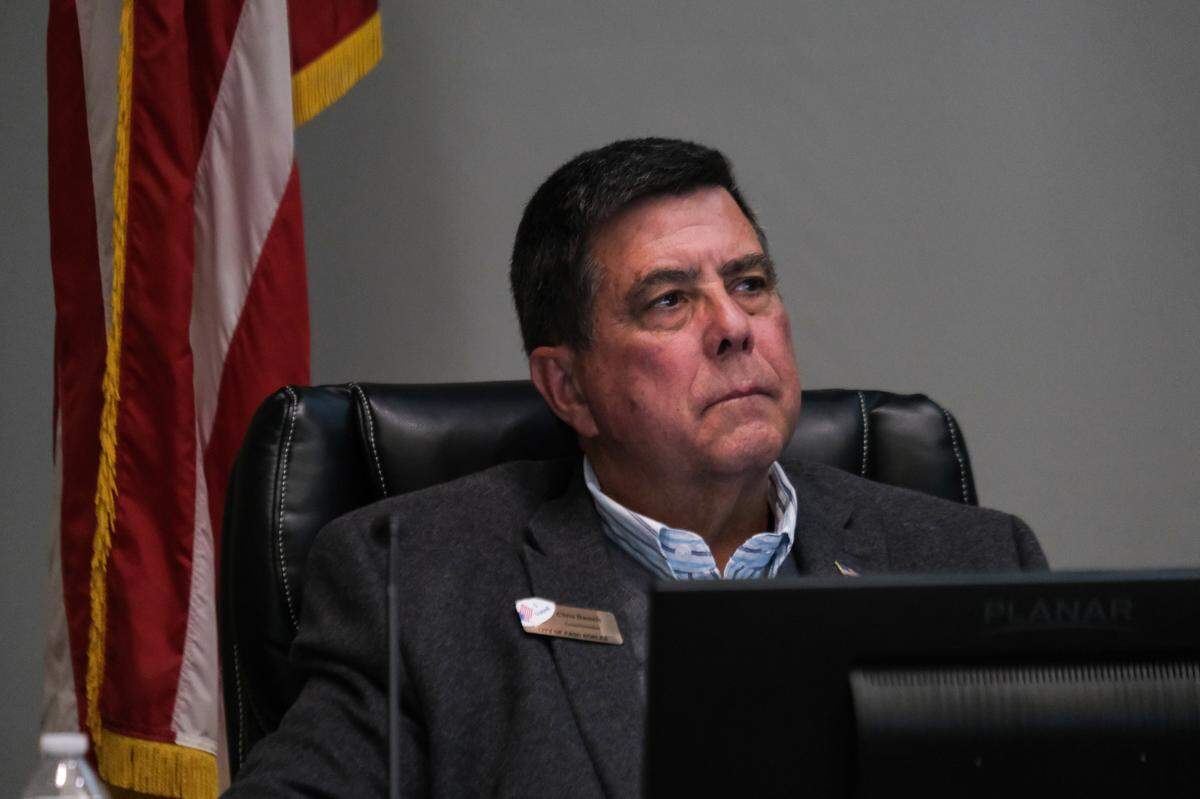
In an unusual move, the city of Paso Robles is calling out Councilmember Chris Bausch, saying he has “explicitly refused” to comply with state law regarding multiple Tribune requests that he turn over public records.
In response, Bausch has broken his long silence to say the city’s statement is not true.
The back-and-forth correspondence comes in the middle of a months-long fight at City Hall over public records requests — many of which were submitted by The Tribune in an attempt to better understand Ty Lewis’ $2.275 million claim, in which the former city manager accused Bausch of harassment and working with Cal Coast News reporter Karen Velie to orchestrate a conspiracy against him.
Lewis resigned from his position with a $365,000 settlement in late January.
But while the city has responded to most of The Tribune’s requests, at least four remain unfilled — and Bausch appears to be the common denominator in each of them.
In a communication detailing the city’s responses to 15 Tribune public records requests on Friday, city attorney Elizabeth Hull wrote that Bausch has refused to comply with California’s Public Records Act.
“Councilmember Bausch has stated that he will not make his personal devices available to the City and that complying himself would require him to conduct over 700 searches on his personal devices, which he deems unreasonable,” Hull wrote.
“Despite being aware of his obligations under the PRA,” she continued, “Councilmember Bausch has explicitly refused to conduct these searches unless ordered to do so by a court.”
In a follow-up email, however, Bausch said Hull’s statement about his refusal to comply was “wrong.”
Bausch said he has searched and continues to search for records responsive to The Tribune’s requests, but will need at least six months to complete the 702 searches identified by the city.
Even then, he said he’s concerned that the release of any responsive records would violate the terms of Lewis’ settlement agreement, which included a non-disparagement clause.
“I do believe it is prudent to seek the opinion of a judge as to whether the nature of the documents requested might be considered damaging and/or disparaging prior to risking a new and possibly justified claim from Mr. Lewis,” Bausch wrote. “Meanwhile, I will continue to search for responsive records.”
Hull replied with a terse, two-sentence email to Bausch on Monday.
“I have reviewed the matters raised in your email below,” Hull told Bausch. “I would like reaffirm that the City stands by the statements and positions outlined in my previous communication.”
Hull declined to offer further comment on Bausch’s response.
What has The Tribune requested from Bausch?
California case law establishes that certain records from public officials’ personal devices are subject to disclosure under the California Public Records Act — but the responsibility to disclose those records is honor-based.
That means it’s up to the respondent to search for and turn over their records in good faith.
Since October, The Tribune has submitted at least six requests for records off Bausch’s personal devices, including two requests for a recording of a March meeting among Bausch, Lewis and Mayor John Hamon at Angela’s Pastries in Paso Robles.
The meeting was mentioned in Lewis’ claim, and was reported by both Lewis and Hamon to have been recorded by Bausch.
The Tribune’s first request for the recording was submitted on Oct. 21. The city denied the request Nov. 19, saying that it had not located the recording.
A second request was submitted on Dec. 19 after Velie leaked a snippet of the recording on her Cal Coast News website in an attempt to refute Lewis’ allegations. Then in January, Velie shared two different versions of what she said was the full recording, along with conflicting accounts of how she obtained it.
Deputy city clerk Mary Sponhaltz told The Tribune at the time that until seeing Velie’s article, she had not been given access to the recording or “had confirmation it existed.” Velie did not receive the recording through the public records request process, Sponhaltz said.
Emails obtained by The Tribune show that the city contacted Bausch and his counsel multiple times regarding The Tribune’s requests for the recording.
On Dec. 27, Hull emailed lawyer Michael Gibbs, who appeared to be representing Bausch, about the requests. Hull wrote that she understood Gibbs was in possession of the recording — a contradiction to what the city had previously been told.
“The City was under the impression that it was no longer within Mr. Bausch’s control,” Hull wrote in the email.
The Tribune also submitted at least four requests to the city for communications on Bausch’s personal phone and email that pertained to public business, including messages relating to Ty Lewis, the Angela’s Pastries meeting, City Council meetings, agenda items, paid parking, public records and more.
Bausch’s apparent refusal to turn over the records sparked two back-to-back closed session City Council meetings, in which the council discussed The Tribune’s outstanding requests. At the end of the second meeting on Jan. 8, Hull reported that Bausch had agreed to search for responsive records.
“As to any public records that may be on Councilmember Bausch’s personal devices, Councilmember Bausch has agreed to review his personal devices and will commence providing responsive documents to the city attorney’s office within two weeks of today,” Hull said at the time.
But on Friday, more than a month after Bausch reportedly agreed to search his devices, the city disclosed to The Tribune only one document that the Councilman had turned over — the already-leaked recording of the bakery meeting.
The now-disclosed recording appears to be the same version that Velie originally posted, which includes an intro that seems to have been added on at a separate time. In the intro, Bausch states that the audio is a “copy of” the meeting recording. The copy provided to The Tribune also includes around 2 minutes of background noise after the conclusion of the meeting, which was not included in Velie’s version.
The city did not inquire about the seemingly edited intro, Hull told The Tribune on Monday.
No emails or text messages from Bausch’s personal devices were disclosed to The Tribune on Friday.
The Tribune also requested communications off the personal phones of other sitting and former Paso Robles Councilmembers and city officials, including Lewis, Hamon, Councilmembers Steve Gregory, Fred Strong and Kris Beal, and former Councilmember Sharon Roden.
All except Bausch turned over their records and signed affidavits, according to Hull.
The city is currently reviewing those communications and has provided the first batch.
The records released from the other councilmembers thus far are unrelated to the allegations against Bausch and mostly have to do with attending meetings or events.
In one email exchange on Dec. 10, records show, Bausch wrote that he did not believe there was enough research done on a potential employee parking program. Hamon responded that he disagreed with Bausch, as did the rest of the council, and found the staff report sufficient.
Councilmember cannot have personal attorney review records before release, lawyer says
Bausch claimed to be concerned that the release of potential public records would violate the terms of Lewis’ settlement agreement, which included a non-disparaging clause.
But according to First Amendment Coalition attorney David Loy, the release of public records does not violate any sort of agreement.
Cities and city employees can make agreements to not voluntarily broadcast information, like make public statements in interviews or press releases, Loy said, but “it cannot legally agree to withhold records for a public records act request just because of a settlement agreement.”
“That is not an excuse or an exemption for disclosing records,” he added.
Loy said the fact that records may contain something disparaging for a city councilmember or city manager is not a legal justification to withhold them.
In fact, it’s the exact objective of the Public Records Act.
“The public has a right to the full story, not just the official story,” Loy said. “The whole point is to create transparency even if it is embarrassing or inconvenient to public officials.“
Emails provided by the city to The Tribune show the city notified Bausch of the requests related to his personal devices. Bausch subsequently told city officials to forward the requests to his lawyer.
Hull told The Tribune’s attorney she was not sure who Bausch’s attorney was and “to the extent Mr. Bausch’s interests are adverse to the city, I do not represent him.”
In his response to Hull on Monday, Bausch also said he was advised to withhold records until his personal lawyer could review them before sending them to the city — a practice Loy also said is not in line with the law.
“He works as a city councilmember in his official capacity, and in that capacity he doesn’t have a right to withhold public records from the city,” Loy said. “It’s the city’s business.”
Loy said it’s up to the city — not Bausch — to decide whether records he has are responsive to Public Records Act requests.
“If it’s a public record, it belongs to the city. It does not belong to him, ” Loy said. “I don’t think his personal attorney should be allowed to veto disclosure to the city.”
Loy said that when public officials keep public records on their personal devices, they can either do a diligent search of their devices and accounts and then turn them over to the city for review or give the city access to their device or accounts so the city can do a search for records itself.
City staff then decides what is exempt from Public Records Act requests and what is not.
Bausch’s actions in denying and/or delaying release of records from his devices also exposes the city to legal liability, Loy said.
“His actions as a city councilmember are attributable to the city. If the request is made to the city for public records on his personal device or account, ultimately, the city itself is responsible for complying with that request,” Loy said. “If the city does not or cannot comply with that request because he won’t turn them over, then the city is potentially liable for violating the Public Records Act.”
Karl Olson, The Tribune’s attorney, said in his 40-year career, he does not recall another time where a city has called out a public official for not cooperating with the Public Records Act.
“When you don’t turn over any records and you don’t sign an affidavit, I think that kinda speaks for itself,” Olson said.
Olson said Bausch’s actions are not consistent with the language or the spirit of the Public Records Act.
“The preamble to the Public Records Act is that access to information is a fundamental and necessary right of every person in this state,” Olson said. “The Supreme Court in one of its decisions said openness in government is essential to the functioning of democracy.”
This story was originally published February 12, 2025 at 10:00 AM.
.JPG)