SLO County landowner wants to rezone farm site to build new housing — but the city is opposed
A San Luis Obispo resident wants to rezone his 56-acre property near the SLO County Regional Airport with the eventual goal of building housing on the land, but the city is in stark opposition to his plans.
It’s main grievance? The property falls within San Luis Obispo’s greenbelt area, 54,400 acres of protected natural habitats, trails and agriculture land surrounding the city.
Located at 800 Evans Road, just west of the intersection of Broad Street and Buckley Road and about 350 feet directly south of the airport, the land has long been designated as agricultural land, but the property owner wants to rezone it as residential suburban.
If approved, up to 54 housing units could be built on the site, but the city prohibits rezoning and building within its greenbelt.
“The city’s greenbelt and scenic character is part of what makes San Luis Obispo such a unique and amazing place where so many people want to live, work, study and visit,” city spokesperson Whitney Szentesi told The Tribune. “Our community has made it clear year after year that protecting and preserving SLO’s scenic character and open space is a high priority.”
The land is in the county’s jurisdiction, so while the city doesn’t have any real authority over approving or denying projects there, it does have a vested interested in working with the county to manage and preserve the greenbelt, Szentesi said.
However, the project land use planner, Pam Jardini, said the land shouldn’t qualify for conservation under the greenbelt at all.
“This site has no special features — it doesn’t have any wildlife habitat, it has no archaeologically sensitive areas and it doesn’t have any special plant species,” Jardini said at the SLO County Board of Supervisors meeting Tuesday. “It’s not a site that the city would consider to warrant protection under the greenbelt plan, so it actually lacks features to be incorporated into their greenbelt plan.”
The landowner — longtime SLO County resident, Cal Poly alum and local business owner Paul Abbot — asked the Board of Supervisors to approve the processing of his rezoning application on Tuesday, citing its lack of farming viability as a major motivating factor.
The board ultimately agreed, unanimously approving the project for processing, but Abbot, 52, still has a few hoops to jump through before he can get the go-ahead.
Tuesday’s approval was only step one of a three-step county approval process. Next, the project will be subject to public review hearings before the SLO County Planning Commission, before it would return in front of the Board of Supervisors again after the completion of an environmental review.
Moving forward, the city will keep tabs on the project as it moves through the county’s approval process and provide comments as appropriate, Szentesi said.
What would be built on the site, and why does the city opposed it?
Abbot, 52, has lived in the county off and on for 35 years, he told The Tribune on Tuesday.
He does not live on site, though three occupied residences and multiple accessory units currently sit on the property.
Two of the property’s residents spoke at the meeting in glowing support of the proposed development.
“Our hope is for providing more housing and providing more opportunities for families to come here and enjoy this beautiful area,” said Jeff Hall, who has lived on the property with his family and elderly parents for six years. “I hope this serves that need, and I don’t, honestly, living on the property, I don’t see really any other purpose for this particular property.”
Alex Wilkerson and his family have lived on the property for nearly eight years, having built their home, raised livestock and planted gardens there, he said Tuesday.
“We’d love to see our immediate community grow and provide housing to others who desire larger spaces and have the opportunities that we have experienced,” Wilkerson said.
The 56-acre parcel sits just outside San Luis Obispo’s city limits and its sphere of influence, but still within the city’s greenbelt, as well as an Airport Review Area inside which noise regulations and height restrictions on buildings and trees apply.
A small portion of the northeastern corner of the property is designated as a wetland area and placed under a noise constraint, but no developments are proposed near the creek.
As for the greenbelt, preservation of the area helps support air quality, provide recreational opportunities, protect cultural heritage and prevent city sprawl, Szentesi said.
The only allowable uses for the greenbelt under the city’s General Plan are for watershed, wildlife habitat, grazing, cultivated crops, parks and outdoor recreation causing minimal land alteration. The city only allows residential development of spread-out, single-family homes in the greenbelt.
“Both the city and county have defined urban areas to prevent sprawl and maintain clear boundaries for urban development to maintain the scenic and rural character of the city and the county,” Szentesi said.
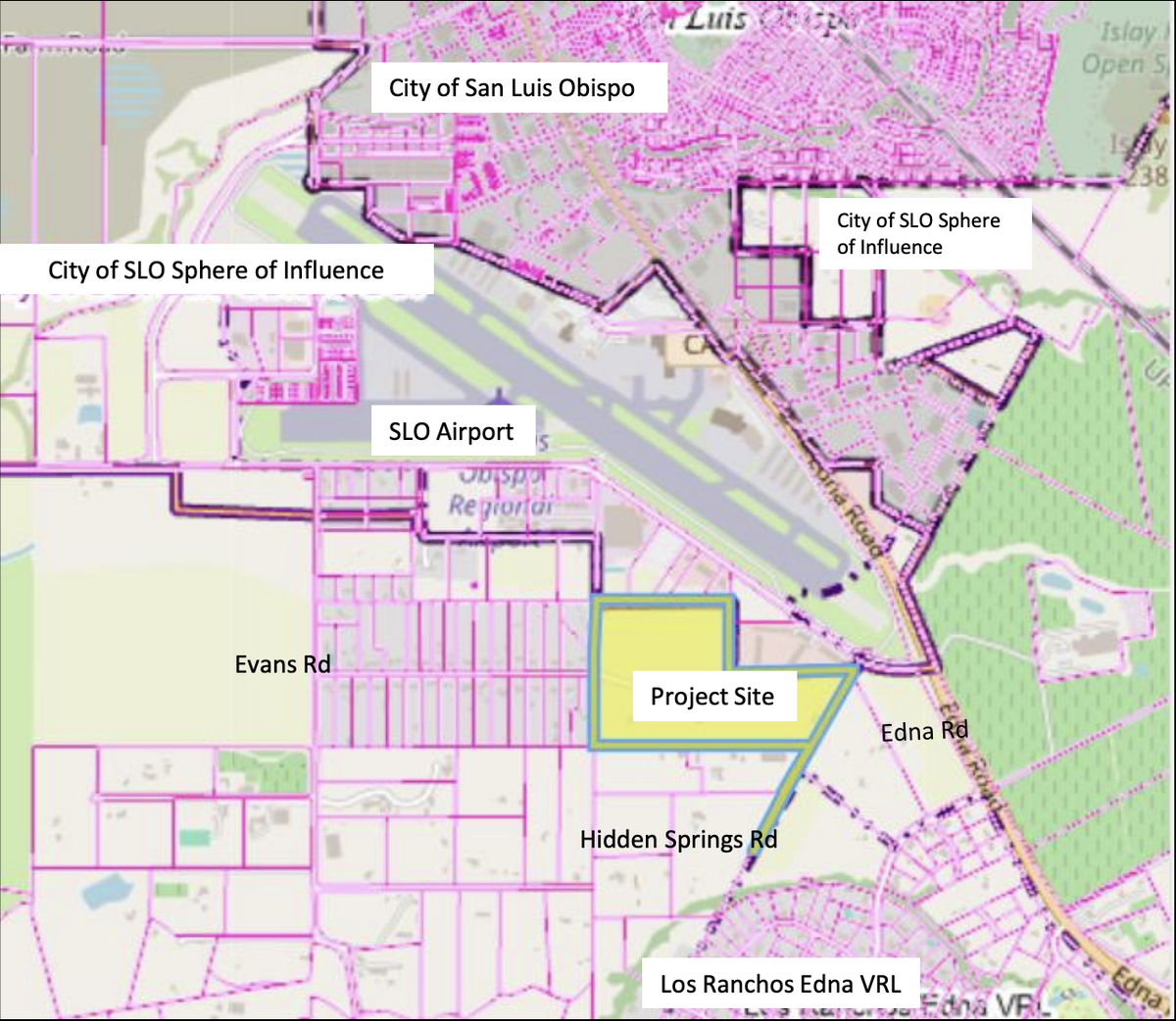
According to the staff report, Abbot already applied for a land use designation change twice before, once in 2002, which he withdrew in 2009, and again in 2017. Both times, he was instructed by the city and the Airport Land Use Commission to address water availability, traffic and noise concerns from the nearby airport.
Abbott submitted his current proposal in May 2024. It would subdivide the 56.34-acre parcel in 18 individuals lots ranging from 2.5 to 5 acres, the staff report said.
Each parcel would have the capacity for one primary dwelling, one accessory dwelling unit and one junior accessory dwelling unit for a total potential build-out of 54 houses of various sizes — three per subdivided parcel.
Part of the city’s issue is that the small, subdivided parcels do not meet San Luis Obispo’s minimum 10-acre lot size policy inside the greenbelt, with exceptions for new contiguously clustered dwellings.
“The city might welcome and encourage the county to allow smaller lots in the greenbelt — but only if new homes are grouped together, most of the land (90%) remains open space and important farmland is legally protected from development,” Szentesi said.
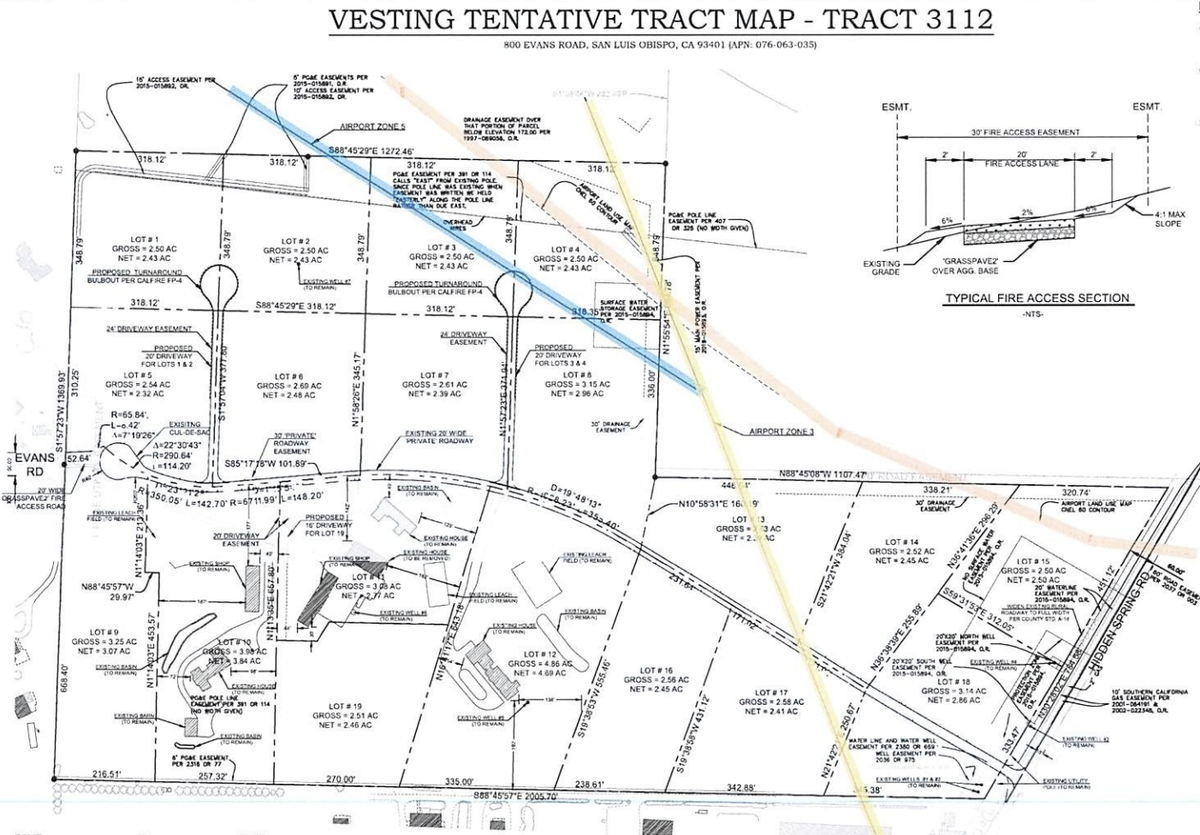
In the build-out, an existing paved road on the property would be improved and permitted for access to homes, the staff report said.
The conceptual tract map shows the road connecting to Hidden Springs Road for access to the parcel and ending in a cul-de-sac, with two other cul-de-sac roads branching off the main one, but an emergency fire access route with a gate would be built to connect the main road to Evans Road to the west.
Hall said he thinks the current plan would keep traffic and noise off of Evans Road on a regular basis with the exception of fire emergencies.
Access to water is another issue that would be addressed during the build-out.
As of now, community water and sewer services are not available at the project site, according to the staff report. There are seven wells on the site, but not much is known about the quality and quantity of the water inside, county staff said during Tuesday’s meeting. A well analysis would be conducted in future site reviews, staff said.
If the project is approved, the Golden State Water Co. has pledged to provide domestic and fire protection water service for the new homes, contingent on the California Public Utilities Commission approval of an expansion of the water company’s operational territory.
The agricultural land can’t be used for its intended purpose, county says
One of the main drivers for Abbot to rezone the land seems to be its inability to support irrigated crops on a mass scale, despite its designation for agricultural use.
As previously mentioned, community water services do not currently serve the property. The land has historically been used for farming dryland hay crops, and while the property’s soils could likely support more water-intensive crops such as wine grapes and vegetables given proper irrigation, the lack of a reliable water supply severely limits the land’s agricultural viability, SLO County Agricultural Resource Specialist Ian Landreth told The Tribune.
The project proposal says that only small, non-continuous areas of the land are designated as prime soil and the majority of the site is made up of non-prime soil.
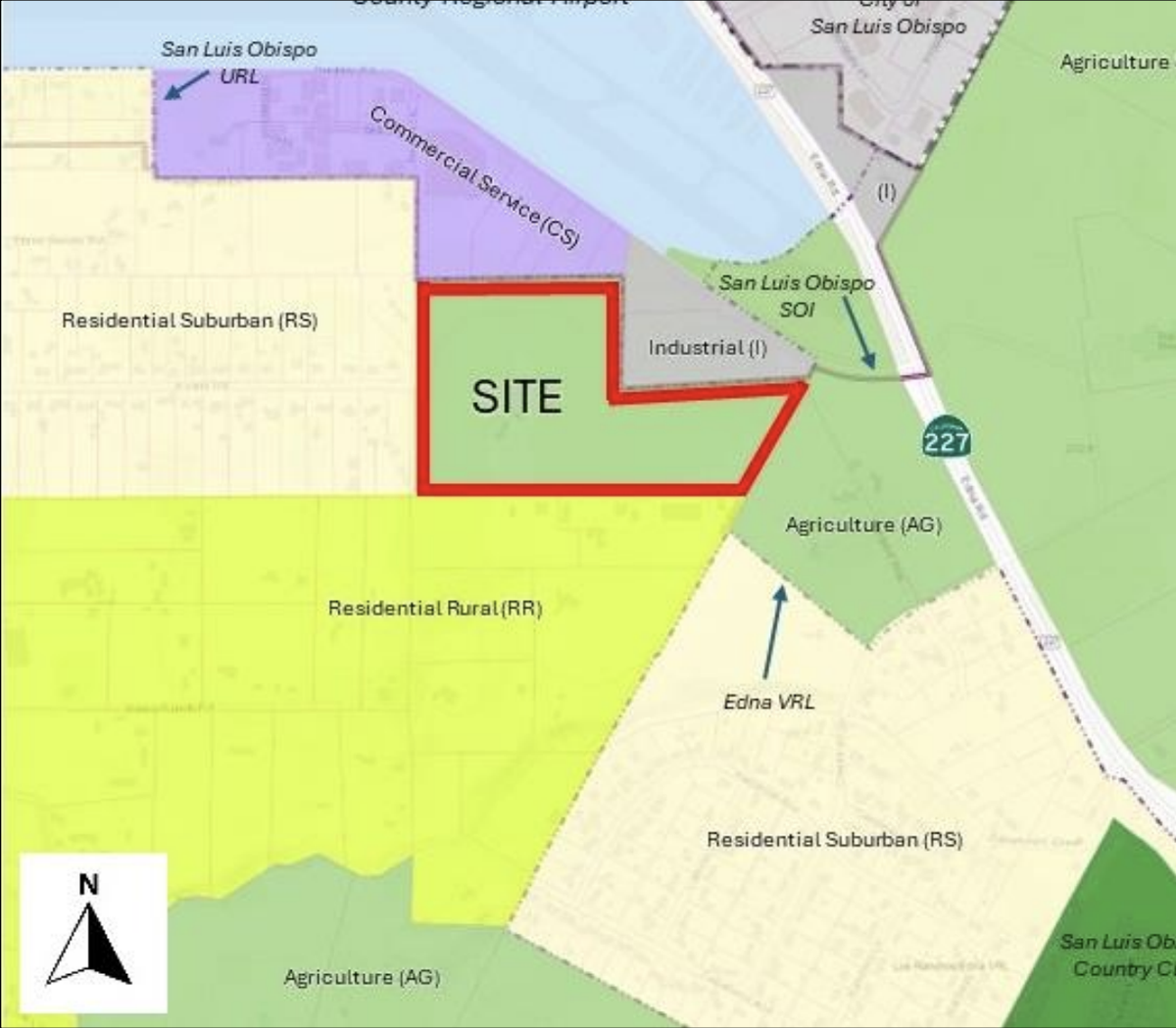
The zoning of the neighboring properties also limits how the land can be used agriculturally, Landreth said.
“This project is surrounded by rural residential developments,” he said. “To intensify the agricultural use on this site would be further constrained by the surrounding developments.”
The property’s residents came to the same conclusion, claiming from first-hand experience that the soil had poor drainage for farming.
“In living there many years, I have a good understanding from an agricultural purpose (that) this land is not good as far as ... being able to grow the crops,” Hall said. “Once you get rain there, you ... can’t do anything on it from an agricultural standpoint.”
The county’s Agriculture Department gave its evaluation to the board on Tuesday, but the city maintained non-agricultural use is not consistent with the city’s rules for the greenbelt.
However, some of the county supervisors seemed to doubt this reasoning.
“I know that the city feels that this is part of the greenbelt, but I’m really not sure,” Supervisor Dawn Ortiz-Legg said. “It’s kind of in a funny place. I mean, it’s surrounded by industry and and housing.”
Would the project increase housing in SLO County?
If his request is approved, Abbot intends to subdivide his property for residential development, therefore increasing available housing in SLO County.
But it was debated if the new housing would effectively help address the county’s housing shortage.
While the project could add housing for median-income families, it would not provide affordable housing, which is the type most needed in the county, the staff report said.
The item still passed the board unanimously, though Supervisor Bruce Gibson gave his support “unenthusiastically.”
“I would note that this is, at best, a mediocre site in order to develop housing for a number of reasons,” Gibson said, citing noise from the neighboring airport as one downside.
Gibson said the project “is proposing to put in housing that this county really doesn’t need,” noting that the city needs affordable housing for low-income tenants, not the median-income level families that would likely live there.
“I don’t think this is really making a great contribution to our house initiative,” Gibson said.
But Ortiz-Legg countered that “all housing is important,” not just low-income, affordable units.
“We need more folks to be able to pay property taxes,” Ortiz-Legg said.
This story was originally published February 6, 2025 at 10:00 AM.