SLO County nonprofit that gives out free senior meals struggling amid high demand. How to help
There is such a thing as a free lunch — and it’s served to San Luis Obispo County seniors five days a week at nine dine-in sites and at homes for the housebound.
Meals That Connect delivers nutritious, free meals to homebound seniors and feeds others gathering together at dining sites across 16 communities for a sociable time of companionship.
But a few of the nonprofit’s sites have been struggling with dwindling use at the dining rooms, while others are struggling to match ever-increasing demand for meals, the managers say.
Cambria’s congregate dining site is even in danger of closing permanently due to the limitations of the facility — putting in jeopardy the delivery of thousands of meals to those North Coast residents.
For many who rely on Meals That Connect’s congregate dining, the get-togethers are about far more than the food, diners told The Tribune recently.
“This is our family,” Cambria diner Chris Anne said. “It’s our only social time, with a sense of community.”
To protect congregate diners’ privacy, The Tribune only used their first names.
So what can be done to help the nonprofit that acts as a lifeline for so many elderly San Luis Obispo County residents? Its managers say they need the public’s help.
Demand for senior nutrition outpaces existing SLO County infrastructure
One of the organization’s most pressing concerns is what to do about its Cambria dine-in site.
Meals That Connect executive director Laura Edwards said while 36 Cambria households currently receive meals via home delivery, the nonprofit’s Cambria congregate dining site peaked in the 2019-20 fiscal year at 23 clients.
Since then, attendance has routinely numbered under the double digits, she said.
Edwards said she believes there are many more seniors who would enjoy the service in the small town of about 6,000 residents, a majority of whom are senior citizens.
At the same time, other Meals That Connect sites across the county are hitting peak occupancy, with the Senior Nutrition Program’s meal delivery program driving most of the growth.
Since the start of the COVID-19 pandemic, the nonprofit has seen its requests for nutrition consistently rise.
In 2019, 21,751 meals were served at the nonprofit’s dining sites, while another 78,688 meals were delivered to homes across Meals That Connect’s service area, which also includes eight sites in the Santa Barbara County area, according to Meals That Connect deputy director Brandee Brown-Puett.
By the 2023-24 year, the nonprofit was serving 32,864 dine-in meals and delivering another 164,962 meals — a 59% increase, Brown-Puett said.
That significant expansion has tested the organization’s capacity both as a meal provider and as the most immediate connection to other resources available to seniors in the county, Edwards said.
The majority of home delivery clients are homebound, making the volunteer delivery crews’ roles as mandated reporters all the more important, Edwards said.
“We’ve had times where volunteers knocked on the door, the client didn’t answer, they checked with emergency contact and then we had to call authorities because the client was laying on the floor — and if our volunteer didn’t follow through on that, that person could have been on the floor all weekend,” Edwards said. “We’re a respite for caregivers, and also just kind of that safety net for a lot of seniors who are living alone as well.”
Cambria volunteer delivery driver Ed Dominguez agreed.
“That’s a really big part of it,” Dominguez said. “In the eight years I’ve been delivering, I’ve had to call 911 a couple of times because the person was in distress.”
Central kitchen needs a new home, fast
Edwards said that in recent years, increasing demand for the nonprofit’s services has started to push some of its dining and meal preparation sites past capacity.
For the past 20 years, the program’s home delivery meals have been cooked in a central kitchen in an old hospital facility within the county’s health campus on Johnson Avenue, turning out around 1,300 meals a day that must be packaged, packed into semi trucks and then delivered to each home delivery address, Edwards said.
Around 80% of the meals currently cooked at the Johnson Avenue kitchen go to home delivery, while the rest goes to the dine-in sites, she said.
Though the rent and central location is favorable, it lacks a loading dock and must share its immediate vicinity with the county’s health campus and drug and alcohol rehabilitation services staff, making it an increasingly poor fit, Edwards said.
Now, the nonprofit’s lease on the 2,647-square-foot kitchen is expiring, giving Meals That Connect both an opportunity to move on to a site better equipped to suit its growing needs and a deadline to make its move.
Edwards said the nonprofit is considering purchasing its own permanent headquarters that can fully meet the nutrition program’s needs, but putting together the funding is likely to be an issue.
“I wouldn’t say we’re over the skis right now, but I would say we’re higher than we’ve ever been,” Edwards said. “I suppose you could say we are exploring new capacity territory, maybe growing into bigger skis.”
Increased demand, potential issues with Cambria dining site may hinder service
Though congregate dining site usage across the county has dropped, dining sites are still vitally important to the senior nutrition program’s needs.
Each of the program’s nine San Luis Obispo County dining sites serves as the distribution point for the home delivery meals, where they are re-heated and delivered by volunteers.
Cambria’s dining site is feeling the squeeze at its current Cambria Community Presbyterian Church location, mostly due to space and kitchen constraints, program manager Fanny Arenas said.
Even though attendance is typically low in Cambria, losing the dining site would disrupt the nonprofit’s ability to deliver guaranteed hot meals, with the next closest dining site in Morro Bay, Arenas said.
“If we do end up closing down this site, we have to figure out another site that can pack those 30 meals for us so that we can send them out, because we obviously are not going to cut off that lifeline to our clients, but logistically that’s going to create more issues for us,” Arenas said.
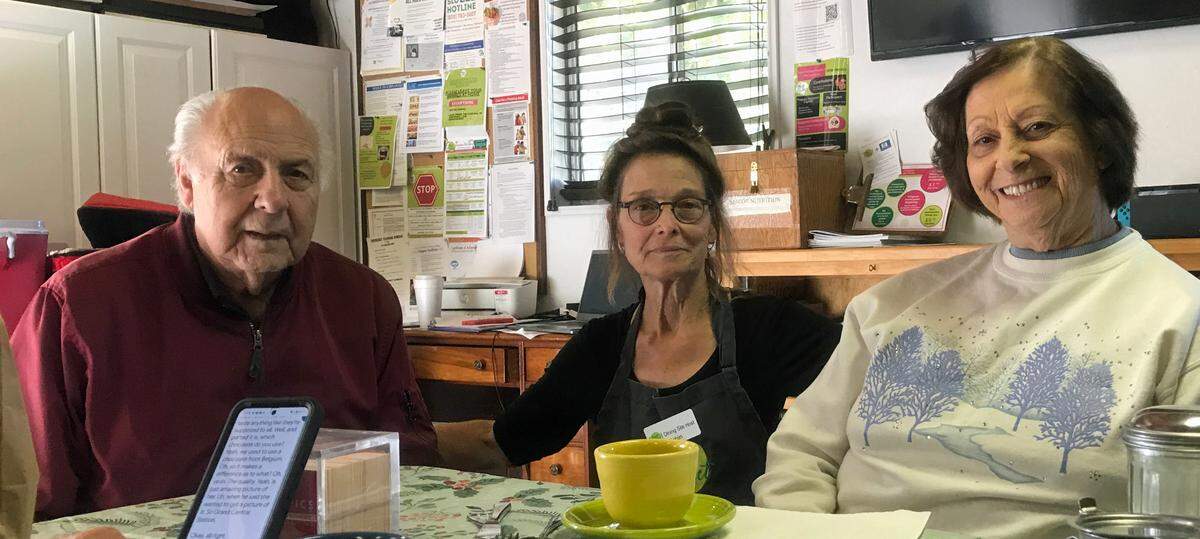
Though Arenas had concerns about the longevity of the Cambria site — into which Meals That Connect relocated about a year ago when it had to leave St. Paul’s Episcopal Church — the regular dine-in clients who gather and eat at the site say they love the cozy place.
While the set up at their former location “was a little more formal, this is like our clubhouse,” diners said.
“It’s comfortable,” said Jim, Chris Anne’s husband. “We like it.”
Jesse Miller was the Cambria site manager for 32 years until he retired earlier this year at the age of 90. He said when Meals That Connect had to leave its last location, finding a new place in town on a short deadline was difficult.
Miller said he was grateful to find the Presbyterian church site, and was pleased by the warm welcome the leaders and congregation gave the program.
“They bent over backwards, even bought us a new refrigerator and freezer,” he said.
Now, the program is in search of a new Cambria site better equipped to serve a larger group of diners, and may fold daily dining operations in Cambria entirely next month if a better site cannot be found, Arenas said.
Multiple dining sites in need of improvement
Cambria’s dining site isn’t the only one reckoning with the difficulties of expanding delivery needs at a site that doesn’t fully meet the program needs.
In Atascadero, while dine-in services have never been more popular, they are fast outpacing the limitations of their dining sites, Edwards said.
The Atascadero dining site currently calls the Atascadero Senior Center home, and is nearly filled to capacity with between 20 and 25 daily diners, Edwards said.
The Senior Center was originally donated to a volunteer board with an endowment to keep the center running around 50 years ago, and is still operated by a volunteer board of seniors.
“It’s right on the Sunken Gardens in Atascadero, so it’s kind of primo real estate,” Edwards said.
In an email, Atascadero Senior Center co-president Vickie Rabourn told The Tribune the center is not aware of any interest in the property, and is actively fundraising to maintain its current operations.
Though the location is great, the building itself is old and not up to the task of handling the increased demand of the past few years, with a relatively small kitchen and several notable issues such as a lack of modern insulation, Edwards said.
Edwards said the Senior Center’s membership is rebounding since dipping during the pandemic, but is always in need of new members and donors.
“That site has been great for us — we’ve been there a long time, but if the center goes out, we go out,” Edwards said.
The issues may force a change of location despite a recent spike in home deliveries in the area — up to 180 households in 2024 compared to 90 in the 2019-20 fiscal year, making it one of the fastest-growing programs in the county.
Volunteer delivery driver Jeff Barry said after making deliveries to the same group of Atascadero seniors every week for the past two years, he’s realized that the connection aspect of “Meals That Connect” is just as valuable as the food itself.
“Fortunately, I have three wonderful kids, but as you get older, those people kind of fall by the wayside, and you get more disconnected and it’s harder to stay connected,” Barry said. “It’s half of what we do, not just the food.”
John Daly, an Atascadero resident in his early 80s who receives deliveries from Barry, said the value of receiving ready-to-eat meals delivered to his doorstop is “tremendous.”
Daly’s wife died of cancer in 2016, and not long after Daly was hospitalized by a case of diverticulitis, severely limiting his mobility and dietary needs.
It was during his recovery process, when nurses and caregivers would visit him to check in on his condition, that he was first introduced to Meals That Connect, relieving him of a significant burden in his daily life, he said.
But more than the meals, Daly said he’s grateful to have someone like Barry to talk to regularly.
“They asked the recipients like me to put in a donation, and they suggest that a month’s worth is $93, so I always write a check for $93,” Daly said. “I’m not being generous — you couldn’t buy this service for $93.”
How can you help?
Going into 2025, Meals That Connect is set to continue expanding its delivery and dining services, Edwards said.
To do that, the nonprofit is hoping to find a new, more centrally-located Cambria site that can better fit its needs, and is turning to the community for solutions, Edwards said.
It also must find a new home for its central kitchen, and will be launching a new fundraising campaign with that purpose in mind soon, Edwards said.
As always, donations are needed to keep the program going, particularly as the incoming presidential administration puts the status of some state and federal grants that Meals That Connect relies on in jeopardy, Edwards said.
You can volunteer your time at dining sites or as a delivery driver at mealsthatconnect.org/get-involved/#volunteer or you can donate to the program at mealsthatconnect.org/give/#donate-now.
This story was originally published December 22, 2024 at 5:00 AM.
CORRECTION: This story has been updated to with more information on the Atascadero Senior Center’s operations.