Will new hotel replace colorful coastal cottages? SLO County city council to decide
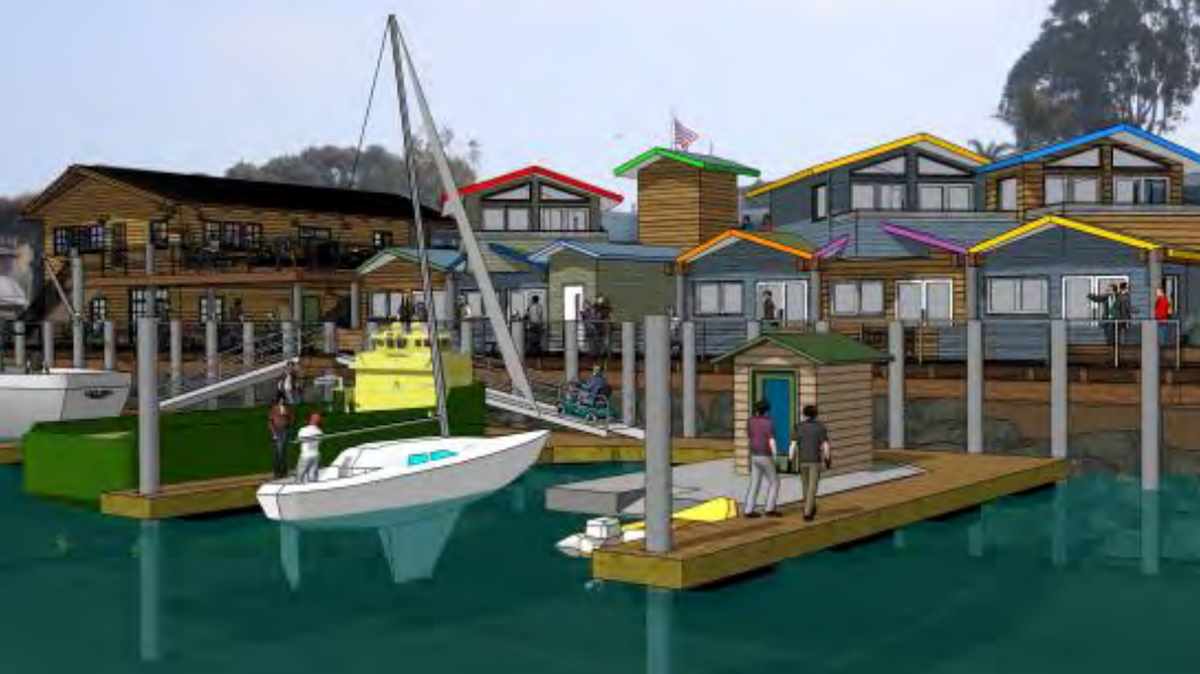
Developer Paul Gillen had a vision: Knock down three cottages on the west end of the Embarcadero and build a two-story hotel with a public viewing deck, space for retail and a park.
The trouble is, that vision would block the view of the bay.
The hotel — proposed by Gillen, owner of the Morro Bay-based marine construction company Associated Pacific Constructors Inc. — would have exceeded the city’s building height limit, and opponents thought Gillen didn’t offer enough community benefits in the project to justify its height.
On Tuesday night, the Morro Bay Planning Commission agreed with those concerns, voting 4-1 to deny a conditional use permit for the development.
“There are not adequate community benefits,” commissioner Joe Ingraffia said. “We can’t approve the project.”
But the project isn’t dead in the water just yet: Gillen said he plans to appeal the decision to the Morro Bay City Council.
“I was very disappointed,” Gillen told The Tribune after the meeting. “I will be the exception if they don’t approve a two-story hotel on the west side (of the Embarcadero).”
Planning Commission, developer couldn’t agree on best design
The property, currently known as Bayside Landing, includes an almost 25-foot-tall office building and three wooden cottages trimmed with teal and magenta paint, Morro Bay planning manager Kim Fowler said.
The cottages were built in the 1950s and later acquired by the late local businessman and craftsman Reggie Whibley. Some people consider the houses a piece of local history. The cottages are now used as vacation rentals, while Associated Pacific Constructors operates out of the neighboring office building.
Gillen originally proposed to renovate the office building, demolish the cottages and build a 24-foot-tall, two story building in their place that would include eight vacation rental units, Fowler said.
The new building would exceed the city’s 17-foot height limit, which meant the Planning Commission could only approve the development if Gillen offered community benefits in his project.
Gillen planned to build a public viewing deck on the second floor of the building, a public restroom, a dock with room for a kayak rental business and a pocket park with a bike rack and benches. City staff considered these amenities to be adequate community benefits to justify the height of the building, Fowler said.
The Planning Commission, however, was concerned about the loss of the cottages and the height of the new building.
At an Oct. 29 meeting, the Planning Commission formed a subcommittee of commissioners Eric Meyer and Bill Roschen to work with Gillen to create a new project design that would address these concerns.
Roschen asked the developer to move one of the second-floor units to the first floor, leaving two units on the top of the hotel and six on the bottom. This would have shortened the second story of the building and opened up some of the view, Roschen said at Tuesday’s meeting.
The commissioners also asked Gillen to replicate one of Reggie’s cottages on the property, too.
“We don’t want to redesign the project, but I think looking at alternatives to get a better project for the community is a reasonable ask,” Roschen said.
Gillen offered to build a 489-square-foot retail building in the style of Reggie’s cottages beside the hotel to preserve local history. He did not, however, change the layout of the hotel. Roschen’s design would have required him to shrink the size of the lower units of the hotel, which was not feasible, Gillen said.
“It wasn’t really an option if they wanted Reggie’s cottage and to remove one of the hotel rooms to the lower floor,” Gillen said.
Commissioner Joseph Ingraffia said the additions just weren’t enough.
Ingraffia said he appreciated the park and public restroom offered by the development, but he noted that parks and restrooms are available elsewhere nearby.
He did not consider the dock a public benefit, as it would only be accessible to people who could afford a boat, and he did not think Gillen’s offer to build a retail space designed after Reggie’s cottages was strong enough — as the proposed design did not replicate the cottage.
“Community benefits have to be commensurate with what we’re sacrificing,” he said. “The community benefits may be getting close to the tilting point, but they’re not there yet.”
Gillen, however, noted that the community benefits he included would cost more than $300,000 to build.
“We certainly believe we offered quite a bit,” he said. “We went above and beyond.”
Gillen said he’s willing to work with the City Council on the design in order to see the project approved — as long as the costs are reasonable.
“It’s a very expensive project, being most of it is over the water as opposed to on land,” he said. “Any changes that are made to it will be a pretty significant financial impact.”
This story was originally published November 20, 2024 at 3:08 PM.
CORRECTION: A previous version of this story incorrectly stated when the cottages were built and acquired by Reggie Whibley. The cottages were built during the 1950s, and they were later acquired by Whibley.