SLO County offered landowner $200,000 for Bob Jones Trail parcel he won’t sell. What’s next?
The effort to connect the Bob Jones Trail from San Luis Obispo to the sea has been held up for years by five property owners who refused to sell their land along the proposed pathway, but one landowner in particular has been at the center of the county’s land acquisition efforts.
Ray Bunnell — despite an offer of over $200,000 — has refused to sell the sliver of his land the county says is needed to complete the project, according to county documents released to The Tribune in a Public Records Act request.
In a last ditch effort to save the popular public works project, another option to build the Bob Jones Trail was set to go before the San Luis Obispo County Board of Supervisors on Tuesday.
County staff designed a new trail alignment that would avoid Bunnell’s property and instead stretch along Highway 101. On Tuesday, the board was expected to vote on whether or not to pursue this option.
The original project would permanently use just more than 1 acre on the corner of Bunnell’s approximately 146-acre property located next to Highway 101 and San Luis Obispo Creek, but he has staunchly refused to sell it to the county.
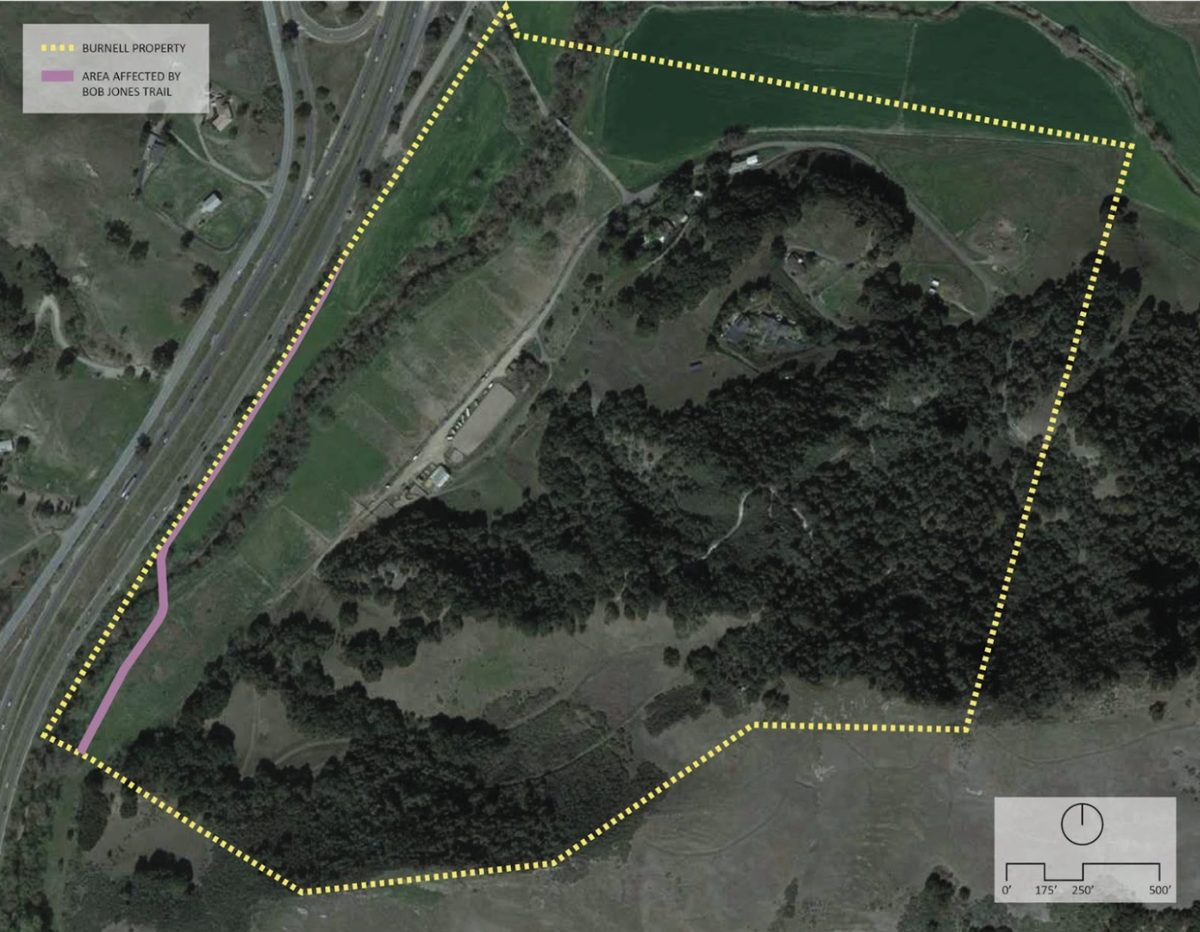
Court documents show that the county already paid Bunnell $20,000 in 2022 — but that was only for one-time, limited access to his property for geological surveying over a month-long period.
That access payment alone is more than what several other landowners received for a purchase of permanent access to place the trail on their property, the documents showed.
The county even at one time discussed exchanging another small piece of land for the desired corner of Bunell’s property, but the idea never materialized, according to Bunnell’s lawyer Edwin Rambuski.
“I am not opposed to the trail,” Bunnell wrote in a letter to the board on Aug. 15. “I think this is a great idea that Mr. Jones had. However, things have changed drastically since that vision began.”
Primarily, Bunnell and his lawyer do not feel the county has engaged in negotiations in good faith.
“To a large extent, the county chooses not to engage and not negotiate,” Rambuski told The Tribune. He said the county has showed “no willingness to share information or share documents” and had “very, very delayed response to any settlement negotiations.”
However, county representatives feel differently.
“I don’t think it’s fair for (Rambuski) to say that we haven’t been responsive,” Todd Amspoker, outside counsel to the county on the Bob Jones negotiations, told The Tribune. “We give (Rambuski) everything he’s asked for.”
Now, negotiations have stalled, forcing the county to switch gears to a new design in order to save its $18 million grant before a March expiration date.
$200,000 was not enough for easement on Bunnell’s property, lawyer says
On June 7, 2023, the county offered Bunnell $207,500 in exchange for easements on his property — but Bunnell still declined to sell, county documents obtained by The Tribune showed.
This amounted to nearly half of the combined payments made to the seven other property owners, which totaled $458,300, and was second only to the more than $300,000 payment made to the Land Conservancy of San Luis Obispo County.
But Rambuski said it simply was still not enough.
“$200,000 out of an $18 million budget for the amount of impact on his property is not within the realm of reason,” Rambuski said. “It wasn’t realistic, and it wasn’t close to even causing Mr. Bunnell to engage in monetary discussions.”
Ramubski said with the amount of money available to the county and its strong motivation to build the trail, he was surprised that it made “such low offers” to all property owners, including Bunnell.
“It really does not compensate the property owners for all of the impacts,” Rambuski said.
The $200,000 offer was based on an outside appraisal made by Todd Murphy.
BEHIND THE STORY
MOREHow we reported this story
San Luis Obispo County has been working for years to complete the Bob Jones Trail, giving cyclists and pedestrians a safe route from the city to the sea. But the process has been repeatedly stymied by the county’s inability to convince some holdout property owners from negotiating access. The Tribune filed an expansive Public Records Act request to see what exactly happened with those negotiations and get a behind-the-scenes look into the process.
Why did The Tribune report this story
The county was at risk of losing an $18 million from the California Transportation Commission if the project was not completed, and there was strong public support for expanding the Bob Jones Trail. Tribune reporters Stephanie Zappelli and Chloe Shrager pursued this story to investigate why the county had not yet been able to acquire the needed land to complete the Bob Jones Trail expansion —even with strong public support and a large grant.
What documents did The Tribune receive and what did they show?
Shrager and Zappelli reviewed more than 3,880 pages of documents from the county, including email correspondence between the property owners and the county, appraisals of the land value, notes from the county’s negotiations with the property owners, the county’s offers to the property owners, signed easement agreements and signed cattle trail access rights modification agreements. The documents showed the timeline and nature of negotiations — as well as the wide disparity in amounts offered to the different landowners. The documents lift the veil on what had been a sparsely reported process over the last two years as the county struggles to fill in the puzzle pieces to complete the trail.
Rambuski and Amspoker both confirmed that the appraisal was made off-site, as Bunnell did not allow Murphy onto his property to make an in-person evaluation.
Rambuski characterized the county’s offer as more of a “threat.”
“From the county’s perspective, it was always in the context of, either take our low monetary offer, and you get these little changes to the trail, or if you don’t, then there was a threat, then we’re going to make the trail to have the highest impact it can on your property,” Rambuski said of the negotiations.
Amspoker, however, said that was not the case.
“That’s not fair, and that’s not accurate,” Amspoker said.
The offer contract stated “the county is willing to negotiate the terms of this transaction if your client is so inclined, both on price and various construction details that may be pertinent.”
Amposker said the offer included detailed information from the appraisal and reaffirmed the county was “happy” to come to the table at any time to hear Bunnell’s reaction, contestations or a counter offer but that it’s “never received anything.”
Rambuski confirmed there was never an official counter offer made, but there was some general talk around Bunnell’s criteria.
In a December 2023 email exchange, Rambuski wrote that he would consider making a “one-time offer with no negotiation and no justification for supporting appraisals from our side,” Amspoker said.
The county’s $200,000 deal also offered up to $5,000 for Bunnell to hire someone to make his own independent appraisal of the property value, so that he could accept the county’s suggestion or make a counter offer, but Amspoker said the property owner never opted to use the appraisal budget.
“You can’t just say a number with no negotiation and no appraisal,” Amspoker said. “It doesn’t work that way if you’re a public agency. You can’t just pay somebody what they want without some basis for doing it, because it’s public money and you can’t make a gift of public funds.”
That was not the only time payment was offered to Bunnell.
In 2022, the county petitioned Bunnell in court for access to his property to conduct geological surveys to support the county’s original trail design.
Bunnell settled, and the county paid him $20,000 for limited access to his property for a period of one month in April 2022.
This one-time entry fee was on-par with the payments made to other property owners for indefinite access to their land and the rights to build the path there.
The county paid Dr. Sarjit and Rupinder Malli $29,000 for perpetual access and a construction easement on their Octagon Way property, and the Colorado-based corporation Hobson Ranch Inc. granted access rights to the county for $18,600. Robert Kruse outright sold his cattle trail access rights to the county for $25,000.
But other landowners did not receive nearly as much. Christopher Goodman sold access rights on his land to the county for a total of $10,900, Steven Brett Whitaker sold for $1,500 and Ronald Rinell, who owns land on South Higuera Street, sold a temporary construction easement to the county for merely $500.
Many other points of negotiation were discussed with Bunnell over the years, such as adding in security fencing on his property or moving the alignment of the trail entirely to meet his satisfaction.
First proposed in 2008 by Bunnell, the county also discussed trading him a piece of land equivalent in size leading into his property on Clover Ridge Lane as recently as July, according to a county Public Works email.
Ultimately, however, Bunnell’s position has been consistent for the last 16 years: that he is against selling an easement to the county, Rambuski said.
.jpg "Image from iOS (29).jpg")
Property owner was originally open to negotiating trail on his land. What happened?
According to his lawyer, Bunnell has never been opposed to the construction of a bike lane, and when negotiations began 16 years ago, he was cooperative with the county and open to discussions.
At that point, Bunnell was frequently communicating with county planner Jan DiLeo.
In a series of letters from 2007 and 2008 obtained by The Tribune, Bunnell and DiLeo engaged over a number of requests by the landowner regarding the trail.
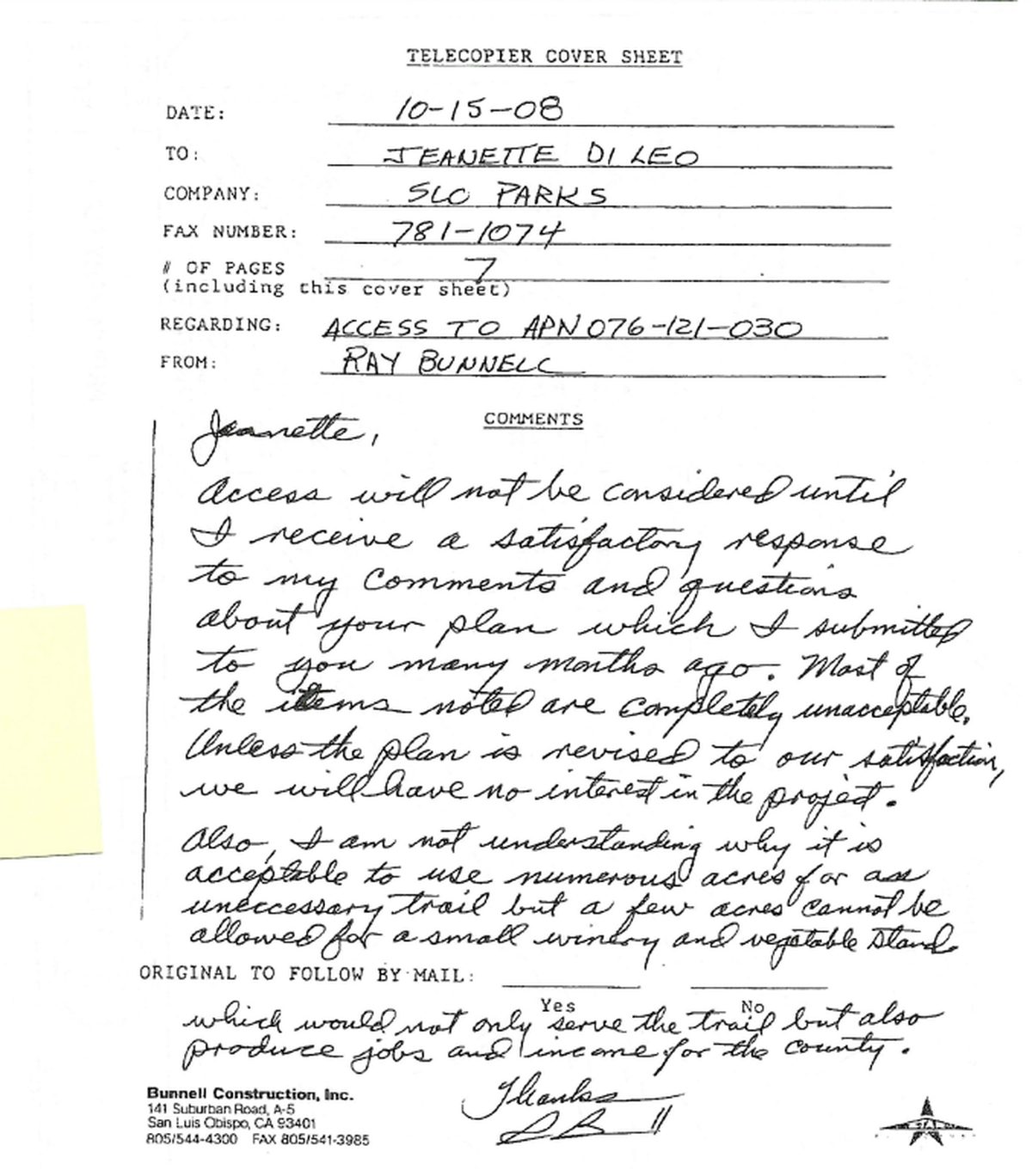
Bunnell asked the county to move the trail off of Clover Ridge Lane, build fencing between the trail and his property, clear the creek annually to prevent flooding and allow him to build a wine-tasting facility, a small winery and a vegetable stand near the trail, according to a Feb. 9, 2007, report.
On May 2, 2008, DiLeo said the wine-tasting facility, small winery and vegetable stand “are possible as long as they conform to the county’s plans.”
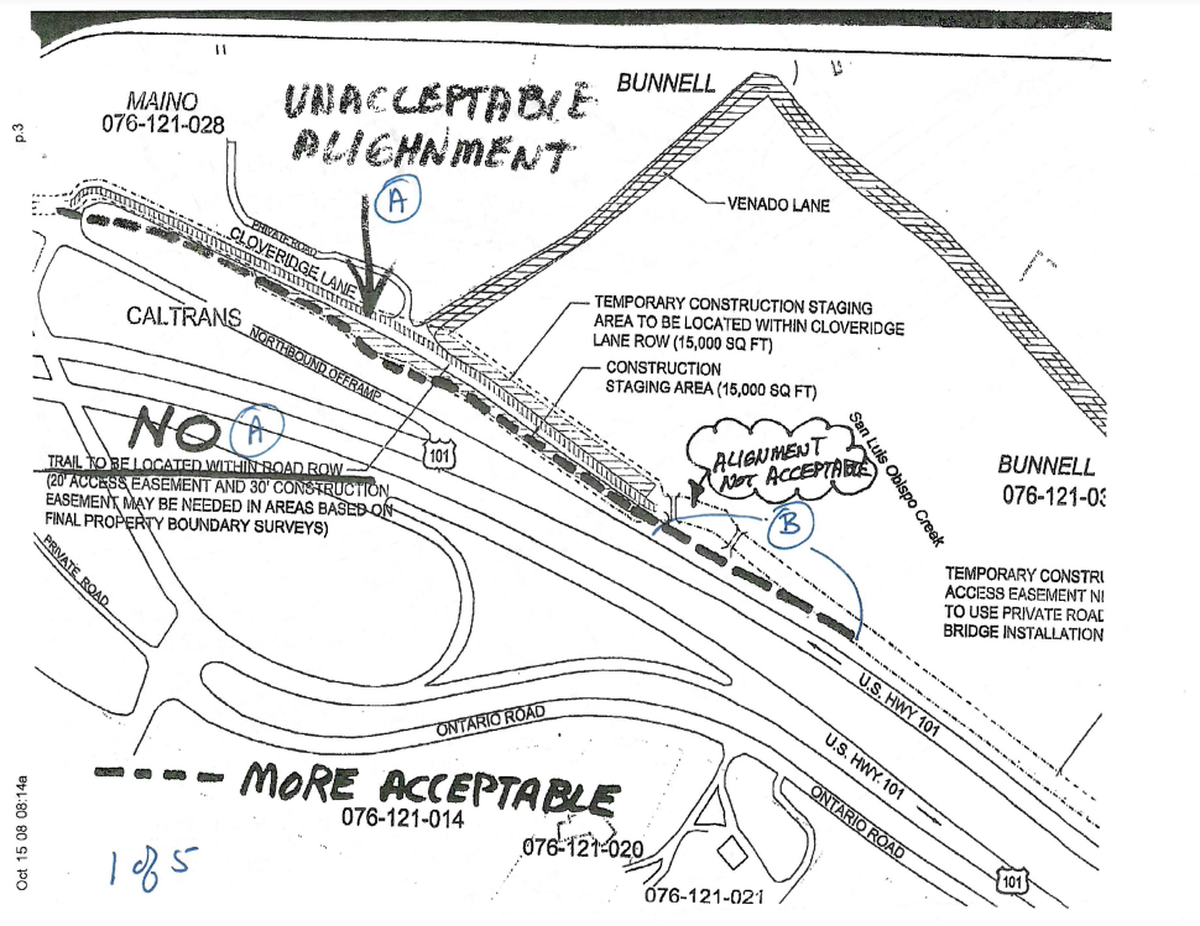
Over the following months, Bunnell provided comments on the proposed alignment of the trail, noting an “unacceptable alignment” over Clover Ridge Lane and writing “access is not granted!” on a fax from the county requesting permission to enter his property for environmental studies.
On that same day, Bunnell faxed a hand-written letter to DiLeo, asking for answers to his questions about the project.
“Unless the plan is revised to our satisfaction, we will have no interest in it,” Bunnell wrote. “Also, I am not understanding why it is acceptable to use numerous acres for an unnecessary trail but a few acres cannot be allowed for a small winery and vegetable stand, which would not only serve the trail but also produce jobs and income for the county.”
Bunnell eventually granted the county permission to enter his property to complete the studies on Nov. 6, 2008.
“This authorization does not mean that the property owner will allow a creek crossing and/or a bike path,” a signed document read.
DeLio declined to comment when contacted by The Tribune.
Negotiations seemed to stall for many years after Bunnell’s early discussions with DiLeo, and at some point “fairly recently,” Rambuski said it became clear that “in the big picture, the county’s only goal and motivation was to condemn property.”
Now, the option of building the path through Bunnell’s property “is not on the table any longer,” Rambuski said.
In 2023, the county considered another alignment that moved part of the pathway onto Ontario Road on the other side of Highway 101. The California Transportation Commission rejected this option because it did not have enough safety features.
Bunnell fully supported that alignment, as he wrote in his Aug. 15 letter to the county, and probably would have even contributed financially, Rambuski said.
But ultimately, they were “not convinced that was a good-faith effort by the county,” Rambuski said.
Rambuski felt the county did not do a thorough evaluation of the proposed alignment because they only looked at putting a Class II bike line on Ontario Road, not a Class I like was originally planned for the Bob Jones Trail. A Class II is an on-road bike line, while a Class I designates its own separate, off-road corridor.
In order for the county to keep the grant, the California Transportation Commission requires the Bob Jones Trail be a Class I bike lane all the way through.
“It seemed to be a very, very low effort, and the purpose to us was clear,” Rambuski said, noting the county would then be able to claim that it exhausted all options and must now resort to eminent domain.
County counsel Jon Ansolabehere said the alignment simply wasn’t a viable option as a Class I bike path, and never was.
“They knew it had problems, but they went, they tried, they got told, ‘No,’” he said. “If it was a viable option, we would have pursued it.”
Rambuski had similar suspicions of the new option coming before the board on Tuesday, mostly due to the county not being forthcoming with details about the new alignment, he said.
He said given confirmation that the path meets Bunnell’s requirements, they could be “behind it 100%” but “it’s just really hard to sort out what we should be doing” without all the information.
Ansolabehere said contrary to Rambuski’s belief, the county has been as forthcoming as possible, but that it simply does not have details to provide yet.
“He’s asking for information that we don’t have right now,” Ansolabehere said. “We don’t have a design, we don’t have engineering, we don’t have environmental on that. We kind of have to start from scratch.”
New approach to the trail design
At the eleventh hour, the county drew up a new plan that just might save the project.
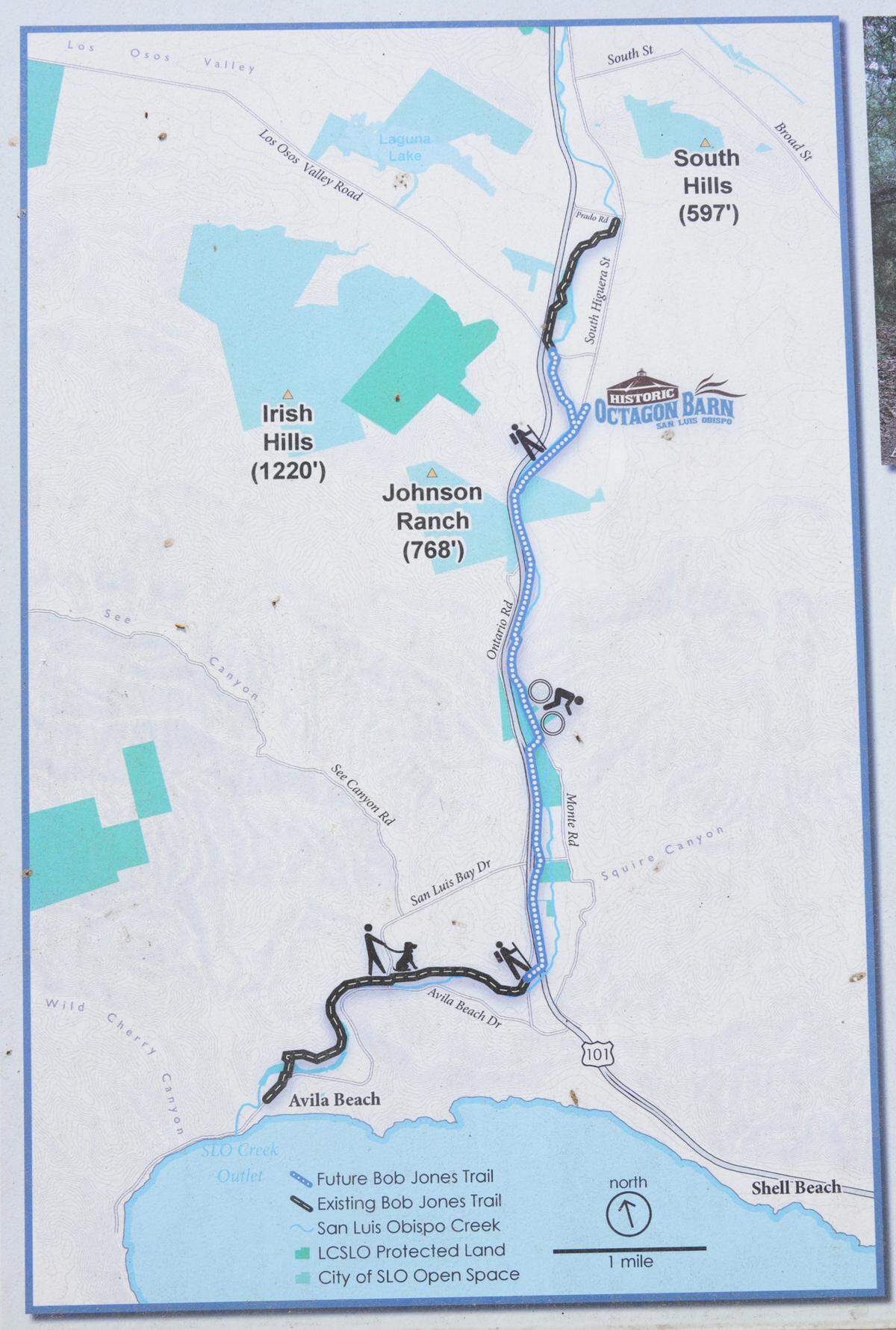
The county designed a “bookend approach,” which divides the trail to avoid the Bunnell property — with the goal of filling in the gap if the county eventually acquires the easement. It was unclear how this new design would impact the other four property owners who have not yet agreed to sell.
The county would build the trail from the Octagon Barn in San Luis Obispo to a potential parking lot at Clover Ridge Lane near Bunnell’s property, county civil engineer John Waddell said.
The second half of the trail would start at the parking lot on Ontario Road and continue on to San Luis Bay Drive, he said.
“This is our last chance with this grant funding,” Waddell said.
The county will use the $18.2 million grant to fund construction of the bookends, while Caltrans pledged to use $6 million of discretionary State Highway Operation and Protection Program funds to fill in the gap in the trail along Highway 101.
From Clover Ridge Lane to Ontario Road, the trail would be built 10 to 12 feet away from Highway 101 — similar to a bike path connecting Rincon Point to Mussel Shoals in Santa Barbara County, Waddell said.
Caltrans would likely build a protective barrier between the highway and the trail, he said.
“(The trail) will certainly be built to be safe for trail users,” he said.
The county must apply to the California Transportation Commission by Jan. 27 to authorize this new approach to the project, the staff report said.
The county thinks the state will likely approve this design because the trail will remain separate from the highway from San Luis Obispo to Avila Beach with no crossings over high-traffic roads, Waddell said.
“This is a very important project to our region,” he said.
If the board doesn’t pursue this design or it is rejected by the California Transportation Commission, the county may be required to return the $18.2 million grant.
While Bunnell has said he supports the trail being built off of his property, Rambuski said they have similar concerns as with past offers.
“If you read the letter from Caltrans carefully, it almost makes it sound as if this new route on Caltrans’ right-of-way is only going to be pursued if the county cannot take Mr. Bunnell’s property by eminent domain,” Rambuski said.
The letter in question is the project proposal letter submitted by Caltrans district director Scott Eades that states that Caltrans would build and pay for the new alignment avoiding Bunnell’s property if “ultimately needed.”
“Starting in January, there’s a new member of the Board of Supervisors, so we suspect that there’s a chance this offer to use the Caltrans right-of-way is not legitimate, that it’s some pretext for another hidden agenda, and the county intends to retry eminent domain in January, hoping that with the new supervisor, they have four votes,” Rambuski said.
He said that hopefully, this concern is addressed on Tuesday, but as of now, “that’s not what the staff report or the Caltrans letters say.”
In a letter to the county on Monday, Rambuski criticized the county for “misrepresenting” and “villainizing” Bunnell throughout the process.
“Continuing to villainize Ray and Ginger Bunnell, continuing to misrepresent the facts to the public and refusing to engage and negotiate in good faith with the Bunnells will do nothing to move this project forward,” he wrote. “Instead, it will most likely result in the public being denied access to a beneficial project which we all support.”
This story was originally published October 29, 2024 at 5:00 AM.