Who is Ray Bunnell and why won’t he help SLO County finish the Bob Jones Trail?
For over a decade, San Luis Obispo County has been trying to complete the Bob Jones Trail, connecting the path’s existing sections and creating an uninterrupted route from SLO to Avila Beach.
But a lone obstacle has consistently stood in the way.
Rancher and business owner Ray Bunnell owns land along the planned route of the bike path. And for years, he has refused to sell a corner of his parcel to the county to accommodate the trail.
“Mr. Bunnell has been objecting to this trail on his property since at least 2010,” Kristen Renfro, Bunnell’s lawyer, told the SLO County Board of Supervisors at their meeting on Aug. 20.
To at least one person who knows Bunnell, the landowner’s obstinance is not a surprise.
“Ray Bunnell is definitely the most difficult man in the county, if not the state of California,” said Larry Silver, a former neighbor who has since sold his property to the rancher. “He is quick to pick a fight.”
With the exception of Bunnell, the trail project has garnered widespread community support.
And the county has successfully worked with other landowners along the corridor to issue construction and land-use easements, but after years of negotiations with the rancher, Bunnell still won’t budge.
“In my opinion, this project causes minimal harm,” Supervisor Jimmy Paulding said at a SLO County Board of supervisors meeting on Aug. 20, making the case for an eminent domain proceeding on the property. “The public good absolutely outweighs the private harm.”
The board needed four votes to compel the sale, but it failed 3-1 when Supervisor Debbie Arnold broke from the majority. Supervisor John Peschong recused himself and didn’t vote because he had received $1,750 in campaign donations from Bunnell last year, including $500 recently as Sept. 27, 2023.
But Bunnell’s lawyer maintains that her client has been treated unfairly.
“What’s occurred here is that a single private property owner has been made ... to feel a villain,” Renfro said at the meeting. “He doesn’t want to sell his property. He doesn’t have to choose to.”
For his part, Bunnell has been something of a mystery man, choosing to remain quiet publicly even as project planners tried repeatedly to cajole him behind the scenes.
That is, until this week, when Bunnell wrote a letter to the Board of Supervisors ahead of Tuesday’s meeting, where a critical vote was scheduled to decide whether the county should force him to sell the slice of his property.
The letter shared Bunnell’s reasons for withholding the land and offered a glimpse into the thinking of the man who has stalled the Bob Jones Trail project.
The Tribune looked into Bunnell’s history here as part of its Reality Check series.
Who is Ray Bunnell?
Bunnell, 89, was born in Texas and attended Cal Poly, graduating in 1961, according to public records and archived reporting from The Tribune.
He founded Bunnell Construction in the late 1970s and is also associated with the Bunnell Land Co., according to company filings and public records.
Bunnell used to split his time between his Texas residence and SLO County, according to his former neighbor Larry Silver.
He now primarily lives in Texas, according to public records, but he has owned land in the county since the 1990s.
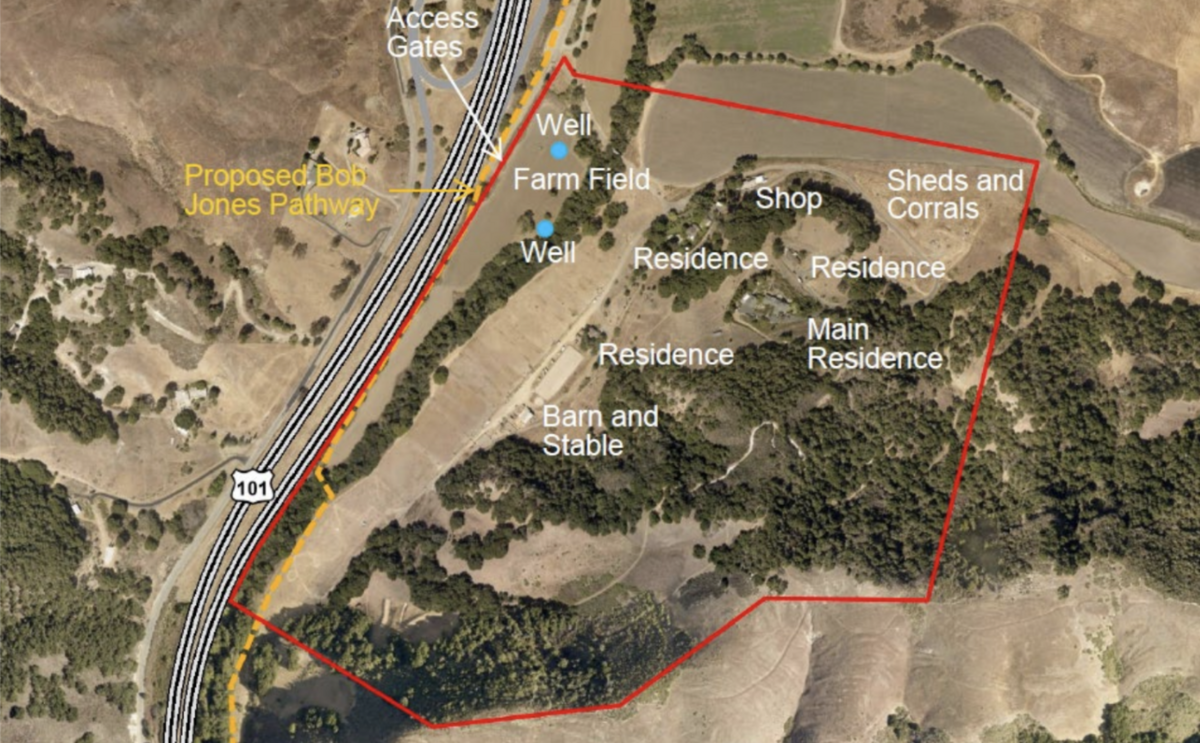
Five residences sit on Bunnell’s land on Paseo de Vaca Drive near the planned trail.
Silver used to live at 5245 Paseo de Vaca. He sold his home to Bunnell around 2018, he said. He now lives near South Lake Tahoe, California.
Silver said Bunnell then gave the home to his grandson, who turned it into an Airbnb.
“He let him do that because he’s his grandson,” but he was otherwise unhappy with it, Silver said.
Silver described Bunnell as “difficult.”
“He on a few occasions exhibited erratic and irrational behavior including chasing one of my personal family guests off the property and onto the freeway for several miles,” Silver said.
For as long as he’d known him, Silver said, Bunnell was always involved in “multiple lawsuits at any given time” and constantly had disputes with his neighbors over land use, including Silver and his wife.
“We attempted mediation with him regarding our dispute, and that was an utter waste of time,” he said. “It was clear to my wife and I that his tactic was going to be to strong-arm us.”
Silver said Bunnell asked him to back his protest of the Bob Jones Trail, but instead, Silver said he supports the project.
Bunnell’s hold-back “doesn’t make any sense,” Silver said. He said the area in question is on a remote corner of the property that isn’t visible from the houses and “is probably only accessible by horseback.”
He thinks Bunnell is wary of the project “bringing commotion” to his property.
The Tribune attempted to reach Bunnell through his company but has not received a response.
Bunnell’s letter explains why he won’t cooperate with the county to help build the Bob Jones Trail
The Aug. 16 letter from Bunnell to the county Board of Supervisors marked a rare direct public comment from the rancher.
Bunnell opened the letter by introducing himself as “The Villain.”
“I am not opposed to the trail,” Bunnell wrote. “I think this is a great idea that Mr. Jones had. However, things have changed drastically since that vision began.”
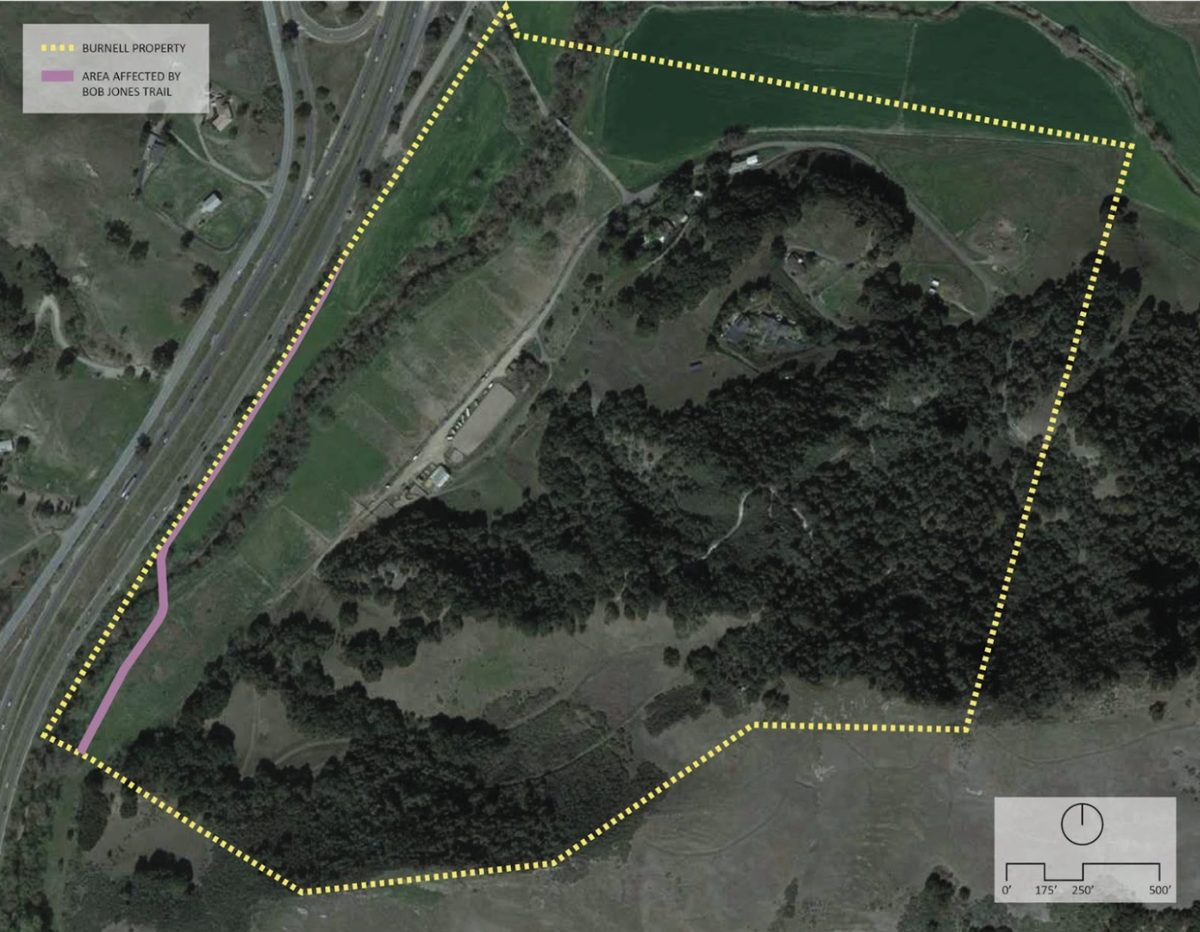
Bunnell’s approximately 146-acre property is made up of five parcels along the east side of Highway 101 near where South Higuera Street crosses under the freeway to meet with Ontario Road.
The proposed Bob Jones pathway would use 1.2 acres on the edge of his land.
“One of the main arguments to move the trail from Ontario Road to the east side of the freeway is to eliminate the danger of being injured by vehicles on the unprotected trail,” he wrote. “However in over 20 years only ONE SERIOUS injury that I am aware of has occurred, which unfortunately ended in death. That is a pretty good safety record for an unprotected trail.”
Bunnell said that placing the trail on the east side of the highway, where his property is located, would put public users in “much greater danger” of serious flooding issues, homeless camps, fire risk, crime, cars coming off the highway and other threats that “are not serious issues on Ontario.”
He did not provide any evidence that these safety concerns are less present on the other side of the freeway.
“Hundreds of thousands of unsuspecting people will be subjected to these hazards, as opposed to an improved route on Ontario,” Bunnell said. “Why would you want to place them on an extremely unsafe trail and why would you want to endanger the property owners and residences?” he asked, referring to residents in Baron Canyon, Bunnell Ranch and others.
He referenced an evaluation made by a third-party consulting firm that denoted the area as “a very high fire hazard severity zone,” and argued that “by placing the trail through this zone, you are drastically increasing the risk of fire going up the hill and wiping out an entire community.”
“A disastrous fire is likely to happen sooner or later by a cigarette, a kid lighting a firecracker, or a homeless person’s campfire,” Bunnell wrote. “Not only are the trail users at risk, but the residents along the trail are at EXTREME RISK, (EXPECIALLY BARON CANYON’S 24 HOMES).”
Despite those arguments, the county’s consulting firm recommended building the Bob Jones Trail through the area to provide a required second emergency evacuation route for residents of Baron Canyon.
But Bunnell was unswayed by that opinion.
“THERE IS NO GOOD REASON TO TAKE THIS RISK WITH THE LIVES OF OUR CITIZENS!” he wrote.
Bunnell said that he spent nearly $10,000 last year to repair a bridge on his property after flooding, adding, “We do not need more bridges in this area!!”
He also noted that he helped build the Octagon Barn, was “directly responsible” for the purchase of Bishop Park by the city for public use, and offered to help design a safe trail on Ontario Road.
“I think it would be dishonest, and possibly illegal, for the county to even vote for taking my property by eminent domain considering all the promises, the General Plan and the (environmental impact report),” Bunnell wrote, referring to policy 3.11 of the Parks and Recreation Element of the county’s General Plan, which says that “eminent domain will not be used for trail establishment.”
But county counsel ruled at the Aug. 20 meeting that the board is authorized to interpret certain planning policies.
“I should not have to hire attorneys and sue the county to keep what you promised,” Bunnell said.
What’s next for the project?
Tuesday’s vote against using eminent domain all but doomed the county’s plan to complete the Bob Jones Trail.
The county previously secured $18.25 million in federal funding to complete the work, but it will only be able to keep the grant if construction begins by March 2025.
Supervisor Bruce Gibson said there was a “maybe 1%, maybe 5%” chance of the project being completed on the current timeline.
Now, unless another option is approved before the rapidly approaching deadline, the completion of the Bob Jones Trail will likely lose its funding, potentially leaving the county with few options for a project that has been years in the making.
The hearing ended with a unanimously approved vote to look for other paths forward.
This story was originally published August 23, 2024 at 10:36 AM.