
Glitch foils SpaceX satellite delivery after launch from Vandenberg

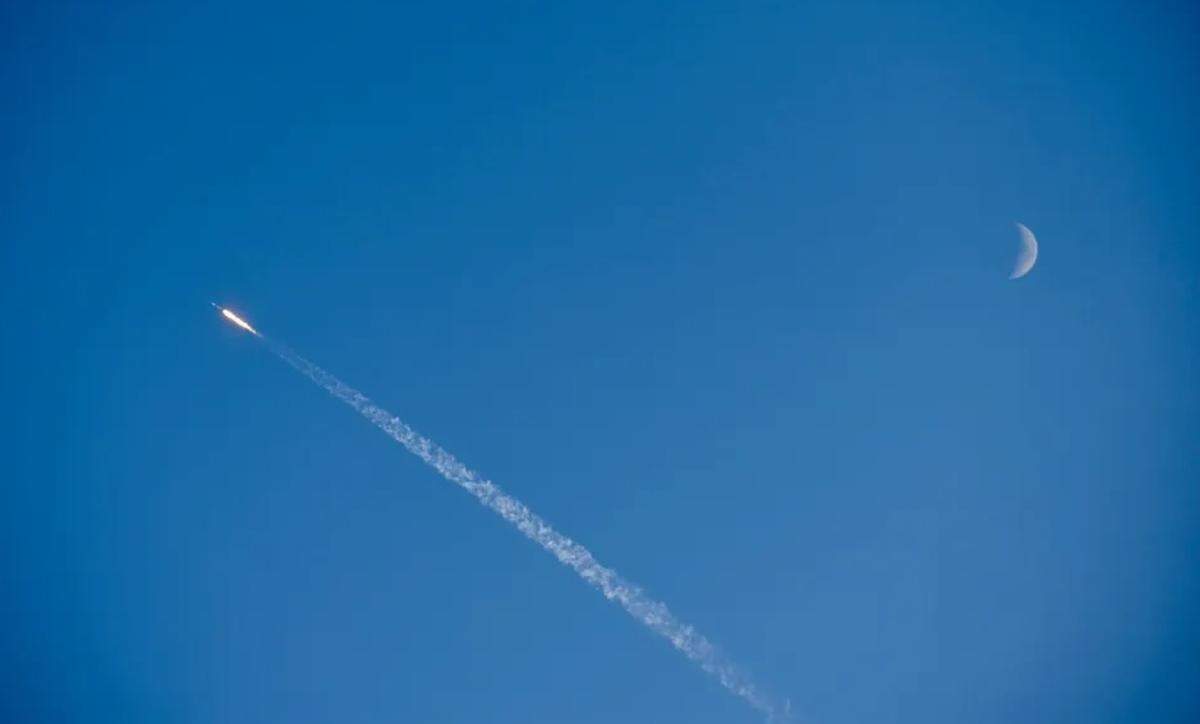
A glitch may have doomed a Falcon 9 rocket mission after it lifted off Thursday night carrying another group of Starlink satellites into orbit from Vandenberg Space Force Base.
The two-stage rocket built by SpaceX blasted off at 7:35 p.m.
Riding inside the rocket’s nose cone, or payload fairing, were the next 20 Starlink satellites, 13 of which have direct-to-cell capabilities.
SpaceX said the satellites were expected to separate from the rocket and arrive in space roughly an hour after liftoff, but the company’s typical confirmation on social media never occurred.
Instead, SpaceX’s Elon Musk said on X (formerly Twitter) that the problem occurred as the rocket’s upper stage restarted to raise perigee, or the point in the orbit when an object is nearest to Earth.
The restart resulted in an engine’s rapid unscheduled disassembly, or RUD, “for reasons currently unknown,” Musk said.
“Team is reviewing data tonight to understand root cause,” Musk added. “Starlink satellites were deployed, but the perigee may be too low for them to raise orbit.”
Later, SpaceX officials noted the second-stage engine failed to complete its second burn, leaving the satellites in a lower-than-intended orbit but ground controllers could communicate with the spacecraft.
“SpaceX has made contact with five of the satellites so far and is attempting to have them raise orbit using their ion thrusters,” the statement said.
The company has another Falcon rocket launch for a Starlink mission planned from Florida and a pair of Norwegian satellites set to launch from Vandenberg in the coming days.
It’s not clear how, or if, those launches will be delayed by Thursday night’s partial failure.
The second stages for Falcon rockets are new for each mission, unlike the first-stage boosters, which are recycled.
The first-stage booster flying Thursday made its 19th flight and successfully landed on the Of Course I Still Love You droneship in the Pacific Ocean near Baja California.
A successful deployment would have meant Starlink had more than 100 satellites in space with direct-to-cell capabilities.
The SpaceX-designed and -built Starlink constellation made up of thousands of satellites provides internet access in remote segments of the world, including where land-based service remains unavailable or unreliable.
Satellites with direct-to-cell capabilities will allow access to data without phone modifications or special apps. However, the Starlink direct-to-cell service will be available only to customers of T-Mobile in the United States since SpaceX has inked deals with certain wireless providers in multiple countries.
The Starlink direct-to-cell satellites reportedly will begin with text service in 2024 and voice and date in 2025.
Thursday night’s mission marked the 70th for SpaceX this year, with 23 of those launches occurring from Vandenberg.
This story was originally published July 12, 2024 at 10:14 AM with the headline "Glitch foils SpaceX satellite delivery after launch from Vandenberg."