SLO County will share some taxes from Dana Reserve with water provider — but not all it wanted
San Luis Obispo County will share some taxes generated by the recently-approved Dana Reserve development with the Nipomo Community Services District — but not all, the county Board of Supervisors begrudgingly decided Tuesday.
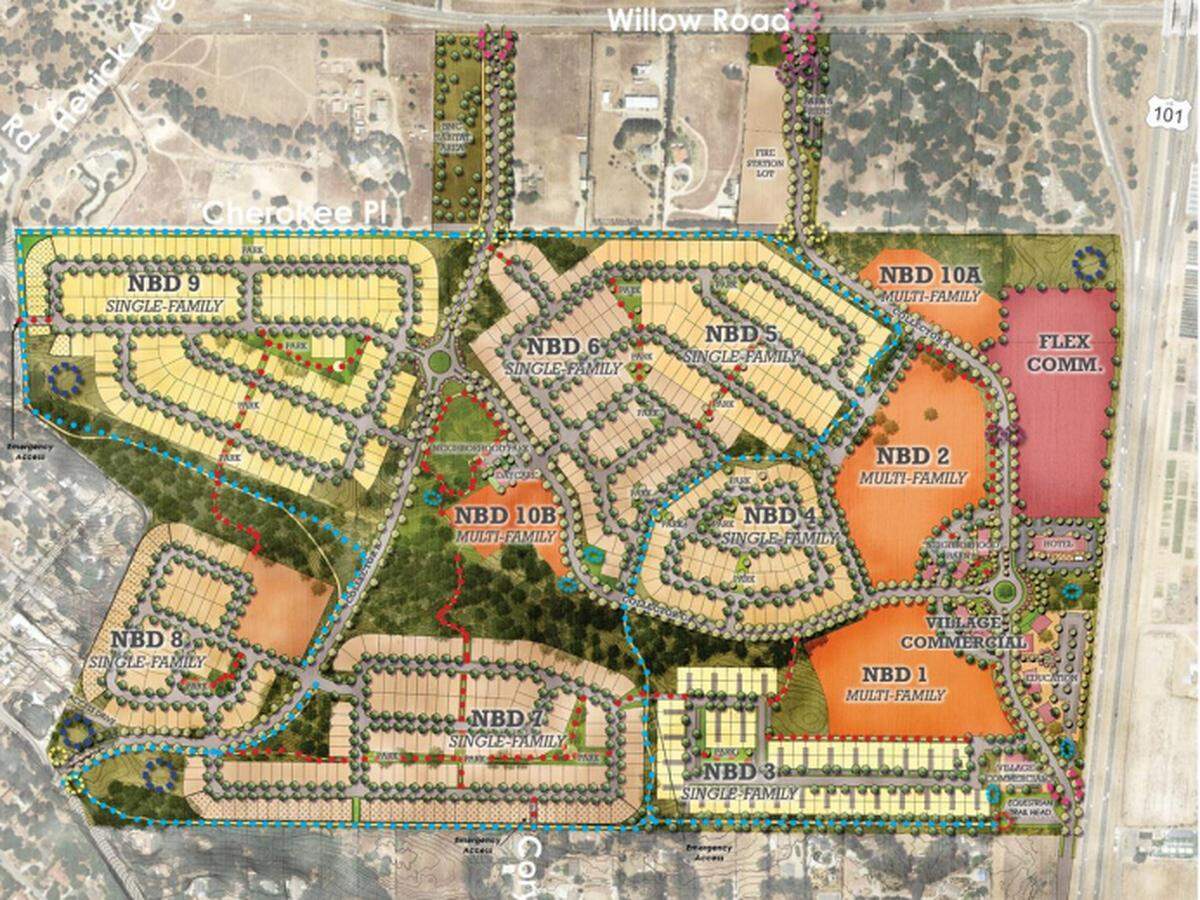
The 288-acre development currently sits on county land. The developer — NKT Commercial, owned by Nick Tompkins — wants the county to annex the property to the Nipomo Community Services District to connect to its water and wastewater services.
However, there’s a hitch: according to county policy, property taxes cannot be used to subsidize special districts such as the Nipomo CSD if doing so would result in a net fiscal loss to the county.
After reaching an impasse at the previous June 18 Board meeting — during which the Nipomo CSD requested it receive a share of property taxes generated by the project — the Board voted 3-2 in favor of sharing incremental tax revenue generated by the project with the Nipomo CSD, but stood firm on not sharing base property tax revenue. Supervisors Jimmy Paulding and Bruce Gibson voted against the motion.
Though this agreement would result in an annual net deficit between $139,707 to $882,618 to the county budget, staff recommended the board waive its policy and accept the financial hit, according to the staff report.
“When we get an opportunity for an agency that’s going to support this significant of a development, I think it requires us to look at this as a long-term investment,” Supervisor Dawn Ortiz-Legg said. “It’s the kind of investment that we needed in this county.”
How will Dana Reserve taxes be divided?
On Tuesday, the supervisors debated the merits of allowing the Nipomo CSD to claim revenue from property taxes.
The controversial 1,470-unit housing project will include homes at varying levels of affordability and density along with space for a grocery store, commercial space, an eventual medical center and land for a fire station.
The Nipomo CSD’s annexation policy was updated in 2023, adding a stipulation that the amount of property tax should be consistent with the property’s historic tax revenue sharing agreements.
Because the county Assessor’s Office data showed that the Dana Reserve project would generate 3.7% more in property taxes, the Nipomo CSD argued it was entitled to that same amount at the previous June 18 board meeting
Depending on the number of residents per household in the development, the county’s General Fund would experience a surplus or deficit by the end of the project buildout.
If Dana Reserve homes in neighborhoods 1-6 are home to an average of 3.16 people and homes in neighborhoods 7-9 are home to an average of 1.9 people, the project would generate a General Fund surplus of around $130,000 per year, documents said.
If an average household size of 3.16 was assumed for all nine neighborhoods, the General Fund would have an annual deficit of around $612,518 each year.
Gibson argued that the Nipomo CSD shouldn’t get any property tax from the development because the county had already removed several financial obstacles.
“We’re already subsidizing the truly affordable side here by foregoing property tax to a nonprofit, by presumably waiving their fees,” Gibson said. “We’re doing our part here, and I get it that the Community Services District and the developer would like us to help them out, but I don’t think we need to in order for this project to be successful.”
Ortiz-Legg, who voted in favor of sharing property taxes, said it was important to remember that few service districts have had to deal with a development of this size at more than 1,400 units, which could cause financial stress.
After some debate, the board approved a resolution that ensured the Nipomo CSD will not receive any base property tax from the county, but will receive annual tax increments from the county starting in the 2025-26 fiscal year at a rate of just under 2.4%.
Tax increments are generated by the growth of the value of the subject property over its base value, collected into a special fund for use by the municipality to make additional investments in the project area.
The Dana Reserve development has an assessed value of almost $7 million.
Water provider worries about groundwater basin with new homes
In South County, water is delivered to customers through meters owned by public bodies such as the Nipomo CSD and private entities such as Golden State Water.
The plot of woodland that will become the Dana Reserve project over the next decade is not in any provider’s jurisdiction, meaning it needs to be annexed into the Nipomo Community Services District to receive water connections.
Currently, Golden State Water is the second-largest water provider in the region, responsible for around 2,500 customers in the Nipomo, Cypress Ridge and mesa areas, Golden State Water Coastal District general manager Mark Zimmer told The Tribune.
Like the Nipomo CSD, Golden State gets its water from the Santa Maria Valley groundwater basin, which extends form Orcutt to Pismo Beach and provides water to northern Santa Barbara County, the Nipomo Mesa management area and the North County management area that includes Los Osos.
The Nipomo CSD and Golden State Water — along with providers Woodlands Mutual Water Company and Rural Water Company — get an additional 650 acre-feet water from the city of Santa Maria via the Nipomo Supplemental Water Project Water Management and Groundwater Replenishment Agreement.
It’s this sharing of the groundwater basin that worries Zimmer in the face of the coming Dana Reserve project; as is, the basin’s resources are “stressed,” requiring infusions of supplemental water to meet demand.
If the NCSD’s demand for water rises by 1,400 homes, that could put pressure on other companies’ ability to serve potential customers.
As it stands, GSW only issues new service connections in Nipomo on a handful of parcels within its jurisdiction that meet certain conservation requirements, Zimmer said.
“We issue will-letters, but that will-serve has letter as a condition derived from the groundwater management and the court stipulation, that all new demand needs to come from a source of water other than groundwater,” Zimmer said.
The Nipomo CSD will vote on the Board’s property tax plan at one of their upcoming meetings, which are held the second and fourth Wednesdays of the month at 9 a.m.
This story was originally published July 11, 2024 at 10:01 AM.