Record strawberry, wine grape crops push SLO County ag value past $1 billion again
The value of San Luis Obispo County agricultural products exceeded $1 billion during 2021 — largely due to the success of strawberries and wine grapes. Livestock and field crops, however, failed to escape the drought and lost value last year.
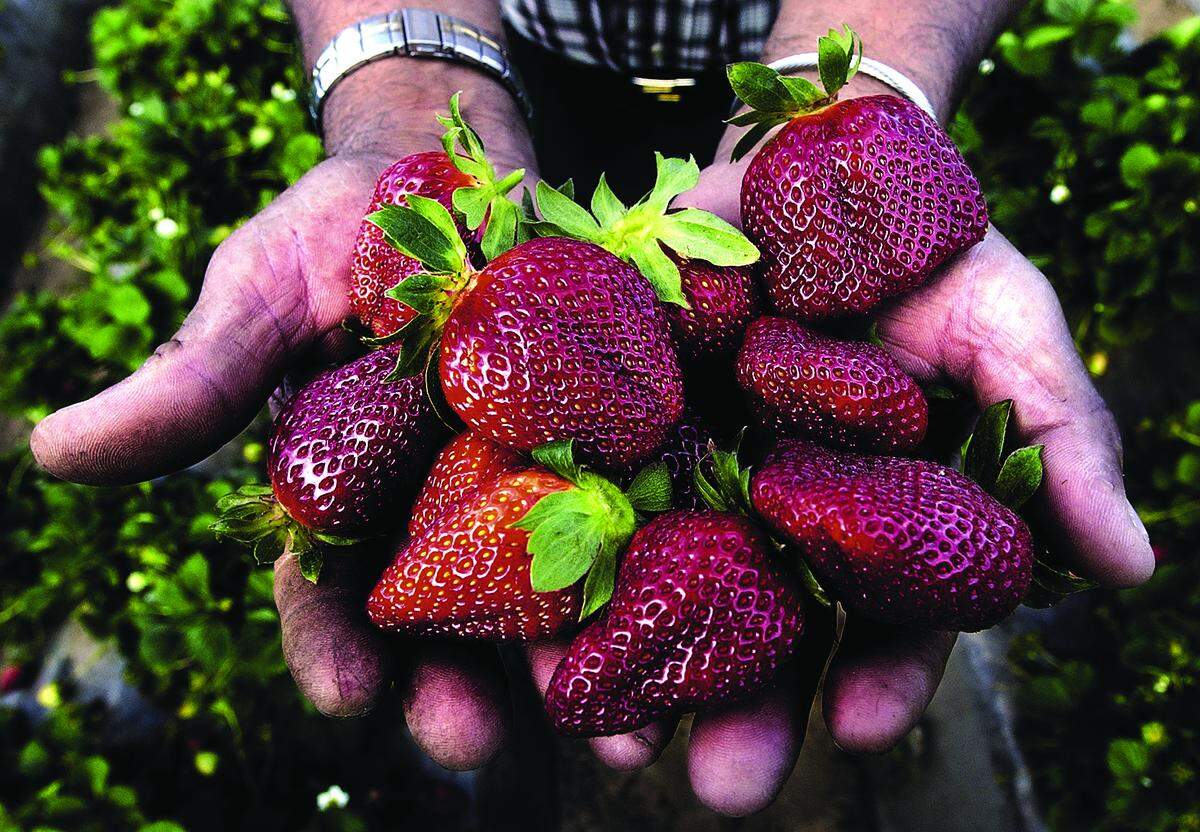
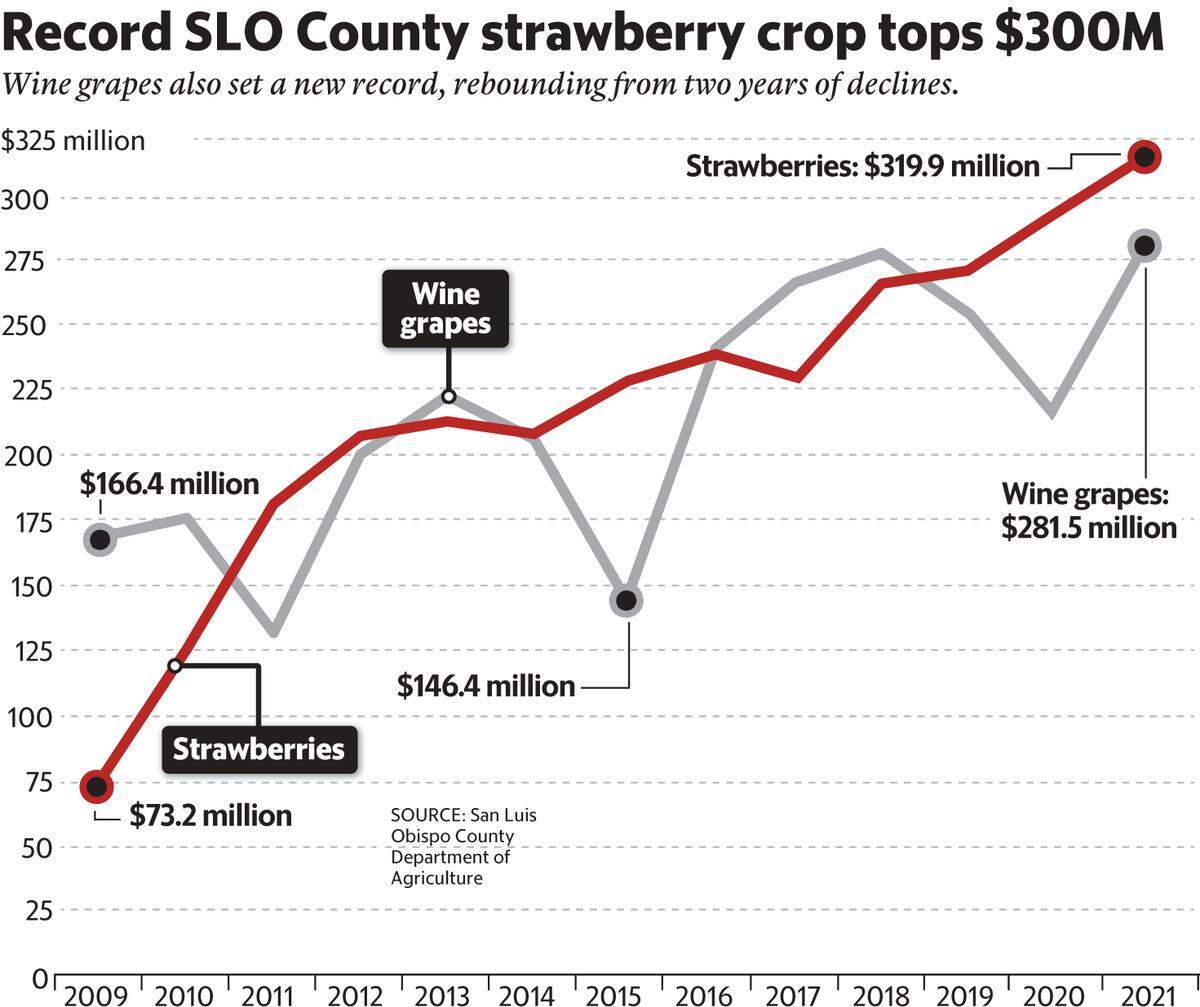
SLO County’s strawberry crop reached a value of $319.9 million, shattering its record and positioning itself as the top crop in 2021, according to the 2021 annual Agricultural Statistics report. This is the first time any individual county crop topped $300 million.
Farmers only planted about 100 more acres in 2021, but the sale price of fresh and processed strawberries increased last year, county agriculture commissioner Martin Settevendemie said.
“That really kicked up the overall value to a record level,” he said.
Wine grapes rebounded from a difficult year with a value of $281.5 million, a 29% increase from 2020. This is the third time in the last decade that grapes bounced back after a low-value year.
Sale prices remained relatively similar for wine grapes in 2021, but farmers harvested 33,000 more tons of grapes than in 2020 — increasing the crop’s overall value, Settevendemie said.
Growing conditions were better for grapes this year, but Settevendemie said he can’t speak to specifics as they vary by vineyard.
“Every grower has their own story,” he said.
As a whole, fruit and nut crops hit a record high of $713.9 million — 18.3% above 2020’s value.
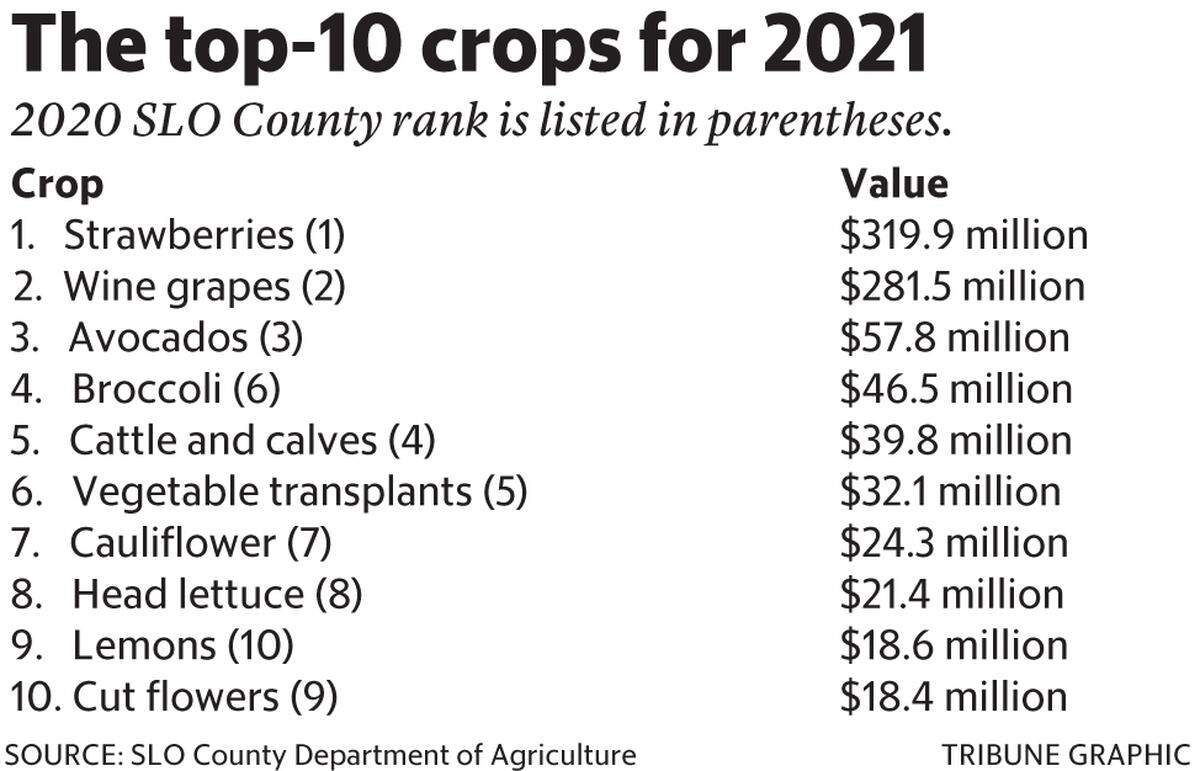
Avocados, broccoli and cattle were the county’s other top five agricultural products in 2021, with values of $57.8 million, $46.5 million and $39.8 million.
The total value of the county’s agricultural products was $1.08 billion in 2021, a 10% increase from 2020, according to the county’s annual crop statistics report.
2021 was only the second time SLO County’s agricultural value passed $1 billion, county documents said. The first time was in 2018, when crops were valued at $1.035 billion.
Not all agricultural products had a record-breaking year, though. The value of nursery crops “remained relatively stable” in 2021 at $76.5 million — a 0.8% increase from 2020, county documents said. Vegetable crops also saw a slight value increase to $233.5 million.
Meanwhile, the value of livestock and field crops decreased due to the drought, county documents said.
Drought conditions impact field crops, livestock
A historic drought in SLO County parched field crops and livestock forage in 2021.
“We’ve never really gotten out of the drought situation,” Settevendemie said, noting that drought conditions have persisted since about 2013.
The value of livestock decreased by 7.3% in 2021 to $43.1 million. Ranchers sold 45,253 head of cattle, a 3.6% decrease from 2020.
Limited rain meant less natural forage could grow, forcing ranchers to buy more supplemental feed or reduce the size of their herd to the carrying capacity of the land — a cheaper and more popular option. That caused ranchers to sell cattle at lower weights in 2021, according to the county.
Field crops, which rely on rainfall rather than irrigation, were stunted by the drought too. The value of field crops declined by 26% in 2021, to $14.9 million.
“Hundreds of acres of field crops were left unharvested,” county documents said.
Much of these field crops are hay and grain, often sold as feed for livestock, Settevendemie said.
If the cost of harvesting the crop exceeds the value of the crop, farmers will either leave their crop in the field or invite cattle to graze it, he said.
“If it’s not cost effective to harvest the crop, they’re not going to expend the resources,” Settevendemie said.
Looking forward, the drought is continuing to impact SLO County agriculture in 2022, especially for dry-farmed crops and livestock. If the drought persists, irrigated crops could also be impacted.
“With the irrigated crops, the salts build up in the water from that irrigation water, and without rainfall, those salts don’t get leached out through the soil,” he said. “They stay at the root zone, and they can have an impact on the quality of the crop.”
Luckily, Settevendemie hasn’t heard farmers complain of their soil’s salt content just yet.
“I think we need to support our local farmers and ranchers by buying their products locally,” Settevendemie said. “They’re producing food not only for our location, our local community, but they’re producing food for the world.”
The Department of Agriculture, Weights and Measures will present the 2021 annual Agricultural Statistics report to the Board of Supervisors on Tuesday morning. People can attend the presentation in person at the County Government Center at 1055 Monterey Street, or watch online at the county’s website.
This story was originally published August 22, 2022 at 1:39 PM.