State awards SLO County $7.6 million to help stabilize Paso Robles groundwater basin
The state announced on Monday that it would provide $7.6 million for five projects to help bring the Paso Robles groundwater basin closer to sustainability so it remains a resource for future generations.
The county of San Luis Obispo will receive the money from the California Department of Water Resources to fund wastewater treatment plant infrastructure expansions, additional groundwater monitoring, engineering studies and other programs, according to a news release by the state agency.
The funding is part of $150 million total awarded to groundwater basins across the state deemed to be in critical overdraft. It helps support 119 individual projects at 20 groundwater basins — 102 of the projects benefit underrepresented or severely disadvantaged communities including Native American tribes, according to the Department of Water Resources.
“Groundwater is a critical lifeline for millions of Californians, and that is especially true during severe droughts like the one we’re experiencing right now,” said Department of Water Resources Director Karla Nemeth in a prepared statement. “We are dealing with the real-time impacts of a warming climate, and we know that less snowpack, precipitation and surface water supply will lead to an increased reliance on groundwater. This first round of grant funding will help strengthen groundwater management, improve the reliability of those supplies statewide and ensure access to safe and clean water for all Californians.”
San Luis Obispo County is currently experiencing “severe” and “extreme” drought conditions, according to the U.S. Drought Monitor. As of the end of April, the Paso Robles region had received 8.7 inches of rain this season (July 1 - June 30) — about 74% of normal precipitation amounts seen by that time of year, according to the National Oceanic and Atmospheric Administration.
During drought periods, the Paso Robles groundwater basin typically sees its storage plummet as the agricultural operations on the basin tend to pump more water to irrigate their crops. In the Paso Robles region, wine grape vineyards are the primary crop. In the past two years, the basin’s water levels dropped a total of 122,300 acre-feet, or nearly 40 million gallons.
Such pumping has been deemed unsustainable for the long-term health of the basin, and therefore San Luis Obispo County alongside the Shandon-San Juan Water District and San Miguel Community Services District — together as the groundwater sustainability agency for the basin — were required by the state to draft a groundwater sustainability plan.
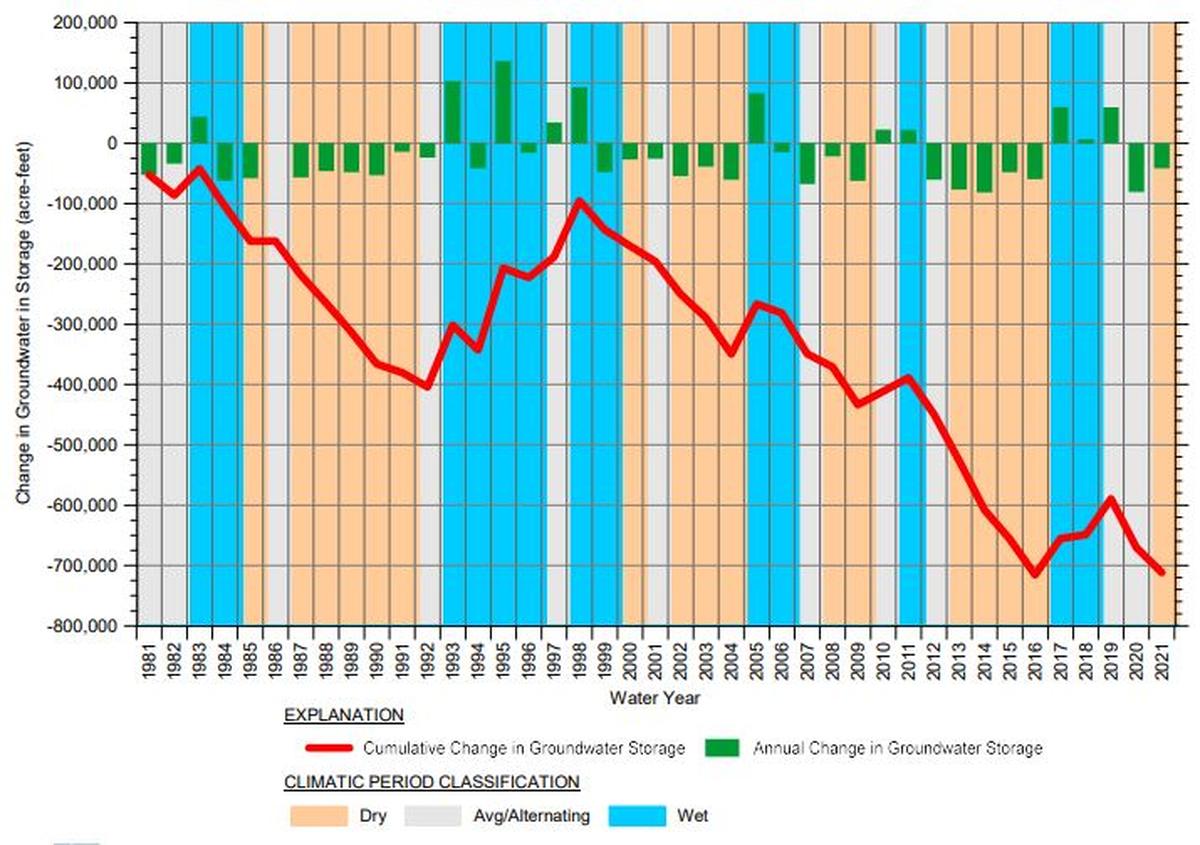
They submitted the plan in early 2020, and the state deemed it incomplete. Now, the agencies are working to fill data gaps and resubmit the plan to the state before July 20.
In the meantime, however, the agencies are still working to implement some of the projects outlined in the plan. So, they applied for funding from the state to aid in the implementation of those projects.
“We’re really excited about this grant money,” said Blaine Reely, the county’s groundwater sustainability director. “We’ve been making some progress on the plan and implementation, but this funding will help jump-start our progress toward sustainability.”
How money will be used to help Paso Robles groundwater basin
The $7.6 million from the state will fund five main projects on the Paso Robles groundwater basin.
A total of $3.5 million will go to build pipelines to deliver up to 4,900 acre-feet of recycled wastewater from the city of Paso Robles’ wastewater treatment plant to irrigate parks, golf courses and vineyards. Any excess wastewater not used for irrigation will be discharged into Huer Huero Creek, which could potentially help recharge the basin, according to the state.
Another $1 million will fund infrastructure for essentially the same purpose at the soon-to-be-upgraded wastewater treatment plant in San Miguel. The state money will go toward a new recycled water pumping station, pipeline and turn-out infrastructure to provide the water delivery, according to the state.
The wastewater used for irrigation will directly offset any water pumped from the groundwater basin, however, vineyards will likely have to blend the recycled water with fresh water to dilute the salt in the recycled water.
Additionally, the county will use $1.4 million of the $7.6 million grant to address data gaps identified by the state in the groundwater sustainability plan. Reely said this includes further assessment on how creeks in the basin may be connected to the groundwater — if found to be connected, then the plan would have to be updated with measures to mitigate impacts to the creeks associated with overpumping of the basin.
Another $800,000 of the state grant will be used for four “high-priority management actions,” according to the state.
First, the funds will go toward the creation of a groundwater well verification and registration program to ensure the agencies are collecting the correct information on how much water is being pumped and from where, as well as to establish an accurate count of how many wells are in the basin.
Second, a reporting and metering program will be established for all “non-de minimis groundwater pumpers” on the basin. These primarily include vineyards, or any groundwater pumpers who extract anything over two acre-feet per year, and means they will have to report their water use annually, which will be a new requirement.
Third, the groundwater sustainability agencies will establish a “drinking well impact mitigation program” to provide protection to drinking water wells primarily those used by rural homeowners from the effects of agricultural pumping.
“Recent experience has demonstrated that some of these wells have experienced several wells going dry,” the county’s spending plan for the grant money says.
And fourth, the $800,000 will fund the development and implementation of a “voluntary multi-benefit land re-purposing program” to incentivize the conversion of water-intensive agricultural land to low-water-use ag land, open or public space, or other uses, the county’s plan says.
Finally, $650,000 of the state’s $7.6 million grant will go toward an engineering study to assess the feasibility of blending water from the city of Paso Robles’ wastewater treatment plant with Nacimiento Lake water. This blended water would be used for irrigating crops, if such use of Nacimiento water is approved by the state.
Another engineering study using the $650,000 will evaluate the potential benefits of increasing the storage of the Salinas Reservoir, also known as Santa Margarita Lake.
The $7.6 million will be used over the next three years, Reely said. In the meantime, the groundwater sustainability agencies will have to find additional methods of funding the other projects proposed in its groundwater sustainability plan — which would likely include a groundwater pumping fee and other state grants, Reely noted.