‘Yahoo! Yippee!’ Businesses cheer news of Hearst Castle’s reopening
As Hearst Castle prepares to reopen May 11 after being closed for more than two years, gleeful entrepreneurs in nearby communities are faced with how they’ll handle the increased business.
The closure due to the pandemic and road repairs hammered area businesses and even those countywide, as tourism either slowed way down, flipped dramatically back and forth, or changed entirely.
“People were here,” Lorienne Schwenk, executive director of the Cambria Chamber of Commerce, said Wednesday about the long closure. “We got lots of visitors, but most of them then were daytrippers from California or closer states,” instead of the bigger influx from across the U.S. and other countries and continents.
“They were here for the outdoors, hiking, the ocean. We were still a traveling resource,” she said, “an attractive outdoor place for people who needed to get away … but not too far.”
When Schwenk learned Thursday about the Castle’s May 11 reopening date, she gave a “Yahoo! Yippee!” cheer, and then went on to say with a laugh, “That’ll change my job,” a position she began in the middle of the pandemic.
“I can’t wait to see what it will be like,” she added, “with more people stopping in with more questions,” along with requests for recommendations about restaurants, motels, shops and even dog-sitters, since pets aren’t allowed at the Castle.
Looking ahead
With continuing difficulties in finding new employees and skyrocketing prices for food and other commodities, the gearing up of individual businesses could be fraught with a combination of excitement, anticipation and, for some, a bit of trepidation.
Miguel de Alba, who with wife Therese de Alba, owns Manta Ray restaurant in San Simeon and Las Cambritas Mexican Restaurant in Cambria, said Thursday by phone that “we’d been hoping for April, but May will work, so we can get ready for summer. But we’ve gotten through two years, so I think we can handle one more month.”
He said that Las Cambritas’ business had held up pretty well during the shutdown, as was the case for many other Cambria shops and restaurants that adapted, rolled with the punches and hung on for the bumpy ride.
Now, de Alba and others are hoping for and bracing for the influx of lots of new business.
“To get ready to open, we’ll have to hire more people” he said. “Once the castle opens, our business at Manta Rey will probably increase by 80 percent at least. That’s what we expect.”
Albert “Buddy” Varreto recently took over his family’s San Simeon inn (formerly the Greentree and later Courtesy Inn), revamped it and renamed it Coast Riders Inn. He said by phone Thursday that he’s excited and upbeat about what’s ahead, as long as pandemic statistics continue to stabilize or fall. He’s already seeing a change in attitude from the visitors. “The people coming in, they’re vibrant again, the doom-and-gloom is going away. Hopefully, we can kick off the season in style.”
Of course, not all businesses impacted by the two-year shutdown, a Big Sur wildfire and a massive storm are stand-alone, mom-and-pop enterprises, and some business owners say they weathered the closures quite well.
Linn’s enterprises in Cambria include two restaurants, gift and other shops and a bustling mail-order and wholesale business.
Those are booming there, according to General Manager Aaron Linn, having weathered the initial shutdown period of only being able to serve take-out food, and later, welcoming diners to the outdoor seating area they set up on their parking lot.
Linn said by text Thursday that the family believes that “Linn’s finds itself to be a destination all its own.” About the Castle reopening, “I’m happiest for the vendors and businesses in San Simeon. (In Cambria). We remain busy, and given the labor situation or shortage, cannot handle peak business all the time anyway.”
That would also seem to be true for some North Coast lodgings. Dirk Winter, owner of the Cambria Pines Lodge and other inns in the coastal community. He replied via email on Thursday that “Our last two years have been the best we have ever had. We do not see any difference in our business with the Castle opened or closed.”
But then there’s Aramark, the major commercial purveyor at Hearst Castle’s Visitor Center, which sells food, clothing, gifts, antiques and more, and was most certainly affected by the closure of the monument.
Maggie Garcia-Nook, Aramark’s district manager of operations at the Castle, said Thursday by email that “Our team is thrilled to support the California State Parks with the reopening of the Hearst Castle this spring to showcase this iconic and historical design masterpiece to thousands of visitors each month.”
She added that “Our team has a thorough process for reopening to include training, restocking of items, ordering supplies, cleaning, etc.” Some team members are returning, Garcia-Nook said, but, as is the case with most other businesses impacted by the Castle shut-down and the pandemic, “we do have some open positions available as well.”
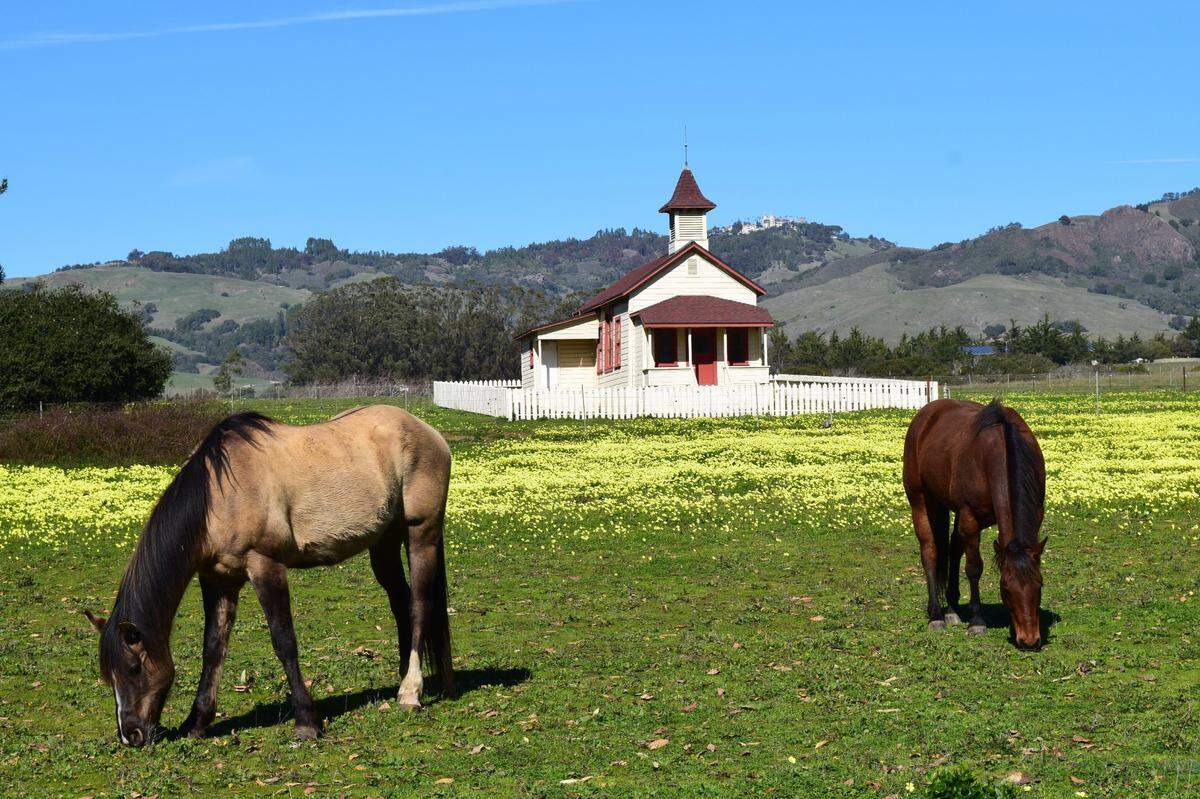
Ben Higgins represents an even larger enterprise, the sprawling 82,000-acre Hearst Ranch that surrounds the Castle, a property that used to include the rambling, hilltop estate of media mogul and art collector William Randolph Hearst. A donation of the compound to the state in 1958 has translated into one of the most popular historic house museums in the world, now a state historical monument.
The Ranch’s director of agricultural operations wrote in an email Thursday that, while “reopening of the hilltop won’t have much impact on day-to-day ranch operations, it’s a welcome indicator we’re returning to normal. And it will be nice to have the bus road open again to our ranch vehicles. This is a critical access corridor not just to Hearst Castle, but also to the inland areas of the San Simeon property.”
Business impacts
For many on the North Coast, entrepreneurs said the news that the tourism landmark would once again greet visitors was long overdue.
The allegory of a mythical pot of gold may not be far from the financial truth for some business owners that cater to visitors.
For area shops, restaurants and services — especially those closest to the Castle — the reopening may literally mean survival.
Most had to shut their doors during the first devastating waves of COVID-19 infections and deaths. Then, when the businesses were able to reopen somewhat, the owners found that employees were hard, if not impossible, to find and keep. Some of the restaurants had to shorten their serving hours and close on certain days of the week.
As some housebound people took to the road for daytrips for mental and physical health, North Coast businesses found ways to serve them.
To take care of those customers as well as possible, fine-dining dinner house restaurants had to quickly master the tricky art of take-out meals. Stores either shut down completely or relied on newly acquired or expanded internet sales options. A few even went old school, setting up tables on sidewalks for open-air shopping.
Even so, during whiplash county and state directives to close up shop, then reopen somewhat, then shut down again, the small, mostly family-owned businesses continued to struggle.
Some didn’t make it.
In San Simeon, the closest community to the Castle where most of the businesses are motels and other lodgings, the hit was especially tough. Restaurants that serve primarily motel guests also reeled from the lack of business.
De Alba said, “The hardest part in San Simeon was trying to juggle the help and trying to keep everything fresh.”
With drastically reduced business during the shutdown, “we had to cut hours down to a minimum staff,” he explained, “with one person in back and one in front on weekdays, and two in each area at night on weekends, when it was busier.”
During the shutdown, the dinner house had evenings with only one customer, and de Alba was working double and triple shifts to keep the doors open, no matter how many people they served each night.
Then when business began to pick up, they were faced with the continuing shortage of potential employees, relying on family to help them keep Manta Rey open.
“In a way,” he said, “it worked out.” With fewer people working, that meant lower labor overhead to maintain.
“We haven’t been searching hard yet” for new staffers, de Alba said, “but now we have to do something about that.”
As is the case for many North Coast entrepreneurs who managed to survive the shutdown, he gives the credit to his employees, family, friends and loyal customers.
Even in busier Cambria, some businesses had a difficult time keeping the doors open during the closures and pandemic, especially small ones, because many people were leery of coming into enclosed places while the pandemic was raging.
On the whole, many restaurants did better than the shops, because the eateries had take-out options and the county’s approval for temporary parklets for outdoor dining. (Most of those parklets are gone now, although some could return with plans that meet the requirements for county approval.)
But again, many made do.
Casa de Oro owner and master jeweler Heather Trimble said she kept busy during the pandemic. “Everybody had to be closed for three months in the beginning, so I took the opportunity to remodel the shop.”
After that, “Luckily, I’m a town-oriented jeweler, and I do repairs and custom design. During COVID, when people were staying at home, they also took the opportunity to be productive. They’d look at all that broken stuff in their jewelry boxes and say, ‘I should get that fixed.”
And besides, “We attracted a lot of people, even during the shutdowns, because everybody wants to get out of the city, and Cambria’s a beautiful place to visit.”
That said, when the Castle reopens, Trimble thinks “it will draw in many more people,” and she plans to be delighted, welcoming and ready.
This story was originally published March 24, 2022 at 1:22 PM.