
SLO photographer recreates panorama of city — from a hilltop that doesn’t exist anymore
An ambitious project to recreate a panoramic photo of San Luis Obispo — mirroring an iconic image taken more than 90 years ago — has been completed and is on display at three building sites around the city.
And it was no easy task, because the hilltop it was taken from doesn’t exist anymore.
Brian Lawler, a photographer and professor emeritus in the Cal Poly graphic communication program, went to great lengths last year to create a modern-day photo from the same location on Terrace Hill overlooking the city as a panoramic shot captured in 1930, calculating the exact spot the first camera was placed and using a lift to reach it.
The project, contributing to the city’s visual history and showing the urban changes over nearly a century, took on a life of its own as Lawler worked to capture the expansive scene as closely as possible to the original.
Where was historic photo of SLO taken from?
The original image is a bird’s-eye view of the city created on a striking, cloudy day by Frank C. Aston — when SLO was far less populated and had fewer trees. Lawler called it “one of the finest photographs ever taken of San Luis Obispo.”
Aston used a large rotating Kodak Circuit camera and a big tripod with a roll of film 10 inches tall and about 6 feet long to produce a 24-foot-long image, Lawler said.
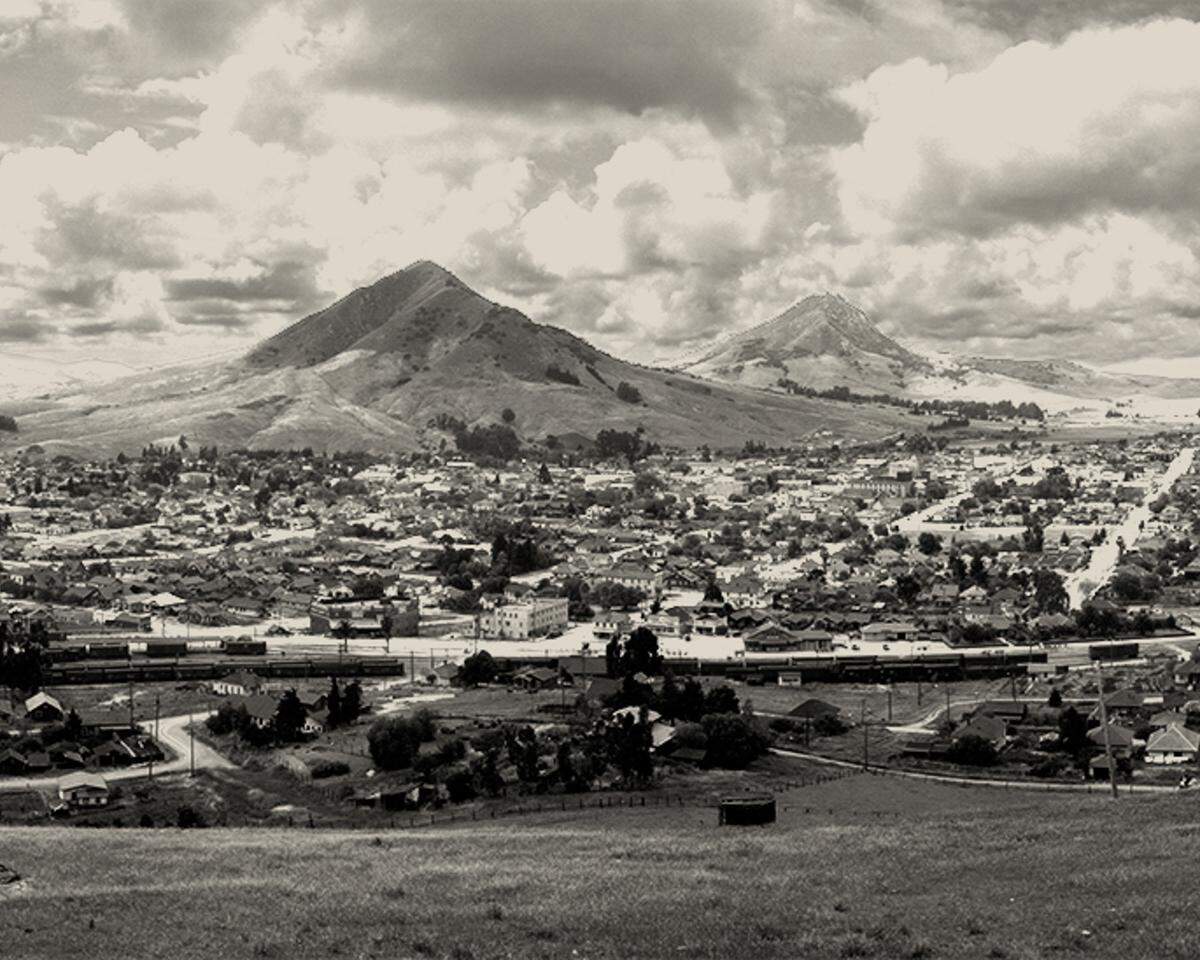
“The 1930 photo is a work of art,” Lawler said. “It was taken on a day when there were big, dramatic clouds over San Luis Obispo. When I put on an exhibition at the SLO Museum of Art in 2014, that Aston photo was my key image, because of its beauty and its vantage point.”
Enamored with Aston’s shot, Lawler concocted a plan to retrace Aston’s steps in the spring of 2021.
But he soon realized an unusual challenge: Reaching the Terrace Hill spot off Rachel and Bishop streets near French Hospital was now impossible — at least by walking there.
The problem? In the 1940s, a mining company removed a large portion of the hilltop to use it as road gravel for Highway 101 at the base of Cuesta Grade. As a result, he was unable to stand where Aston positioned his camera, Lawler said.
“Terrace Hill was ‘terraced’ by 60.5 feet,” Lawler said.
Shooting 60 feet above ground
Undeterred, Lawler used GPS coordinates and a 100-foot tape measure to plot the current surface of Terrace Hill.
Using geometry and drawing from the positioning of landmarks in Aston’s photo along with the technological assistance of a drone, he was able to calculate the height of the peak as it existed in 1930. His son, cinematographer Patrick Lawler, also helped.
Once Lawler pinpointed the location high up in the air, his problem then became how to reach that spot.
After thinking it over, he sought permission from City Manager Derek Johnson to take a man-lift to the point of interest.
Lawler coordinated with Parks and Recreation Director Greg Avakian and Chief Ranger Doug Carscaden to drive the 65-foot hydraulic machine up to the top of the hill.
Lawler then recruited his friend Chris Bahr to operate the man-lift.
Perched above the city and using the big tripod and a device called a Gigapan computerized camera mount, Lawler began his intensive photo session on April 17, 2021.
“There, I went up 60 feet, and took a new ultra-high-resolution panorama of San Luis Obispo,” Lawler said. “I carried a print of the 1930 photo up with us on the lift to check altitude. The easiest way to do that is to compare ridge lines and their intersections.”
His recreation involved using special software to blend together the 1,694 digital images he snapped to create one massive image that “almost exactly matches the photo taken by Frank Aston.”
The process of stitching together photographs to achieve the high-resolution final version took six hours to complete.
He printed the portrait on a 24-foot-long, specially coated sheet of aluminum.
A print of his image is now mounted on the outside of the Crew Wealth Management Building at the corner of Johnson and Monterey streets, right beside Aston’s in a side-by-side comparison “for the pleasure of the people of San Luis Obispo,” Lawler said.
Ten-foot-long prints are also on display inside San Luis Obispo’s City Hall. The law firm Carmel & Naccasha has posted prints that are about 75 inches long.
How SLO has changed
Recently reflecting on the project from Germany, where Lawler currently is teaching abroad, he noted that one difference in the two photos is that the modern portrait was captured on a sunny versus a cloudy day.
As for how SLO itself has changed, Lawler pointed out the presence of more trees added since 1930, recalling a push by former Mayor Ken Schwartz and Linnaea Phillips (former owner of Linnaea’s Cafe), who along with others advocated for more plantings in SLO in the 1960s, 1970s and 1980s, Lawler said.
“The city is a more more lush and green community now than it was in 1930,” Lawler said.
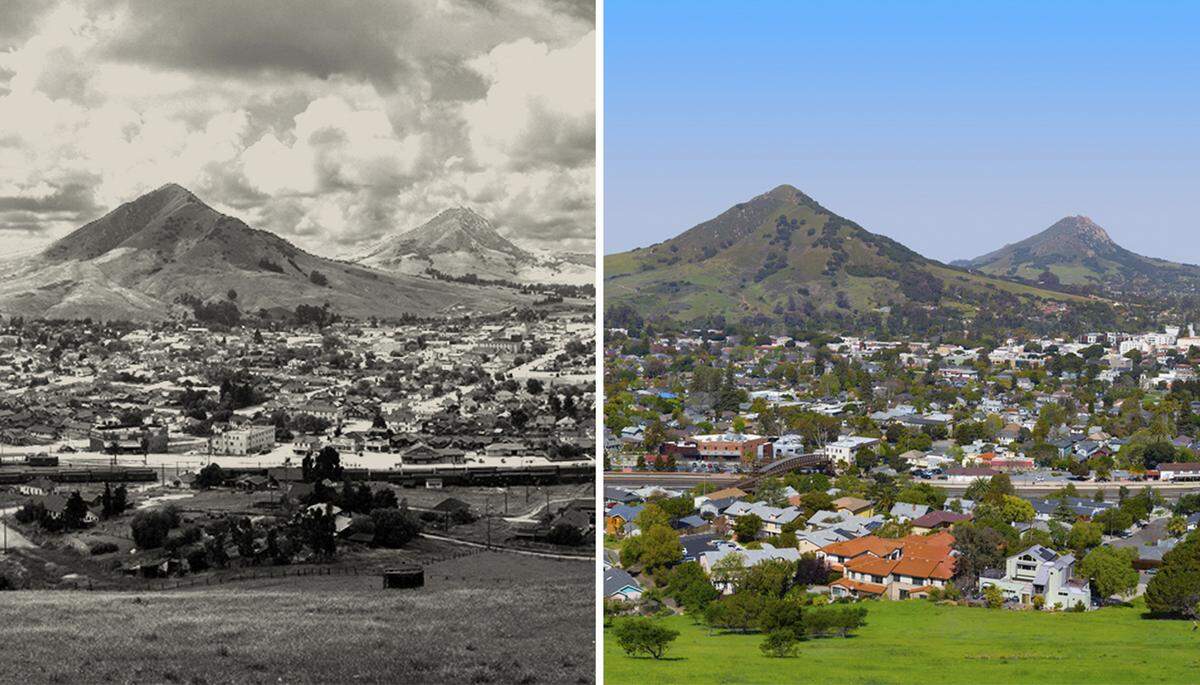
Other distinctions include in-fill on Johnson Avenue and the presence of taller buildings downtown, especially the addition of four-story structures and the parking garages.
Cal Poly’s campus hasn’t visibly changed as much in the images, but “the Performing Arts Center and some of the outlying agriculture buildings are new and prominent,” Lawler said.
“In the 1930 photo there are piles of wheat or grass ready for baling. In the photo in the same spot now is the French Hospital campus,” Lawler said.
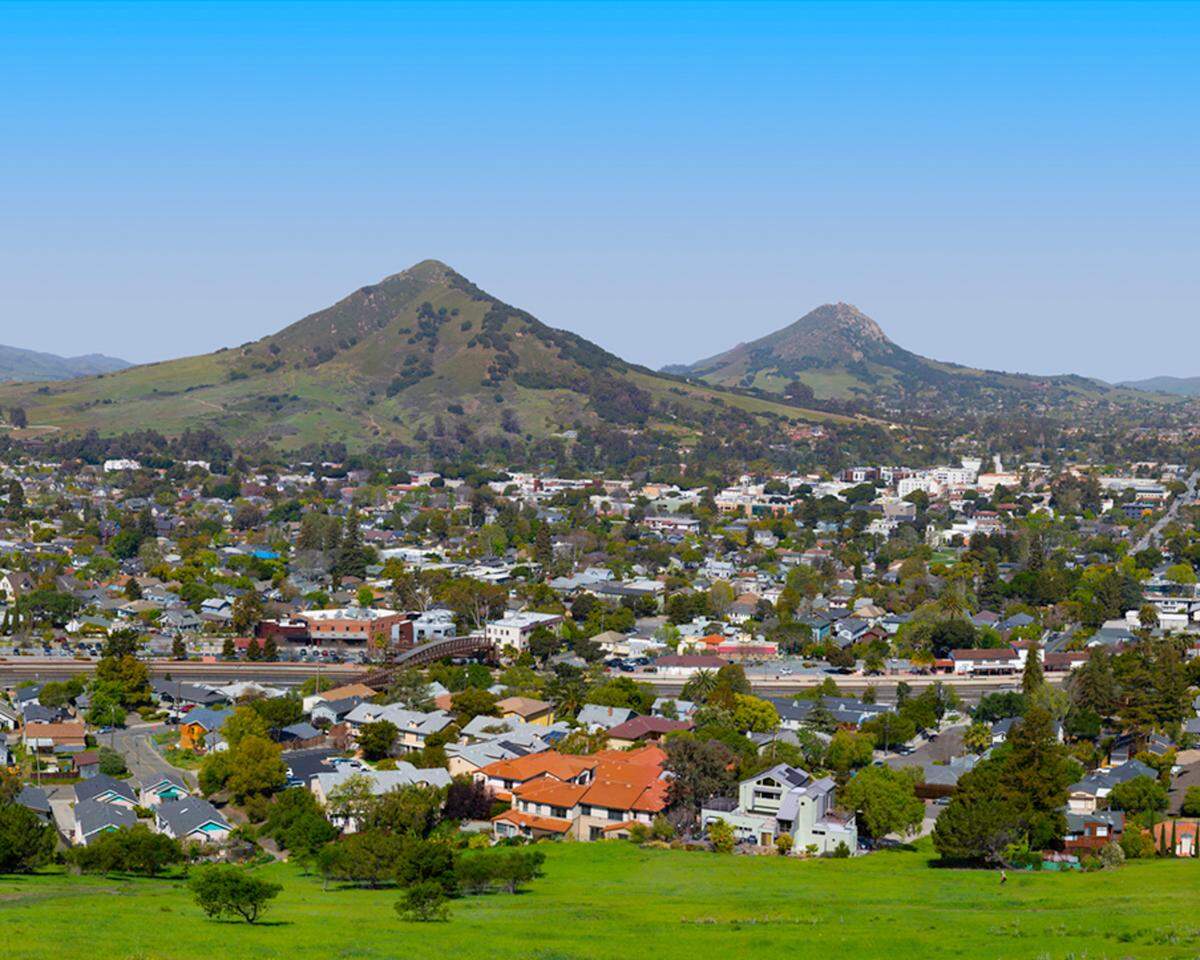
But the mountains that surround SLO are largely the same after nearly a century of city growth and development.
“Both Cerro San Luis Obispo and Bishop Peak are the same now as they were in 1930, with the exception of the hiking trails that you can see in the modern photo,” Lawler said. “In both cases you can see people on top of the mountains.”
Lawler hopes in the future, maybe another 90 years from now, that someone will repeat his project.
“San Luis Obispo is a beautiful city, and I am very proud of this photo,” he said. “I hope that people will take the time to appreciate what a beautiful city we live in.”
.jpg "_D2L0113 (1).jpg")
This story was originally published January 9, 2022 at 5:00 AM.
%20Cropped.jpg)