
SLO water, sewer rates to increase in each of the next 2 years. Here’s how much and why
Water and sewer rates in San Luis Obispo will increase 3.5% in each of the next two fiscal years as part of a move to upgrade older facilities.
The City Council budgeted the hike as part of its two-year financial plan, passed earlier this month, to help support “water resiliency and keep the city’s aging water and sewer infrastructure in good working order.”
The new rates, passed unanimously at the council’s Tuesday meeting, will become effective July 1, 2021, and July 1, 2022, respectively, according to a city news release.
As of Tuesday’s meeting 672 residents submitted protest letters to block the rate increase, short of the 7,198 to meet the threshold of over 50% of community members in opposition. The sewer rate increase was protested by 686 residents, short of the 7,653 needed to block the hike.
The City Council also approved the Utilities Customer Assistance Program to provide a 15% discount to community members in financial need.
In public comment, a community member expressed concern that the new housing developments in progress throughout the city would impact water supply during drought years, including the 580 homes at the San Luis Ranch under development off Madonna Road near Highway 101.
The speaker, who didn’t identify herself on the Zoom meeting, posed a question on whether other strategies could be used to evaluate additional options for water supply “other than constant price increases.”
“Is anybody or any department looking into new strategies of possibly getting any more water here?” she said. “I know we can’t make it rain, obviously, and that’s a big problem. But there are some potential other strategies that maybe should be evaluated.”
SLO officials say city has adequate supply amid drought
But city officials say that water supply and the new rates aren’t connected.
SLO’s utilities director Aaron Floyd said that the city has a conservative approach to water planning that “really looks way beyond all of the current development when we forecast the amount of water we need as a community.” He said the city’s supply is adequate.
SLO has five water sources contributing to its supply, which officials say will ease the impact of drought: Salinas Reservoir, Whale Rock Reservoir, Lake Nacimiento, groundwater and recycled water.
“We look at the maximum amount of water that each of us could use and the maximum number of people that could live in the city by 2035,” Floyd said at the meeting, “and then we apply climate action scenarios to our available multi-water supply to ensure that we have more than enough water with the dire consequences forecasted of climate change in our future to ensure that we still have enough water to meet not only current needs but also those beyond the General Plan.”
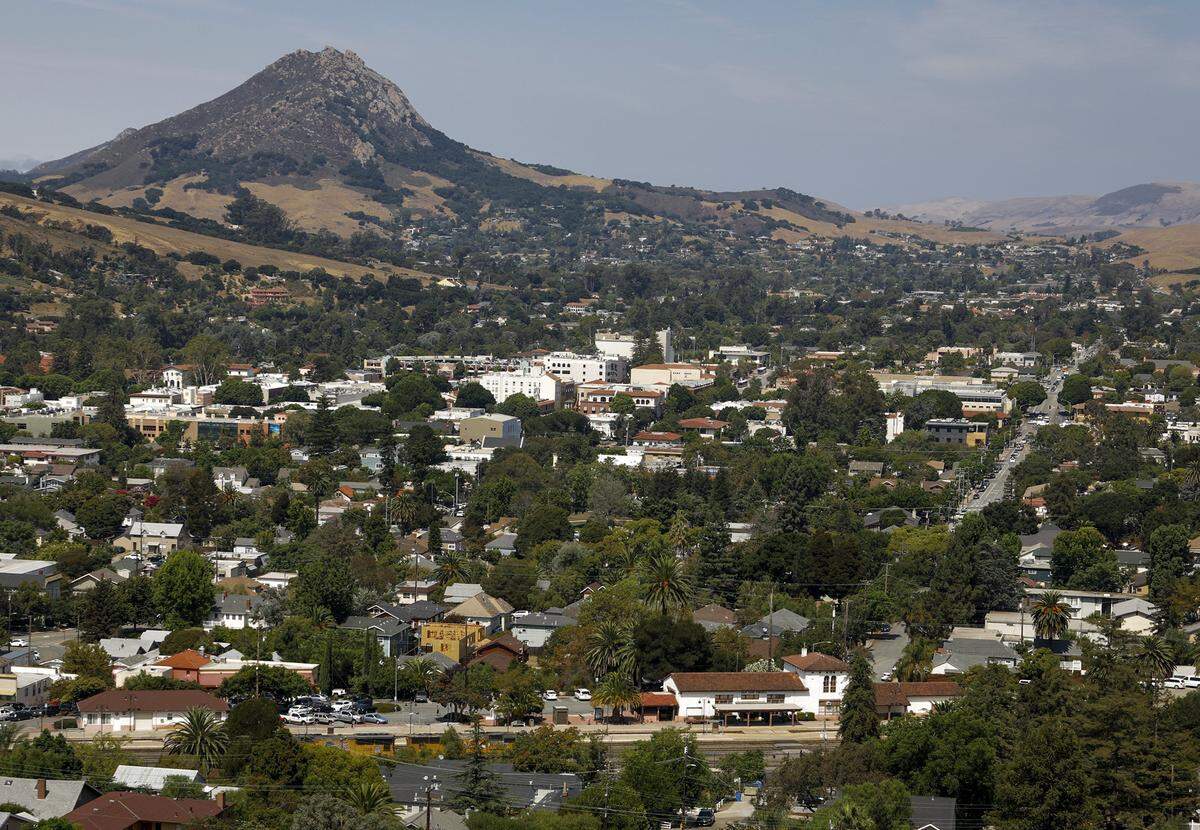
Mychal Boerman, SLO’s deputy director of utilities, said SLO currently uses about 4,700 acre-feet of water per year and has enough water supply to meet the needs of the community through 2040.
“Although much of the the city has received less rainfall than normal this year, SLO is not experiencing a water shortage and has ample supplies to meet the needs today,” Boerman said.
Mayor Heidi Harmon said the city has a “robust water portfolio” and most of the city’s costs come from infrastructure.
Money needed for system upgrades
Among its water costs, including providing for its minimum $10 million working capital balance for unforeseen emergencies, the city has more than 190 miles of pipeline from reservoirs as far as 50 miles away, a city staff report states, and the majority of those piples have not been replaced since their original construction.
Based upon aging wastewater infrastructure, a city staff report states, SLO’s Sewer Fund likewise “needs to continue replacement of sewer mainlines to reduce inflow and infiltration into the collection system, reduce scheduled maintenance, increase capacity to allow for development and reduce wastewater overflows,” among other wastewater needs.
The city is also upgrading its wastewater treatment plant with a water reclamation component, aiming for a minimum $15 million working capital balance for that project.
Despite the increases, the rate hikes are about half of what was originally projected by the city in a 2018 study because the Utilities Department “improved operations, secured more than $9 million in grant funding to offset costs, and worked with Cal Poly to ensure that the university is paying its fair share for water and sewer services,” the city’s news release said.
The most recent 2018 study projected water rate increases ofat 5.5% in fiscal year 2021-22 and fiscal year 2022-23, and projected a 6.5% increase for sewer rates over the same time frame.
To learn more about the program, visit the Utilities Department Assistance Program website or contact a Utility Billing Assistant at 805-781-7133.
%20Cropped.jpg)