Cal Poly students honor Kristin Smart with candlelight vigil, share campus safety fears
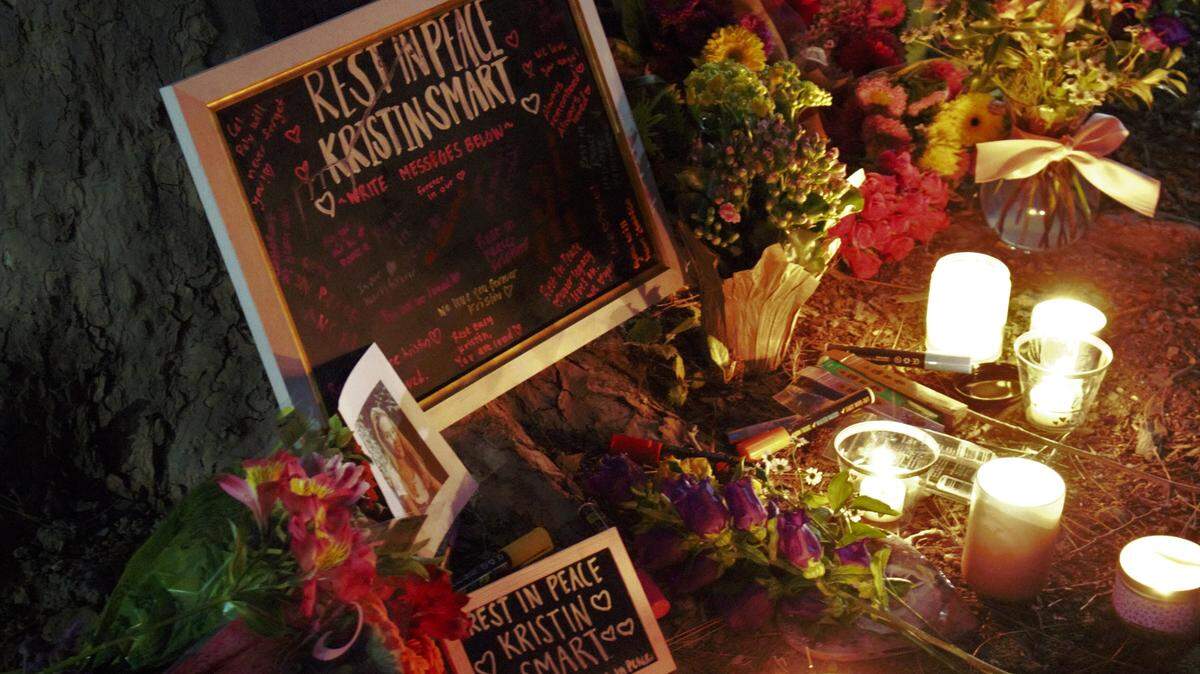
Cal Poly students gathered for a candlelight vigil on campus Tuesday night to honor Kristin Smart on the day Paul Flores was arrested on suspicion of murdering the former university student.
The event, which was loosely organized by a first-year student, Michelle Mueller, united about 70 students on the lawn outside Santa Lucia Hall in the South Mountain housing complex.
They laid out flowers, lit candles, burned essence and wrote well-wishing messages to Smart and her family.
“We wanted to pay our respects to her because she died right here,” said Madeleine Emeric, a first-year anthropology student at Cal Poly.
Mueller said she was surprised at how many students showed up. It was incredible, Mueller said, that even though probably none of the students there Tuesday evening were born yet when Smart disappeared, they still wanted to honor her memory.
“I think it’s great that people are coming together to pay respect to someone they’ve never known,” said Chris Raynes, a second-year political science student. “That’s really cool, it’s a nice sign of the community we have here.”
Flores lived in Santa Lucia Hall during his time at Cal Poly, and Smart lived in neighboring Muir Hall.
Smart, 19, was last seen Memorial Day weekend in 1996, walking back to her dorm from a house party just off campus at 135 Crandall Way at about 2 a.m. on May 25, 1996, with Flores and a friend.
The friend later told investigators that she left Smart with Flores at the intersection of Perimeter Road and Grand Avenue so that Smart could walk back to her Muir Hall dorm room.
Flores later told police the two parted ways near his room at Santa Lucia Hall.
On May 27, 1996, a friend of Smart’s at Muir Hall reported Smart missing to the Cal Poly University Police Department.
In a statement during a news conference announcing the arrest of Flores in connection with Smart’s disappearance, Cal Poly President Jeffrey Armstrong said the news today brought “sadness, but also a measure of relief and hope for resolution.”
“While we know that today’s developments do not represent the end of the case, it is a significant step,” he said at the press conference.
Students say Cal Poly campus feels unsafe for many after dark
As the sun set over the campus Tuesday evening and streetlights lit up over the walkways leading to the various residences and buildings on campus, some students reflected on what Smart must have been feeling the night of her disappearance.
Many said that even though the disappearance happened nearly 25 years ago, they felt as though Cal Poly has not implemented many safety measures for students who may feel unsafe on campus and live in the same area that Smart did.
“In the new dorms that were put in a couple years ago, it’s really well lit, and everybody knows that there’s cameras there,” said Anjali Shute, a first-year graphic communications student. “Most of our friends live over there so a lot of us will walk back late at night from there to here.
“And the campus just gets darker as you’re walking. It just feels like we’re paying a certain amount and we’re equally as important students, but we just don’t have light or safety measures over here.”
The newer residence halls in the yakʔitʸutʸu complex at Cal Poly also have several “blue safety towers” with a button students can press to call authorities in an emergency. The older Santa Lucia housing complex, however, doesn’t have those towers, students told The Tribune.
“Those emergency blue lights should be everywhere, and Kristin’s murder is definitely proof that bad things can happen here,” Emeric said. “And so I feel like Cal Poly just needs to do a better job of letting people know about their resources, especially when it comes to something like walking home alone at night.”
Max Messmer, a second-year civil engineering student, said it’s sad that women still feel like what happened to Smart could happen to them.
“It’s really tragic,” he said. “It’s just a reminder of how little has changed for society, especially for women.”
Messmer and his friend, Raynes, noted that they don’t really worry about walking on campus after dark.
“I walk a lot at night around here — I’ve really only felt unsafe a few times,” he said. “But as a man, I know it’s definitely a privilege still to be able to do that, unharmed, pretty much all the time.”
In response to a request for comment from The Tribune, Cal Poly’s Director of Media Relations, Matt Lazier, said that there are 98 total blue safety towers around campus and that the university has “focused in recent years on updating existing lighting with newer, brighter lights.”
“Generally speaking, the campus has relatively low (reported) crime rates, in part because our Cal Poly Police Department provides 24/7, full, year-round service that includes proactive patrols and response to calls,” Lazier wrote to The Tribune in an email. “This includes the department having its own 24/7 911 dispatch center to receive calls.”
“All of this said, CPPD can’t be everywhere at once, and residents and visitors also should exercise their personal judgment and make safe decisions,” Lazier wrote.
“CPPD provides personal safety and crime prevention information online: afd.calpoly.edu/police/crime-prevention and afd.calpoly.edu/police/crime-prevention/personal-safety,” Lazier added. “The department does a lot of proactive outreach to the community as well, including through orientation programming for new students and through University Housing. See here for more: afd.calpoly.edu/police/crime-prevention/outreach.”
This story was originally published April 13, 2021 at 10:21 PM.