
This Central Coast city is making stores corral abandoned shopping carts — or face fines
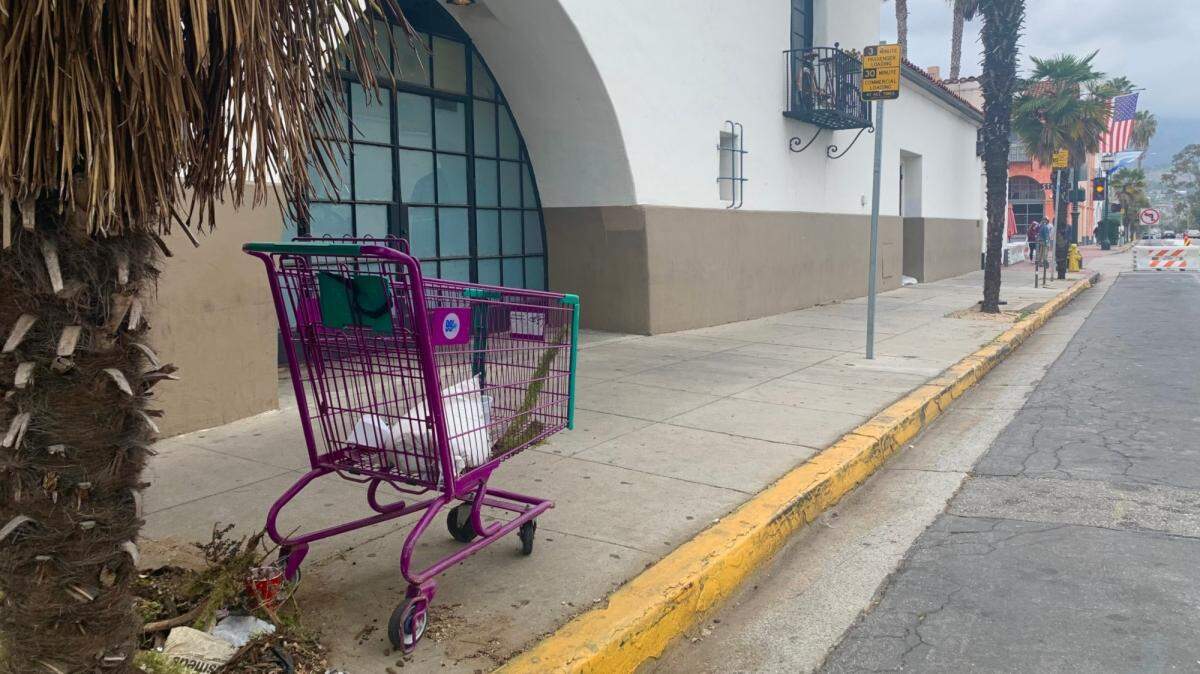
Grocery store owners will have to retrieve their abandoned shopping carts or face fines, according to an ordinance approved Tuesday by the Santa Barbara City Council.
Council members said they are not targeting members of the homeless community who use shopping carts, but “truly abandoned” carts that create a public nuisance.
“I wish this wasn’t necessary,” Councilwoman Meagan Harmon said. “I don’t, particularly now, like putting any extra onus on our local businesses, but we are talking about issues of safety. When a truly abandoned shopping cart is in the public right of way, it needs to be dealt with, unfortunately. That’s the reality of the world we live in.”
The vote was 6-0. Councilman Eric Friedman recused himself because he works at Trader Joe’s.
The shopping cart discussion came at the end of a six-hour City Council meeting. No members of the public spoke.
Assistant city attorney John Doimas said that 538 shopping carts were retreived in the city in 2020. The city contracts with a company to retreive abandoned shopping carts, paying about $5 for every shopping cart picked up.
Many of the carts are found in city creeks or beaches, Doimas said. From 2017 to 2019, 116 shopping carts were found abandoned in creeks and beaches.
At least 32 stores in the Central Coast city use shopping carts. Doimas said that California has 150 cities with shopping cart retreival ordinances, including Carpinteria and Oxnard.
State law already says that it is unlawful for someone to remove a shopping cart from its premises.
Santa Barbara’s ordinance would enhance the law and require companies to place signage on each cart with store-identifying information, as well as a warning that removing the cart is illegal. It also requires companies to retrieve the shopping carts immediately when an unattended cart is in a location that could impede emergency services or if the cart doesn’t identify the store.
The city then will inform the owner in writing that the cart would be impounded and in storage for 30 days before the city can sell or trash it.
In addition, store owners must submit a site containment and retrieval plan as well as take loss prevention measures, such as a wheel lock.
It would cost a company about $100 to retreive a shopping cart, Doimas said.
“The primary focus is on retreival, not punitive,” Doimas said.
Doimas stopped short of saying what the storage fees would be, but he did say that the city will not discard personal items found in the cart.
Councilman Mike Jordan expressed some concern on behalf of the business owners, but eventually voted for the ordinance after he was assured by Rene Eyerly, environmental services manager, that the city had conducted outreach to every store.
“This really makes a business suffer from no fault of their own,” Jordan said. “The costs worry me, in particular the storage fees. We are talking about an ordinance without knowing what those fees would be. I am reluctantly looking at it at 8 o’clock at night. I won’t be the fly in the ointment.”
Jordan also said that some people need to use the shopping carts.
“They wander around for a reason because people are walking to the market to get their food, and I guess have almost no choice to push their food home,” Jordan said. “The only bad part of the scenario is they don’t walk the cart back.”
Councilwoman Kristen Sneddon said the ordinance was fair.
“This is purely for truly abandoned shopping carts that are in the right of way,” Sneddon said.