
COVID-19 concerns close public viewing site for SpaceX rocket launch
Because of COVID-19 concerns, a public viewing area at Vandenberg Air Force Base won’t open for Saturday’s Falcon 9 rocket launch that is expected to draw thousands of spectators to the Lompoc Valley.
A NASA satellite, the Sentinel-6 Michael Freilich, is set to ride the Space Exploration Technologies Falcon 9 rocket into space at 9:17 a.m. Saturday from Space Launch Complex-4 on the South Base. Launch times are established by where a satellite needs to be placed in space.
The Falcon’s West Coast launch facility can be seen on the horizon when looking south of Ocean Avenue (Highway 246).
On Wednesday, 30th Space Wing representatives said public health orders related to COVID-19 will mean that the public viewing area, dubbed the Hawk’s Nest, will remain closed.
“In compliance with COVID-19 restrictions, the normal public viewing area on Azalea Lane off of Highway 1 just a half-mile south of Vandenberg Air Force Base’s main gate will not be open to the public,” representatives said.
That’s likely to flood other locations in the Lompoc area with visitors eager to see the rocket launch. Spectators typically fill West Ocean Avenue and other vantage points to catch a glimpse of the blastoff.
Santa Barbara County, like most of its California counterparts, returned to the most restrictive purple tier this week on the state’s Blueprint for a Safer Economy because of rising COVID-19 cases.
Falcon rocket launches planned for weekend daytime departures typically attract larger-than-normal crowds to the area.
Spectators also hope to catch a glimpse of the first-stage booster’s return to land since it’s set to touch down at a South Base site just west of the launch pad.
Central Coast residents might hear both the launch and the landing. The re-entry of the booster as the vehicle breaks the sound barrier could cause multiple sonic booms heard in Santa Barbara, Ventura and San Luis Obispo counties, Vandenberg officials said.
“A sonic boom is the sound associated with the shock waves from an aircraft or launch vehicle traveling faster than the speed of sound,” Vandenberg officials said. “Sonic booms generate a sound similar to an explosion or a clap of thunder. The sonic boom experienced will depend on weather conditions and other factors.”
If successful, the booster’s landing will allow SpaceX to recycle the component for future missions, helping trim costs and time between launches.
As is typical for some South Base rocket launches, campers at Jalama Beach County Park, just south of Vandenberg, will be evacuated for several hours before the blastoff as a precaution.
In preparation for this weekend’s launch, SpaceX crews on Tuesday conducted a successful static-fire test, igniting the engines but remaining on the ground, clearing one hurdle for departure.
Liftoff initially was set for Nov. 10 but was delayed to allow SpaceX crews to replace engines because of a problem spotted during a different mission.
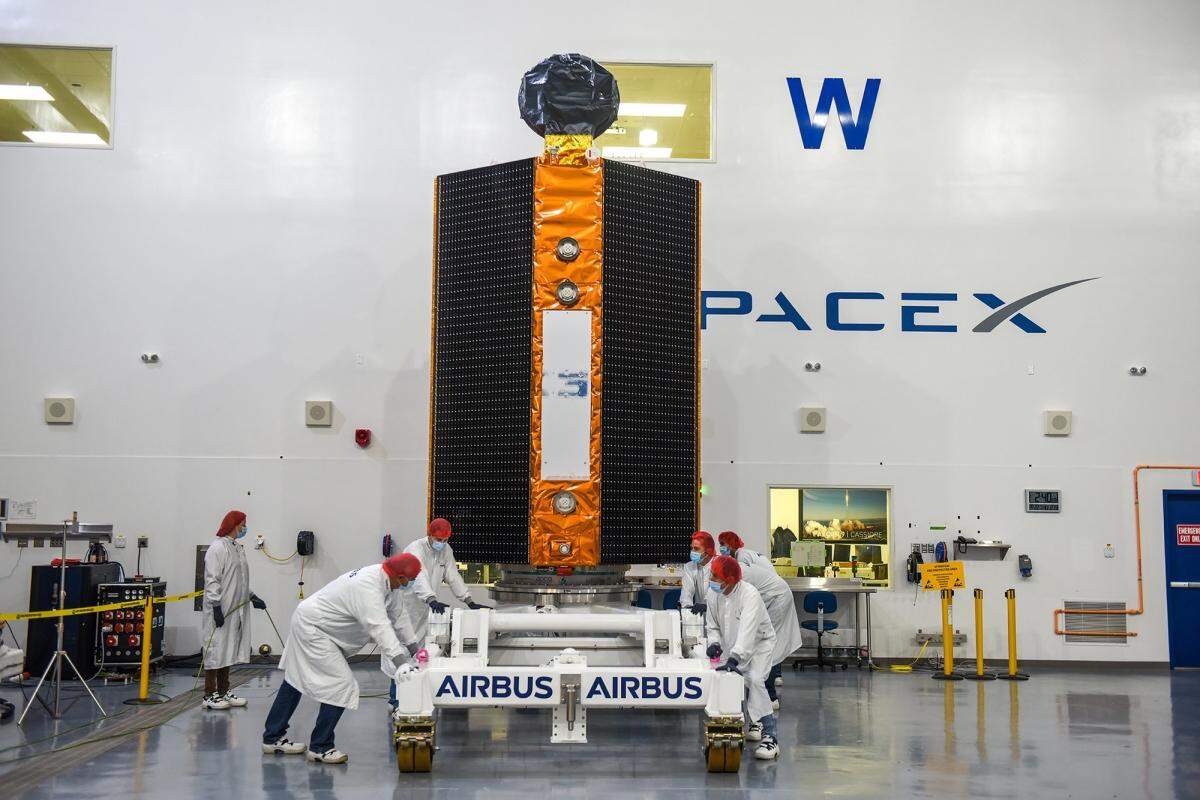
The Falcon 9 rocket will carry NASA’s Sentinel-6 Michael Freilich satellite, the first of two spacecraft, each about the size of a small pickup truck, planned to launch five years apart to continue collecting sea level data for the next decade.
“We’re almost there,” project manager Parag Vaze of NASA’s Jet Propulsion Laboratory said. “Soon, we’ll be watching the satellite on its journey into Earth orbit 830 miles above our planet.”
Equipped with five instruments, Sentinel-6 will collect information about a key indicator for global climate change.
This data also will lead to improvements in both short-term forecasting for weather predictions in the two- to four-week range, such as hurricane intensity, and long-term forecasting for seasonal conditions such as El Niño and La Niña.
The launch will be carried live on NASA Television and on the agency’s website starting at 8:45 a.m. Saturday, NASA officials said.