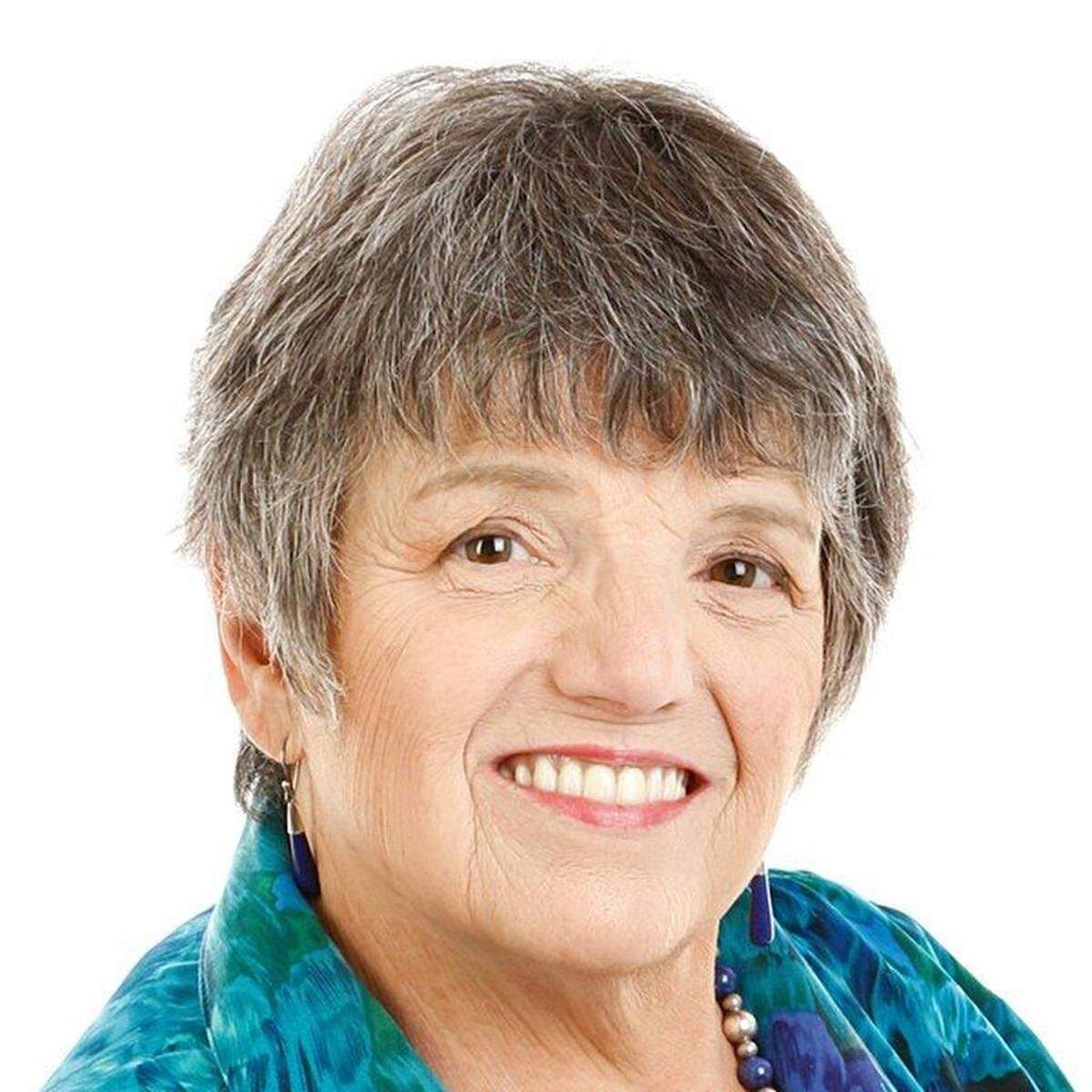
Coronavirus put this SLO County sign language interpreter in the public health spotlight
The COVID-19 pandemic has thrust into the public spotlight many people who for years have worked in relative obscurity.
Take Dr. Anthony Fauci, director of the National Institute of Allergy and Infectious Diseases, or Dr. Penny Borenstein, head of the San Luis Obispo County Public Health Department.
Just as visible as Borenstein are the American Sign Language interpreters who work beside her at the county’s news conferences about the spread of the novel coronavirus.
Those skilled professionals use their hands, facial expressions and even body language to interpret Borenstein’s words for the deaf and hard of hearing.
One of the sign language interpreters most often seen at those news conferences is Robin Babb, who grew up in Atascadero and still lives in the North County.
Babb is so immersed in her work that sometimes she will “sign in my dreams or dream about people using ASL,” she said. “It’s not very often but it does happen.”
In a series of interviews with The Tribune, Babb explained what she does, how she does it and how and why she learned ASL.
What is American Sign Language?
“ASL is a language. It is not a coded version of English. The grammar and sentence structure is completely different,” Babb explained.
In the visual and gestural language, Babb explained that “every sign has five features that help describe it — hand shape, movement, location, palm orientation and something known as non-manual markers ... body language and facial expressions that (are) not a part of what the hands are doing.”
“Facial expression plays one of the largest parts in the construction of the language,” she continued. “I can sign one word and change the meaning a hundred ways with my facial expression,” Babb continued, “in much the same way that tone and inflection can change meaning with spoken language.
There are ASL translators, too, but they communicate what’s in written documents, she said, rather than from the spoken word.
Different countries have different visual and gestural ways of communicating with the hearing impaired. According to Wikipedia, there may be 300 or more signed languages.
Babb said ASL “is only really used in the U.S. and most of Canada.”
However, Babb added, “it is very often much easier for deaf people from different countries to communicate than it is for hearing people. One reason is the frequent use of iconic signs.”
For instance, she explained, “you can imagine that most languages likely use the movement of cradling a baby to mean ‘baby.’ ”
How SLO County interpreter learned ASL
Babb was born in San Diego during her father’s eight years as a radioman in the U.S. Navy.
Once Mike Gray left the service, he and his family “moved to Los Osos because that is where my mom, Kathy Gray, grew up,” Robin Babb said. “After a year of fog, we moved inland.”
Mike Gray became a security guard at Diablo Canyon Power Plant, rising to the top seniority spot before he died suddenly in 2012.
According to Babb, “The only reason I learned sign language was because my friend and her family are deaf, and they taught me the language in the late 1980s.”
“I wasn’t really that fluent at that young age,” she said, but “I communicated well with my friend and had a definite advantage when I took the ASL classes offered through Cuesta in the ’90s.
“My first unpaid interpreting job was in the eighth grade,” she said, when “I’d get pulled out of class with my mom’s permission” when the school’s interpreter didn’t come in.
“I guess the school was more worried about not providing services for her than they were about me missing out on my education,” Babb added with a chuckle.
By the time she was 19, Babb was getting paid to interpret spoken language into ASL.
“I never went to college,” she said, but she was able to become a certified interpreter without a bachelor’s degree, which is “nearly impossible” to do these days.
Starting in 1996 when Babb was 21, she interpreted ASL at San Luis Obispo High School for three years.
After her son Sam was born, she began a three-year stint at Templeton High School, interpreting and teaching ASL. Once her son Seth was born, she homeschooled both boys until enrolling them in San Luis Obispo Classical Academy.
Sam is now 19 and a senior majoring in political science at UC Irvine/ Seth is 16 and a junior in high school.
The family has two cats, Magnus and Orion, and Surdi, a deaf dog adopted from the San Diego ASPCA. “She understands the signs for sit, stay, eat, walk and someone is here … but she really doesn’t understand ‘no,’ ” Babb said with a chuckle.
Babb became an independent contractor about eight years ago, contracting with several agencies. She’s also interpreted on ocean cruises to Virgin Islands, Alaska, the Caribbean and Canada.
Babb has qualified for a national interpreter certification since 2014, and an ED K-12 certificate.
She also holds a California Office of Emergency Services interpreter’s credential. To get that, a certified interpreter must have “10 years of experience, plus being contracted by one of the big deaf/hard of hearing-focused, nonprofit advocacy agencies in California,” such as the Greater Los Angeles Agency on Deafness, Inc., also known as LifeSigns.
Now, Babb said, “there are three of us in San Luis Obispo who currently hold that CalOES credential, and I believe two in Santa Barbara County.”
Once the COVID-19 pandemic hit and Borenstein began holding regular, public updates, Babb usually was the one that the Independent Living Resource Center in Santa Barbara decided to “put in front of the camera” during the local news conferences.
Expertise and skill are especially crucial now as she interprets vital details for the hearing impaired -- information about a disease that could kill them.
SLO County Public Health news conferences
In most of Babb’s previous assignments, ASL interpreting tended to come in short bursts during a conversation or interview, or moderately long stretches during classes or lectures.
Interpreting Borenstein’s lengthy, fact-and-number-heavy reports was an entirely different challenge.
Babb relies heavily on a partner interpreter, frequently Katie Voice, to fill in the blanks so hearing-impaired people watching the news conference can get the full gist of what the health director and others are saying.
Voice or another member of the interpreting team are “there to feed me information that I miss,” Babb said. “For me, that is usually numbers, statistics. I tend to work about four or five seconds behind the speaker, so sometimes by the time I get to a number, like how many classes Cal Poly will be offering as in-person courses, I don’t remember the number. I will look to my team for that information.”
Normally, the two interpreters “tend to switch roles — interpreting versus monitoring — every 15 to 30 minutes,” Babb said, but “press conferences do not afford us the ability to switch roles due to the nature of the job. So, it is very helpful to have someone there to provide support.”
However, news conferences aren’t new turf for Babb. She interpreted for Santa Barbara County officials during the 2018 Montecito mudslides.
What ASL interpretation means for hearing impaired people
To say that the ASL interpretation that Babb and other provide is appreciated would be a substantial understatement.
Sarah Tucker, who teaches the hearing impaired for the county and is married to Cuesta College ASL teacher Erich Tucker, said via email that she thanks “the interpreters who have worked tirelessly around the clock to provide ASL access to the COVID-19 county health department meetings.
“Robin and her team have been phenomenal about interpreting every meeting so that we deaf (and) hard of hearing all get access to the news,” Sarah Tucker wrote.
“The interpretations have not been easy, with all the new vocabulary and findings,” Tucker said, “but Robin has made it a smooth transition with her interpretation so that I get access to all the updated information out there.”
Sara Putman, another ASL client, said, “It is important to have language access to current events that are happening around us. ASL for the deaf is clearer and more understandable than the traditional English language.
“ASL interpreters, like Robin, and many others who live in the area, are valuable resources for those who use ASL as a primary language.”
How Robin Babb deals with work stress
Interpreting, “while it can be physically tiring, is far more mentally exhausting than anything else,” Babb said.
Babb works off that stress by running “about 20 miles a week right now. I’ve done three full marathons and countless half marathons,” she said with pride.
She loves to hike in scenic areas, especially in early mornings and warm summer evenings
Babb has even begun rock climbing, “but I’m not very good at it,” she said.
Babb is obsessively devoted to the New York Times crossword puzzles, and she and her colleague Jackie Ford regularly remove trash from their two adopted roadways, Golden Hill Road in Paso Robles and El Campo Road in the Arroyo Grande.
The road adoption signs read simply, “ASL Interpreters of SLO County.”
Babb said that, despite the responsibility and pressure of interpreting, “my work is important to me because I have a lot of friends who depend on interpreters for information.”
What might that information include?
“I might have to help someone open a bank account or get their taxes done,” she said. “I might interpret for back-to-school night or commencement. I might make a teacher’s words visible so a student can learn algebra or world history.
“I also may have to convey a medical diagnosis or the gender of a baby. I might hold a vital key that a mental health professional needs in order to make a proper and correct diagnosis.”
There are heart-wrenching moments, too, she said. “I have told people that they were dying, and I have told people that someone they love has already died.”
“I am still learning,” Babb emphasized.
Some of that education now comes from regular Zoom meetings with about a dozen other interpreters from Santa Cruz to Ventura, “to talk about what worked and what didn’t.”
“Deaf and hard-of-hearing people who depend on ASL for communication do not always have the choice about whether or not to have a perfect stranger present for all of their important and not so important moments,” she said.
“None of these things is to be taken lightly,” Babb said.
This story was originally published September 8, 2020 at 5:00 AM.
CORRECTION: An earlier version of this story gave the wrong last name for Robin Babb’s father, Mike Gray. The error has been corrected.