On a bluff in Cambria, bagpiper adds his melancholy song to the shore’s chorus
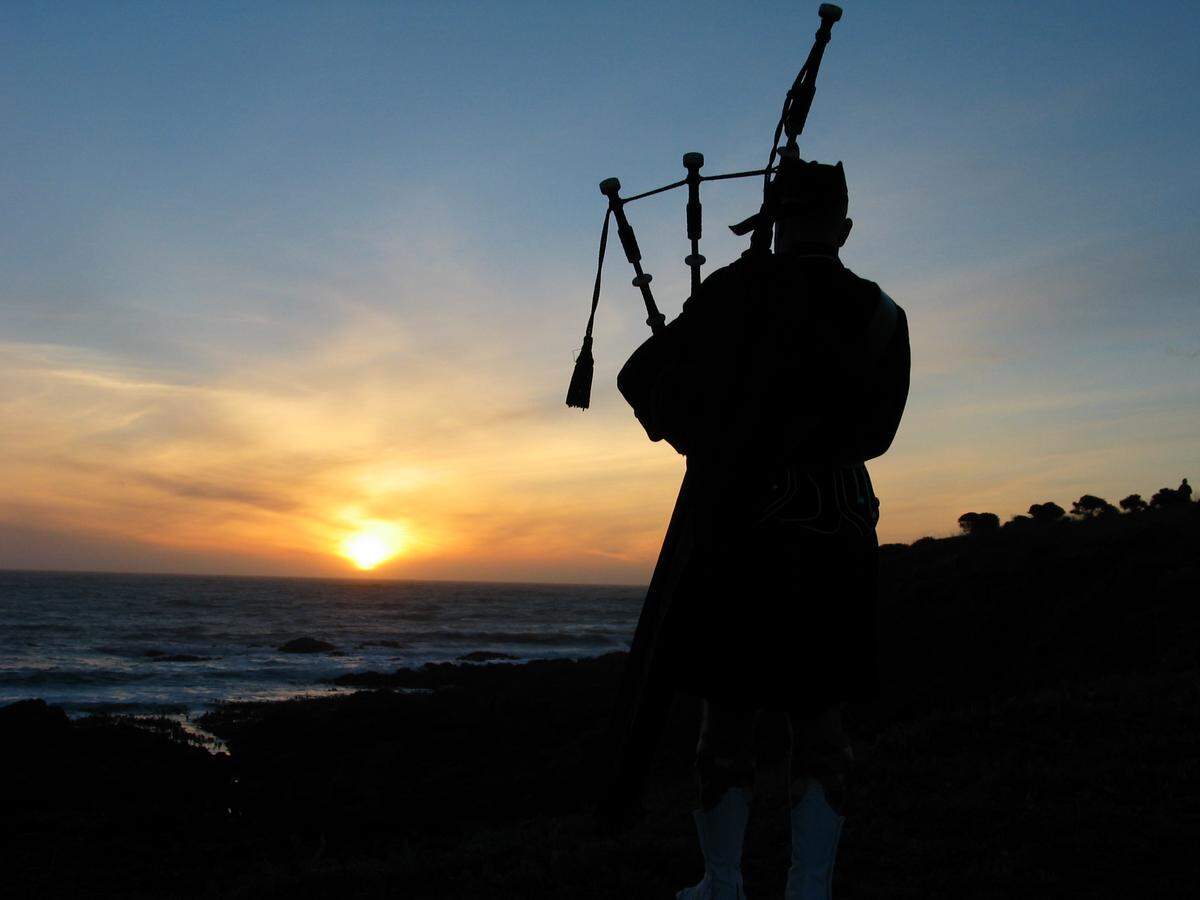
Imagine looking at the ocean in Cambria and, over the sounds of the sea and the marine birds, hearing bagpipe music at sunset.
People who hike along the southern part of Cambria’s Fiscalini Ranch Preserve bluff trail at the right time of the right day just might hear a performance by former competitive piper Neal Dundas.
Every other Friday or Saturday, Dundas hangs his Scots flag on the eave of his nearby Cambria home, alerting those in the know that he’ll be playing his instrument that night from a blufftop overlooking Otter Cove. The performances usually start about 7:30 p.m., depending on the weather, the time of year and the light.
Dundas often plays for about a half hour, depending on the wind chill. Neither the pipes nor the musician’s fingers adapt well to cold, windy weather.
For about two centuries, the distinct sounds of bagpipes have wafted out over battlefields, funerals, memorial services, concerts and competitions. The melancholy music is part moan, part whine and always evocative with a touch of mournfulness.
Social media users who’ve heard Dundas play on the bluff have described their experiences as being “awesome,” “amazing,” “so serene and comforting and “a wonderful thing for the community.” One woman thanked Dundas for bringing “a little joy to us,” especially during such stressful times.
How Cambria man started playing bagpipes
Dundas loves to tell how he started playing the bagpipes, how he got his illustrious set and so much more about his quarter century of being a piper.
As the fourth-generation Scot said, “Scots are notoriously known as being story tellers. I often have to tell people to give me a timeout when I get started.”
The Dundas ancestors were from Queensferry, Scotland, about 15 miles west of Edinburgh.
There’s still a Dundas castle there, the keep of which was used as a fire beacon to warn Edinburgh Castle of impending danger, Dundas said. However, the family no longer owns the eponymous castle.
His parents were “very active in the Scottish Clan Society and Scottish country dancing,” he said, and “as a child, I used to go with them to many of the Scottish Highland Games in Southern California.”
“So, at an early age I grew to appreciate and love the instrument of my ancestors, the bagpipes,” Dundas said, but he didn’t yet want to put in the time to learn how to play.
By the time he was 50, however, Dundas said, “I just couldn’t stand watching a pipe band or piper play and not be involved. … Man, was I in for a challenge!”
His teacher, Scott McDonald, “was the pipe major for the L.A. Scots, one of the few grade-one pipe bands in the United States. At first, he did not want to teach me and said I was too old,” Dundas said, noting that the average age of his students was 16. “I told him I had really good fingers — I could type 90 words a minute — and an intense desire to learn.”
Finally, McDonald “relented and gave me an OK under one condition: If I did not show any improvement in three months, he would drop me,” Dundas said.
Apparently, 98% of McDonald’s older students drop out, Dundas said, but he prevailed.
“I lasted for over a year learning the hundreds of pipe-fingering movements” on a practice chanter,” he said. “And in the 13th month, I started a band called the San Clemente Scots Drums and Pipes.”
Eventually, that band started competing at the Highland Games, but subsequently merged with the L.A. Scots Grade Four Band, in which Dundas played before retiring from competition in 2012. He loved competing, but it was hard work, he said.
In the late 1990s and early 2000s, he said, “while coming up from Orange County for some R&R from business,” Dundas would often practice on the blufftop above Cambria’s Otter Cove.
But then he retired from competition — the rigors of competing, including two or more daily hours of practicing, had caught up with him. He was suffering from bagpipe burnout.
In 2012, Dundas moved permanently into the little Cambria beach cabin he’d owned for decades, the place he calls “my slice in heaven,” and promptly stopped playing the pipes for about four years.
But before he told a listener the rest of the story, he relayed the amazing tale of how he got his bagpipes, because that is integral to why he went back to playing.
Priceless pipes
After learning to play, Dundas knew he needed his own set of pipes. Myra George, a family friend, was selling hers, so he went to see her and the instrument.
“After almost an hour of grilling me,” he said, George agreed to a deal. If he’d commit “to always play these pipes,” she would sell him the set for $50.
Dundas had no concept about the value of that set, but it sounded like a stupendously good buy, since he knew a reasonably good set was selling online for about $1,600.
Later, he took the pipes to McDonald to get the teacher’s impression. “I wished I could have videotaped the expression on his face when he saw” the set, Dundas recalled.
The shocked McDonald asked his student, “Do you know what kind of pipes these are? These are Lawries. They are considered the finest bagpipe ever made.”
Dundas said McDonald told him that “six of the greatest pipers in the world play on Lawries.”
Then when the student told the teacher what he’d paid for the instrument, Dundas recalled, “I am glad he was sitting at the time, as he would have surely fallen over!”
Afterward, McDonald “took out a bottle of his finest 25-year-old Scotch, and we both toasted to the ‘deal of the century!’ ” Dundas said.
Later, an appraiser set the value of the 1938 set of Lawries at about $6,500.
“Myra knew this when she sold them to me for $50,” Dundas said. “All she wanted was to see them played. She has long since passed away, but I know Myra can hear her pipes resonating in heaven as I play.”
Musician plays in Central Coast band
Even though he had retired from competition, “there was always that very small voice I would hear from Myra and the commitment I made to her,” Dundas said. So, after four years off, he went back to playing, but this time strictly for pleasure, his own and that of his audience.
“In 2016, I joined the Central Coast Pipe Band,” he said. “We are not a competition band, but play for fun for the communities in and around San Luis Obispo.”
“Now, I do it to give my friends and neighbors a little happiness” during these stressful, COVID-19 pandemic times,” Dundas said. “I wanted to get them out of the house, in the fresh air, and put some smiles on their faces.”
Dundas isn’t Cambria’s first piper, and he recalls a years-ago meeting with his predecessor, Ed Edmonson, who called himself “’The Lone Piper of Cambria.”
“During our conversation, I really think he knew someday I would carry the torch that made him so well loved in Cambria,” Dundas said of Edmonson, who has since died.
Dundas knows he won’t play forever.
Getting older, he said, “I find it more difficult to play tunes the way they’re supposed to be played” especially when the wind-chill factor is in the 50s.
“I don’t know how the Scots do it,” he said, because Scotland is very windy and cold.
“I sometimes feel I am letting Myra down,” by not playing more, Dundas said. “But if she were alive today, I know she would be happy her pipes are being played, if only to put a few smiles on people’s faces.
“I hope someday when I am dead and gone,” Dundas mused, “those who heard me play at Otter Cove will remember that moment and reflect on just how special Cambria truly is.”
SLO County resident shares bagpipe history
According to Dundas, “A very crude form of bagpipe has been around since Roman times. However, it was the Scots who perfected the ‘highland’ bagpipe in the early 1200s or thereabouts.”
Bagpipes were “used primarily as a war instrument, as the shrill sound of the chanter coupled with the deep drone sound was used to drive fear into the enemy of the Scots,” he said. “Many British war films today show pipers marching into battle before the troops. Moreover, most of the tunes I play today are hundreds of years old and were written about famous Scottish battles or persons. We call them tunes, as very few have any written words to them.
“The first bagpipes made had an inner bladder made of an elk’s stomach. Today, we use either a synthetic, sheep- or cow-hide bag,” Dundas said.
In a set of bagpipes, “there are two tenor drones and one bass drone that resonate a constant tone that you often hear,” he said. “The chanter has a very small cane reed, similar to an oboe reed, that makes that shrill sound.
“Playing pipes is like playing a ‘mini’ orchestra,” Dundas said. “There are so many things happening that to ignore just one thing causes all of the other parts to malfunction. It truly is the MOST difficult instrument to play. If I can compare blowing the pipes, it would be like blowing up a hundred or more of those small balloons.”
This story was originally published June 15, 2020 at 5:00 AM.