3 years after jail death, Andrew Holland Foundation is a voice for mental illness training
Almost three years after a broken mental health and criminal justice system led to their son’s shocking death in San Luis Obispo County Jail, Sharon and Carty Holland are following through on their pledge to fight for better treatment of those with mental illness.
From connecting people in the criminal justice system to legal assistance to planning and lobbying for a new mental health facility in San Luis Obispo County, the Hollands’ new nonprofit, the Andrew Holland Foundation made significant progress in 2019.
One major development has been improved relations between the family, its supporters, and the Sheriff’s Office they held responsible for Andrew Holland’s death on Jan. 22, 2017.
“Being more vulnerable and experiencing a lot of pain creates in you different strengths, as well as a lot of compassion,” Sharon Holland said. “We’re in this for the community.”
In fact, the county Sheriff’s Office has offered the foundation a seat at the table during ongoing mental health training sessions the county now requires for all of its deputies, Sharon Holland, of Atascadero, said.
With representatives of the Andrew Holland Foundation now working with the county on various goal-oriented initiatives, the Hollands say they have welcomed county Sheriff Ian Parkinson — who won re-election in 2018 in a bitter race against a challenger funded by the family — to attend the third annual candlelight vigil in memory of their son outside County Jail in January.
That prospect seemed all but impossible not long ago.
It is unclear if Parkinson will participate; the Sheriff’s Office declined any interviews with Parkinson or other employees for this article.
Department spokesman Tony Cipolla provided an emailed statement in response to questions about the Andrew Holland Foundation.
“Every improvement the Sheriff’s Office has made with respect to this issue, from the hiring of a chief medical officer to the outsourcing of all medical and mental health care for inmates to the opening of our new behavioral health unit in the jail has been made public in open forum at the County Board Of Supervisors,” Cipolla wrote. “We have met and worked with members of the Holland Foundation and we support their efforts to partner with us on productive improvements at the jail and in the community.”
Mental health issues ‘bigger than our story’
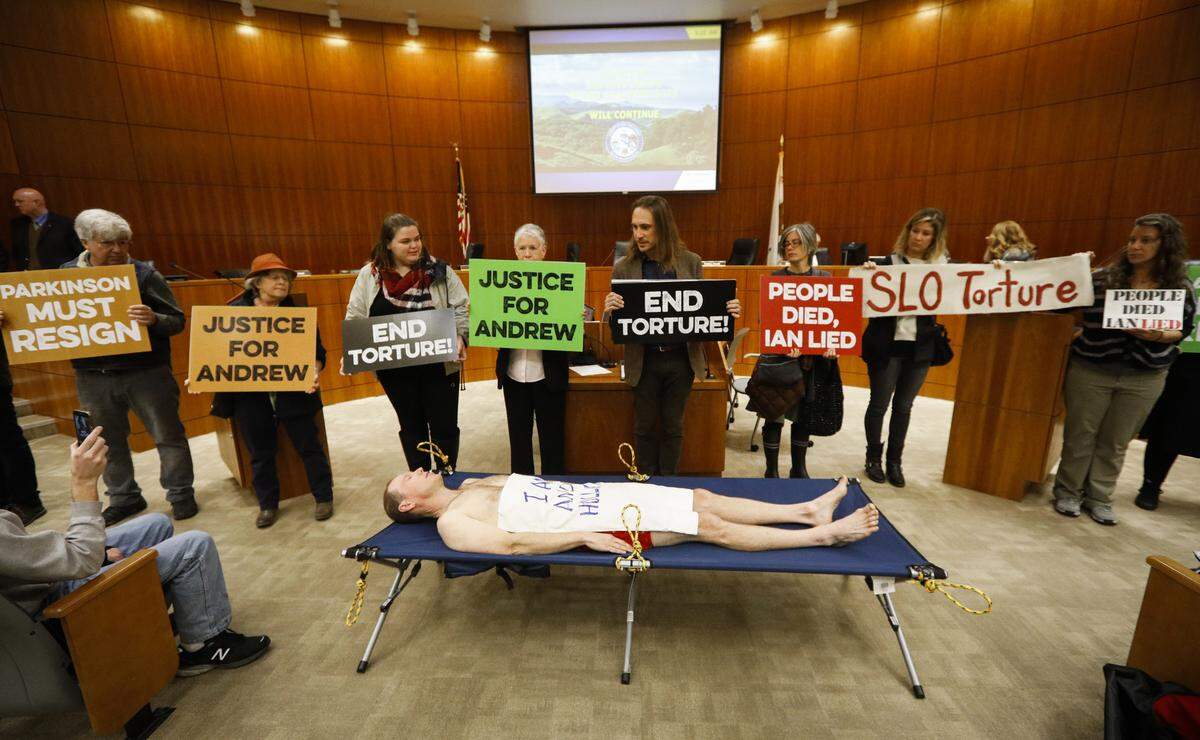
In a case that sparked national outrage, 36-year-old Andrew Holland was held for 16 months in San Luis Obispo County Jail for low-level offenses and suffered severe symptoms of his diagnosed schizophrenia after months in isolation.
He died of an embolism shortly after being released from the jail restraint chair he was held in for nearly two days in January 2017.
.JPG "IMG_IMG_IMG_Drew_4_1_RDB_5_1_K1C9963M_L339269749 (2).JPG")
As Carty and Sharon Holland pledged to do when they were awarded a $5 million settlement from the San Luis Obispo County government in July 2017, they used portions of the proceeds to form the Andrew Holland Foundation — with the mission of advocating for treatment, rather than incarceration, for people with severe mental illness who are caught in the criminal justice system.
Within roughly the past year, the foundation has received its 501(c)(3) nonprofit status, allowing it to raise donations, And in the first quarter of 2019, the Hollands pumped an additional $100,000 of their money into the organization for operating costs.
The foundation has been invited to have representatives attend and participate in the Sheriff’s Office’s 40-hour crisis intervention training, which it has made mandatory for all deputies.
In a Nov. 14 interview, Sharon and Carty Holland said that the foundation, in turn, has invited Toby DePew, a deputy assigned to the Sheriff’s Office’s Community Action Team to respond to reported criminal matters possibly involving mental illness in the field, to join its eight-member board of directors.
DePew has served as the foundation’s liaison to the Sheriff’s Office and has been “a very welcome member” of the organization, Sharon Holland said.
“We were there (at the training sessions) to encourage and self-facilitate, and somehow to let them know we appreciate not only what they deal with as jail (correctional staff), but also police and deputies,” she said.
“We didn’t want this continued ‘us versus them’ attitude, and I feel the sheriff and I have forged this in private talks,” Holland said.
The Hollands said they are optimistic that what they see as a healthy dialog about mental illness across the country today will continue to grow.
“Our 15 minutes of fame is pretty much done, but I feel encouraged that generally speaking folks are getting more aware of severe mental illness as an issue that needs to be addressed,” Carty Holland said. “It’s so much bigger than our story at this point.”
“I feel momentum is on our side,” he added.
Big steps for Andrew Holland Foundation
One of this year’s biggest steps for the Andrew Holland Foundation is the hiring of its first executive director, Anna Boyd-Bucy, who served as director for Big Brothers Big Sisters of San Luis Obispo County for more than a decade before leaving the organization two years ago.
Boyd-Bucy said Wednesday that the foundation is being strategic and practical about what it’s taken on, given its current size and resources.
“At the same time, we’re really ambitious because we know the county needs mental health facilities and treatment programs and we want to push for that,” she said.
The foundation’s most ambitious goal by far is to develop, or join forces in support of, a mental health facility in San Luis Obispo County that can accept and treat people with mental health issues as an alternative to jail custody.
Currently, the county’s sole psychiatric facility for involuntary mental health holds has only 16 beds, and jail inmates routinely wait for openings.
The foundation’s project is in its very early conceptual stages, Boyd-Bucy said, though a community member has volunteered significant time to assist in its development.
Boyd-Bucy, whose background is in strategic planning and grant writing, also spends a large portion of her 20 hours per month searching for funding opportunities and scholarships.
Specifically, the foundation is exploring ways to help law enforcement agencies other than the Sheriff’s Office afford to send officers to crisis intervention training.
The foundation has also connected the families of two men with severe mental illness with legal counsel for their low-level criminal cases.
Though the Andrew Holland Foundation does not have the staff to provide direct assistance to people who reach out to it, Boyd-Bucy said the nonprofit refers inquiries for assistance to Transitions-Mental Health Association. The foundation shares a mutual volunteer with the association — Los Osos resident Dawn Marie Anderson, who acts as a community advocate and ambassador.
On Monday, ✓members of the foundation’s board will take a private tour of the San Luis Obispo County Jail with Sheriff’s Office staff and county supervisor Bruce Gibson, Boyd-Bucy said, focusing on updates on jail improvements, including its new medical wing and contracted healthcare services.
The tour is one example of improved relations between the foundation and the county. Another is regular communication between Boyd-Bucy and Dr. Christy Mulkerin, the county’s new chief medical officer.
“We’re looking forward to working with them,” Boyd-Bucy said of the county. “I think there’s been a lot of positive change and we just want to see it implemented fully and assist where needed.”
Looking ahead
The Hollands say they remain encouraged by the early work done by the foundation and its volunteers as well as progress made by the county.
But there is still a degree of skepticism over county government and leadership’s commitment toward lasting reform.
“They say a change in culture takes about three to five years,” Carty Holland said. “If they go back to the old ways, we’ll be all over them with all the power we have in us. We don’t want to be swept under the rug.”
He added that as the foundation grows through its volunteers and community partners, a day will hopefully come when the couple “can step away because it’s become too big for us.”
“That will be a good day,” he said.
The public is invited to attend the foundation’s annual candlelight vigil memorializing Andrew Holland outside the Sheriff’s Office administration building at dusk on Jan. 22.
For more information about the Andrew Holland Foundation, visit andrewhollandfoundation.org.