
Mountain lion stalking Cambria backyard is caught on camera
It may be unusual to see a mountain lion in rural and urban regions of the Central Coast, especially in what firefighters call the “wildland-urban interface,” where residential neighborhoods snuggle up to fields, ranches, forests and other wide swaths of vacant land.
But it does happen, as Mark and Kathy Berry can attest.
They live in a hillside area of southernmost Cambria, near many acres of the North Coast’s rare native Monterey pine forest.
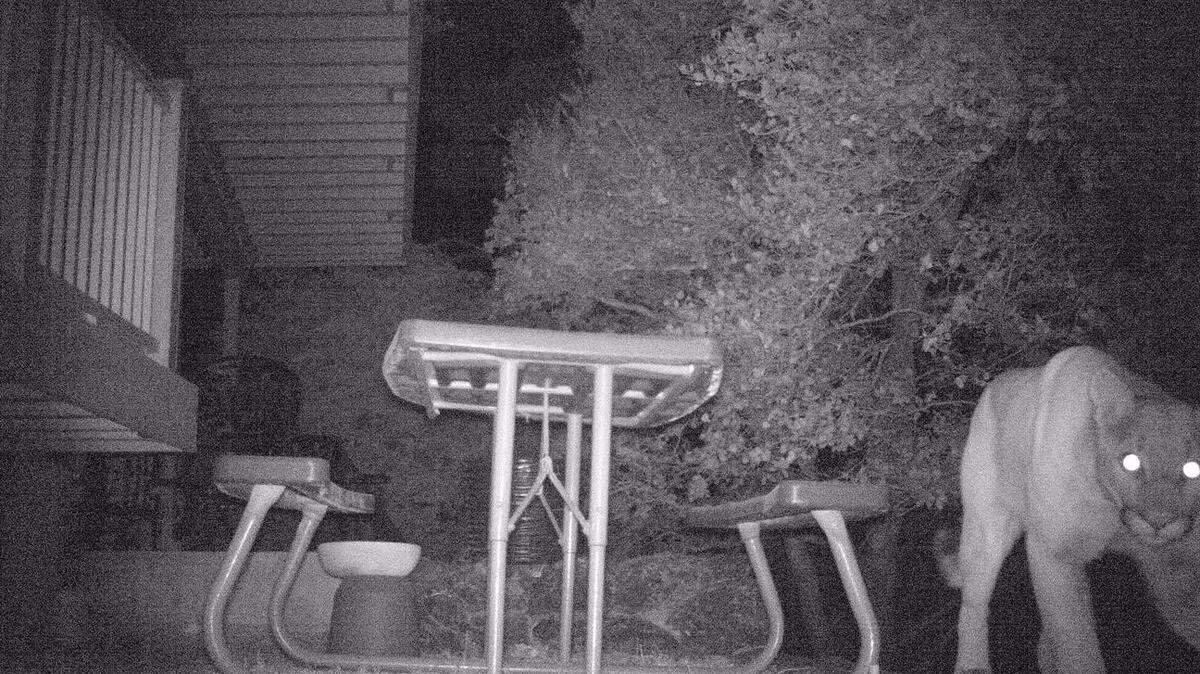
On Monday morning, Mark Berry checked his motion-detecting trail camera, which shoots via infrared at night, and was “shocked,” he said, when he checked its images.
There on one frame was a substantial, healthy-looking mountain lion, stalking past the family’s picnic table on the patio adjacent to the Berry’s home.
The camera noted the time as 10:19 p.m. Sunday.
That would be a perfectly normal time for a mountain lion to be on the hunt, according to Lt. Todd Tognazzini of the state Department of Fish and Wildlife.
But normal doesn’t mean safe.
After all, he said, an average big male mountain lion can weigh 135 pounds, with larger ones tipping the scales at 150 pounds.
Safety tips
Wise residents and visitors stay alert in wildlife territory, Tognazzini said, especially around predator species like mountain lions.
“Watch your kids in the backyard, especially in the early morning and after dusk, because most predation happens at nighttime,” he said.
If you see a mountain lion near you, “don’t try to run away,” Tognazzini said.
Lions can sprint at speeds of up to 45 miles per hour, according to the Mountain Lion Foundation’s website at mountainlion.org.
Don’t bend down or act afraid, or the lion could mistake you for prey.
Instead, Tognazzini said, “make yourself (look) big, grab a stick” or other potential defense weapon.
The website also advises making lots of noise, acting defiant, maintaining eye contact and taking other protective action to let the lion know you can be a threat, too.
‘Cambria is in lion habitat’
More than half of California is mountain lion habitat, according to Fish and Wildlife. Many of Cambria’s urbanized areas are prime lion territory interlaced with forested canyons, hills and creek habitats, rolling meadows and marine terraces.
“Cambria is in lion habitat,” Tognazzini said, “with lots of cover, lots of open space and creek areas in which the lion can wander around and not be seen … a typical male has a very large home range, maybe 25 square miles.”
And the area has lots of deer, which are a mainstay of a lion’s diet.
Cambria sightings are far from rare and are usually benign. One mountain lion wasn’t so lucky. Dept. of Fish and Wildlife warden had to euthanize the young-of-the-year female after it was grievously wounded in a car-vs-lion collision on rural Santa Rosa Creek Road in May.
That said, it’s difficult to know how many lions are in the area from Harmony to the Monterey County line, according to Ken Spencer, Fish and Wildlife’s new unit biologist in the area. He said “no super-good studies have been done here since the 1970s,” but that a new “capture-and-collar” study began recently.
Toward that end, it helps when people report seeing a lion because it tells the scientists where the big cats were ranging at that time.
Report sightings at 805-594-6175.
At your backdoor
The foundation explains that “living away from the crowded cities means having your own piece of land and plenty of room for children and pets to play. However, it also means wildlife is just outside your backdoor.”
Literally, for the Berrys.
They’ve seen one other mountain lion nearby, Mark Berry said, “a smaller one a few years ago, and have seen some paw prints.”
Their small dog is on a leash with them anytime she’s outside, he added, and they don’t keep food or water out, but “there are outside cats in the neighborhood … we have a lot of turkeys and deer out here that may be attracting” the mountain lion.
The lion may not be the only predator on the hunt in the neighborhood.
“We have been getting coyotes out here, as well,” he said.
The Berrys are doing the right things, Tognazzini said, especially since they don’t set out food or water for their dog or wild animals. But other Cambrians still feed the deer. And where there are deer, predators will follow.
“This may be a one-time sighting,” he said.
But remember, the Berrys didn’t see the lion. Their camera did.
“Lots of people are buying trail cameras and security cameras,” which is a good idea, Tognazzini said.
Photos can help a lot, Spencer said, because quite often that big cat someone thought they saw really was just a big cat, of the house variety, or a bobcat.
But when the equipment captures a photo of a visiting predator, people shouldn’t panic. Chances are good the mountain lion sees you a lot more often than you see it, officials say, and it doesn’t want to interact with you any more than you want to buddy up with it.
“If you see a lion in the wild, treasure your safety and that of the lion, and be grateful for the rare opportunity,” the foundation’s website says. “Many people work their whole lives in the wild and never catch a glimpse of this elusive creature.”
This story was originally published August 7, 2018 at 2:09 PM.