Cal Poly students learn to cook up synthetic cells in new lab course
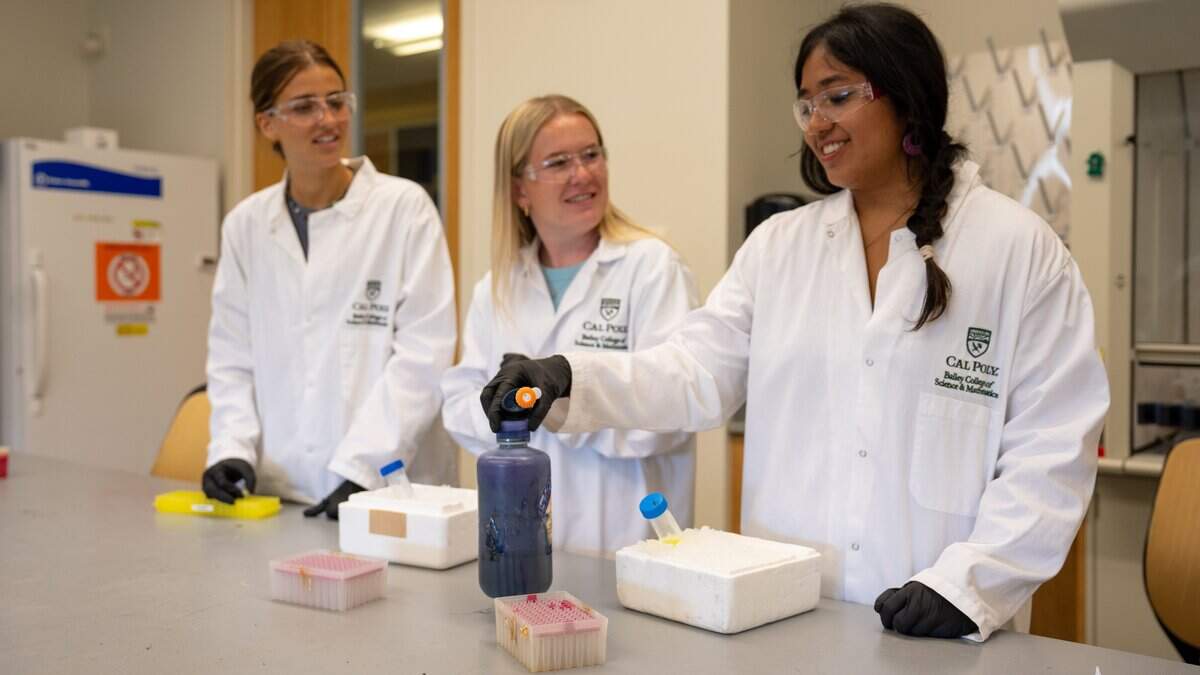
In a lab on the third floor of the Baker Science building at Cal Poly, students under the tutelage of Dr. Javin Oza are cooking up life in a bottle — or at least, the closest thing to it.
Dr. Oza, an associate professor of biochemistry, started teaching a class on the engineering and manufacturing of synthetic cells in this year.
Under Dr. Oza’s guidance, undergraduate students of the class have learned to assemble cells in batches of millions from the basic ingredients that make up organic life.
“Synthetic cells for us are kind of a proof of concept to say, ‘Look, we understand the principles of life, we put the parts back together, and we can get the engine running again,” Dr. Oza said. “It’s kind of like rebuilding a car from its parts — when the engine turns over and starts cranking, and it makes that awesome sound of an engine, you know you did the assembly correctly.”
Beyond the classroom, though, synthetic cells represent a possible emergent bioengineering technology that could be used in fields such as medicine, research, public health and more, Dr. Oza said. Only time will tell the full scope of their application.
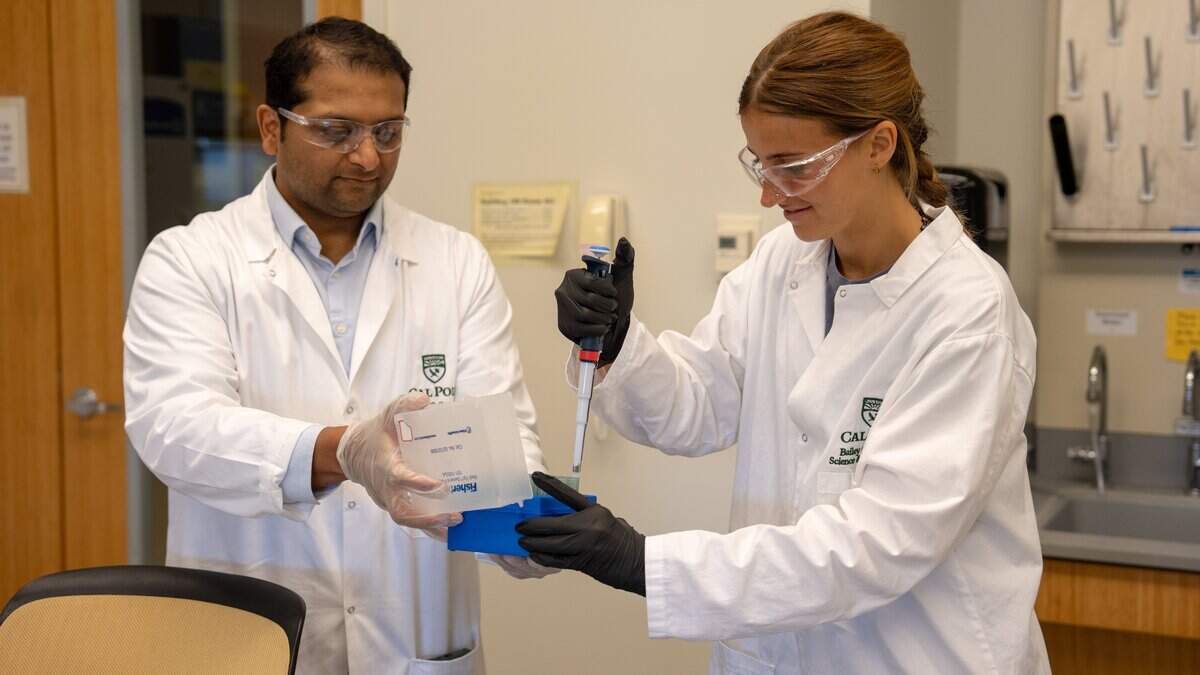
Fourth year biological science major Maia Lambson said she was invited to join the cutting-edge Engineering Synthetic Cells class after working with Dr. Oza as a teaching assistant, one of a handful of undergraduates with the know-how to break into a more advanced field of study.
“It’s actually surprisingly easy to build a cell,” Lambson said. “With my experience, it did take a little bit of practice to perfect, but most of the students were getting like pretty solid cells after the first time making the cell.”
How to make a cell from scratch
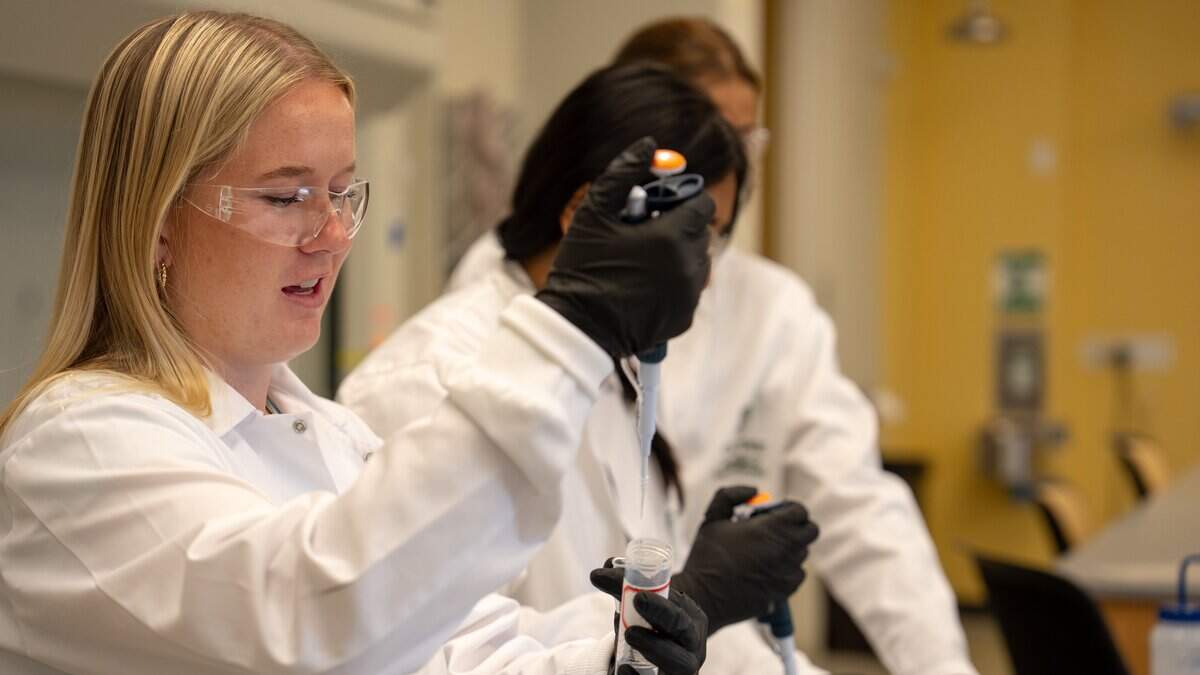
In the lab, students learn to disassemble and assemble cells from their base components to understand how each component is supposed to work.
On a basic level, cells are made of DNA, RNA and systems that process proteins into energy, Dr. Oza said. So long as you have those components, cells can be manufactured at scale by mixing them in the correct ratios.
Creating those components is “quite laborious,” so Cal Poly’s lab mostly focuses on building the cells from existing parts, he said.
That’s where support from the lab’s outside partner comes in. Dr. Oza and his students are working with b.next, a San Francisco-based applied research company that developed the open-source synthetic cell platform Nucleus, supported by a Schmidt Sciences grant that also funds partner labs at Northwestern University, the University of Michigan, University College London, Imperial College London and King’s College London.
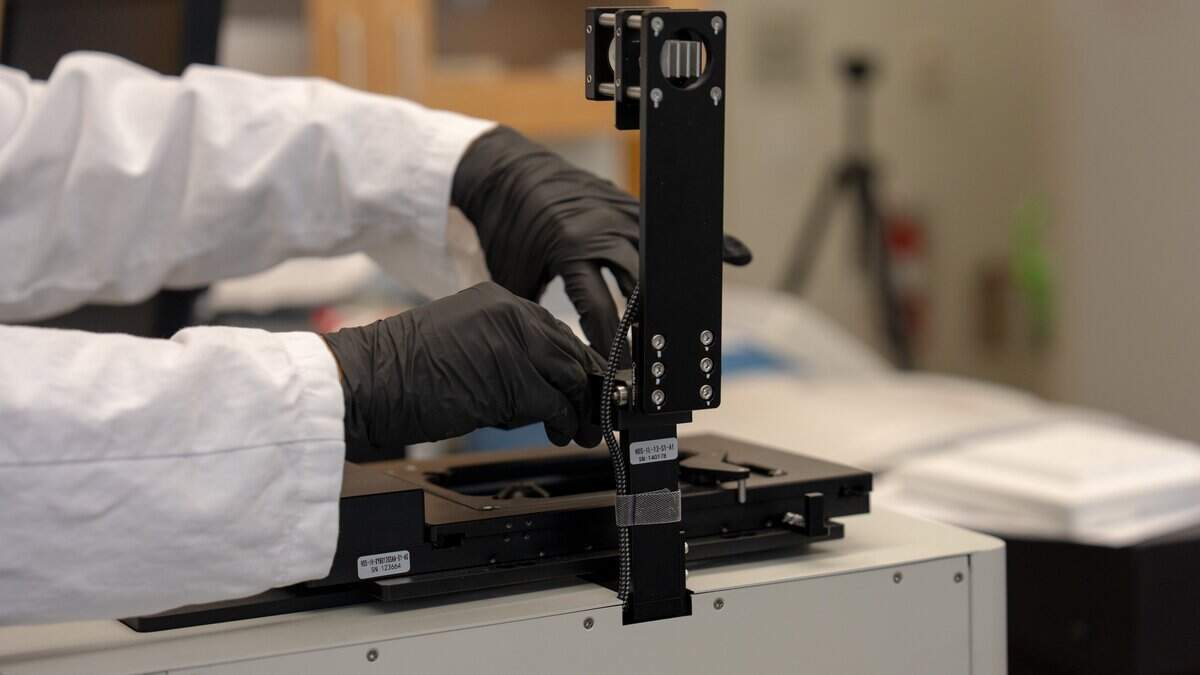
“Labs who do it completely from scratch will usually require PhD students to spend months and months to develop all of those steps,” Dr. Oza said. “For us, we’ve had a lot of support from industry and other academic partners who are part of this node supported by Schmidt Sciences, and so there are other groups and other nodes in our organization that are supporting us.”
In Dr. Oza’s lab, fourth year biological sciences majors like Grace Montgomery learn the assembly process using test batches of cells.
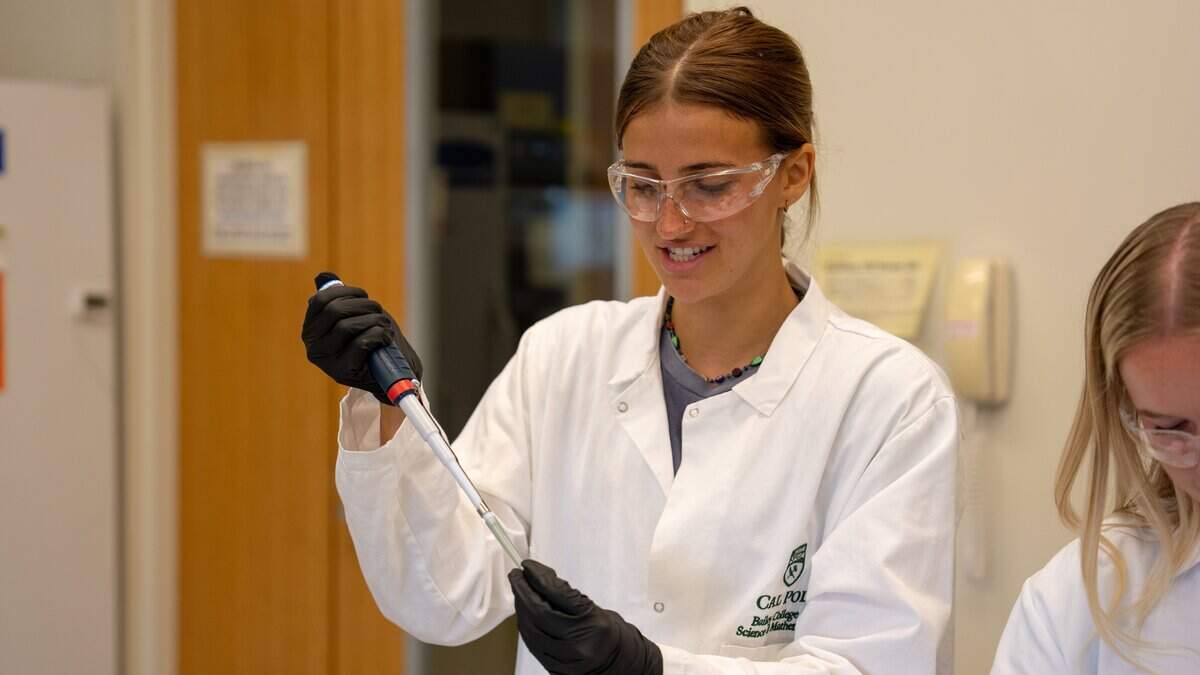
To assemble the cells, ingredients such as DNA, transfer RNA, ribosomes, energy systems and proteins are mixed for around 30 minutes in a test tube, while a solution of lipids — essentially, the compounds that make up fats — is prepared to receive the mixture, Montgomery said.
The solution of components is then mixed and centrifuged for 10 minutes, letting the processes of cell formation take shape, before the solution is deposited into a liposome solution on a microscope plate, she said.
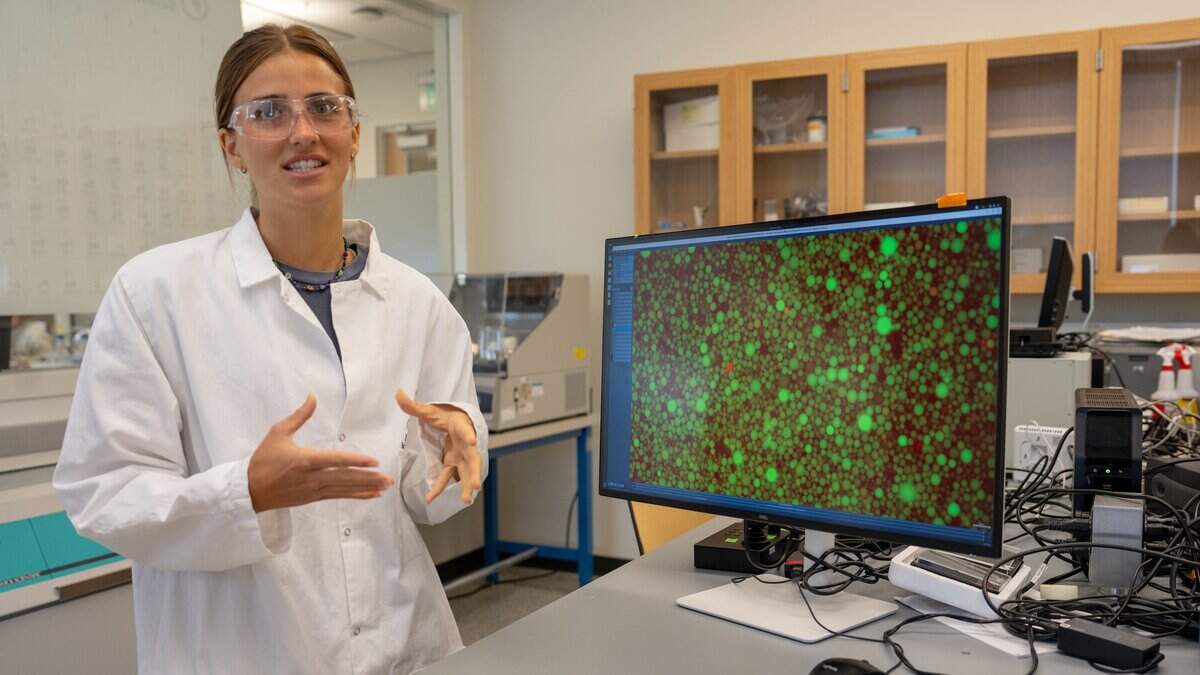
“We essentially make the outside layer of the cell, and then on the inside there are proteins that are being made via DNA that we give the cell,” Montgomery said, gesturing to a live view of a batch of cells under a microscope. “We give the cell all of the things that are needed for proteins to be made in the cell synthetically ... and then we can track how much protein is made over time by looking at how much brighter the cell gets over time.”
Real-world application of cells coming
While this may resemble creating life, synthetic cells are not alive because they can’t exist without human intervention, Dr. Oza said.
The first ever self-replicated synthetic bacterial cell was created in 2010 by the J. Craig Venter Institute, but the cells like the ones created in Cal Poly’s lab are a far more recent development.
Dr. Oza said because the field of study is relatively new, real-world applications of the cells are still developing.
The easiest application of the technology would generally fall under the umbrella of sensors, using cells programmed to react to specific changes in conditions, whether that’s light, the presence of certain types of bacteria or other external stimuli, Dr. Oza said.
“Let’s say you were testing, (whether) this water safe to drink, or do I have this contaminant in the water, and then maybe you can have like a little Post-It stamp size, little block of Jell-O, and you drip some water on it, or dunk it in that water sample,” Dr. Oza said. “All of a sudden, it will sense the molecule, or the thing you’re worried about, and then respond by changing a color pattern that generates a QR code that would, if you can scan that QR code with your phone, say, ‘Oh, it’s safe to drink,’ or, ‘Don’t drink this.’”
That Jell-O-sized block of synthetic cells could be assembled within a day, which speaks to the speed at which the cells can be manufactured, Dr. Oza said.
Because the synthetic cells are incapable of replicating on their own — a feature of their design, not a bug — the synthetic cells would not be capable of mutating or infecting the body’s systems, Dr. Oza said.
Biosensors could be used both inside and outside the body to detect the presence of specific pathogen, potentially eliminating the need for certain types of invasive imaging, he said.
“What if you could have it stay dormant and only activate later?” Dr. Oza said. “What if you could embed these into materials? What if you could augment a table with sense and response, or maybe even structural properties, things like that.”
Lambson said the ease of building synthetic cells opens the door to exciting scientific developments in the near future.
“It’s just really fascinating that we’re able to do such amazing science pretty easily,” Lambson said. “Obviously the materials are a little bit difficult to get, but once you have it, it’s a very easy process for the most part.”