What are the leading causes of death in SLO County? 5 takeaways from the latest health data
SLO County has seen a decrease in coronary heart disease and a rise in accidents and drug overdose deaths, according to the most recent community health data.
But it’s one of the worst counties in California as far as death and injury rates for bicycle crashes.
These findings and others are represented in the latest data from SLO Health Counts — a coalition of community members, leaders, nonprofits and county health professionals that collaborates to inform the public about community health and improve access.
With data going back to 2011, the most recent update covers the leading causes of death in SLO County through 2022 based on data from this year’s County Health Status Profiles from the California Department of Public Health.
The overall leading cause of death in 2022 was heart disease, but this varied across age groups, ranging from drug overdoses and accidents for younger people to chronic and cardiovascular illnesses and strokes for older residents.
Overall, women in SLO County have a life expectancy of 83.8 years, while men are at 79.1.
Here are five key takeaways from the data.
Death rates still higher than state averages for overdoses, accidents, suicides and strokes
SLO Health Counts compares the county’s health data to statewide averages — and some trends have remained consistent over the past decade.
“Broadly speaking, San Luis Obispo County is doing very well in terms of causes of death,” County Public Health Department epidemiologist Roxanne Archer said. “We’re a generally fairly healthy county, but there are, of course, some areas where we have historically had rates of death that are higher than the state average.”
Those include deaths by stroke, accidents, drug overdoses and suicide, Archer said.
She said the county’s death rates for all four of those categories have been higher than the state average for all data available since 2011.
While the county death rates due to suicides and strokes have held more or less steady over the last decade, the local and statewide averages for death by accidents and overdoses have both increased notably in recent years, with SLO County consistently remaining a bit higher than state averages, Archer said.
In 2020-22, the three-year averaged age-adjusted death rate for drug overdoses in SLO County was 40 for every 100,000 people — which is the number of deaths divided by number of people that live in that area to help reduce the impact of age on the data — while California’s age-adjusted death rate due to drug overdoses was only 25 per 100,000 people.
That’s up from several years where that number was in the high teens, from 2011 to 2019, before it started to rise.
For accidents — defined as “unintentional injuries” — the county’s age-adjusted death rate was 60 in contrast to California’s rate of 48.
That number has also seen a recent spike, going from the mid-30s from 2011 to 2019, before increasing to 43 in 2018-20, 54 in 2019-21 and 60 in the most recent three-year average.
For deaths by suicide, the county age-adjusted death rate of 16 was above the state’s rate of 10, but that number has held steady ranging from 16 to 18 in each three-year average.
And for strokes, the county age-adjusted death rate of 56 was well above the statewide death rate of 37. That number has also held steady.
Archer said there could be some overlap between these categories that may compound the data — for example, between accidents and drug overdoses.
Opioid-related deaths at an all-time high
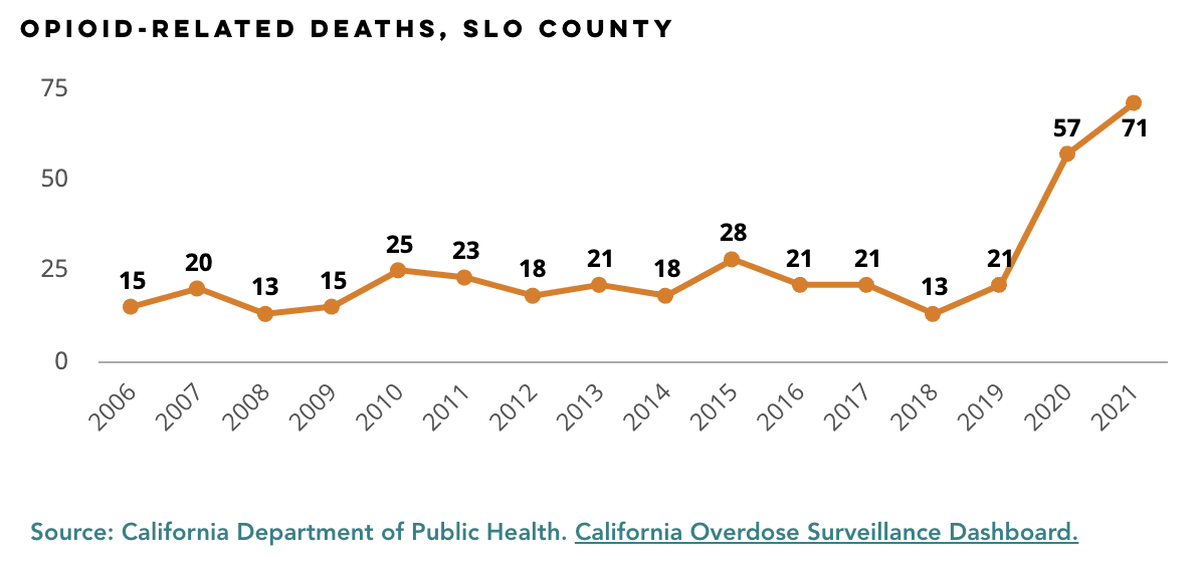
The majority of all drug overdose deaths involve opioids, and opioid-related deaths in SLO County reached an all-time high in 2021, according to the most recently available Health Counts data.
According to the data in that report, 71 people in SLO County were killed by overdoses involving opioids in 2021 — a significant uptick from the 21 opioid-related deaths just two years earlier.
This gave SLO County an age-adjusted death rate of 25 opioid-related deaths per 100,000 residents in 2021. By comparison, California’s age-adjusted death rate of opioid-related deaths was 18 in 2021, according to the state public health department.
The data shows that before 2019, opioid-related deaths remained generally low and steady at around 15 to 20 deaths per year, on average.
The recent increase can be attributed to the rise in fentanyl use in combination with non-opioid stimulants or tranquilizers such as Xylazine, a powerful animal tranquilizer that does not respond to the opioid overdose reversal effects of Narcan. Xylazine was recently designated an emerging threat by the Biden administration.
Drug overdoses now kill two to three times as many people as car accidents, more than four times as many as homicides, and more than either diabetes or lung cancer, according to Sacramento consulting group California Healthy Policy Strategies.
The Health Counts data on opioid-related deaths only goes through 2021, but the county Sheriff-Coroner’s Office suggests that drug overdoses may be decreasing so far into 2024 after spiking in 2023, when a total of 84 deaths were recorded by that office.
While the county had already seen 52 opioid-related deaths by early July 2023, it had only documented 25 opioid-related deaths by the same time this year, according to data from the Coroner’s Office obtained by The Tribune.
Additionally, only 7 of the 84 total opioid-related deaths recorded by the county Coroner’s Office in 2023 — and none in the 2024 data collected so far — involved Xylazine.
Decrease in deaths from diabetes, coronary heart disease and firearms
Some other trends that have been historically lower than the state average have remained so and even saw a decrease in the most recent data, Archer said.
That includes coronary heart disease, which is especially impressive given SLO County’s aging population, she said.
The overall leading cause of death in SLO County in 2022 was heart disease in general, but local cases of coronary heart diseases specifically went down.
In 2020-22, the three-year averaged age-adjusted death rate for coronary heart disease in SLO County was 52, compared to California’s 77, according to the Health Counts data.
Archer attributed the already low and improving rates of coronary heart disease to SLO County’s physically active lifestyle and population.
“Heart disease can be ... ameliorated by physical activity, and we have a very healthy, active community here,” Archer said. “We have relatively low rates of smoking, especially among our older population, so that might help to explain why our rates have been lower than the state.”
She said the same thing is true for diabetes, too.
In 2020-22, the three-year averaged age-adjusted death rate for diabetes was 13, while the most recent statewide rate was 24.
Though SLO County’s age-adjusted death rate for diabetes has consistently averaged below the state’s, the latest data indicates that the county might be doing slightly better than usual, Archer said.
“Our rate seems to be holding relatively steady, whereas in recent years, it looks like the state trends are ticking up just ever so slightly.” Archer said.
She noted a similar change with deaths by firearms, too, for which the county’s age-adjusted rate dipped below the state’s as it slightly increased in the latest readings from Health Counts.
The death rate for firearms in SLO County has historically fluctuated above and below the state’s in 2020-22. SLO County saw an age-adjusted death rate of 7 compared to California’s 9 for the same timeframe.
SLO County ranks 4th in state for rate of victims killed, injured in bike accidents
In SLO County, the rate of deaths and injuries from accidents remains one of the more striking changes in recent years.
The three-year average of 60 for accidents was 50% higher than drug overdoses at 40.
That number is reflected in the 2020 rankings from the California Office of Traffic Safety.
There, SLO County ranked fourth in California for rate of people killed or injured in bicycle accidents. — where No. 1 in the rankings is the highest rate or the “worst” and 58 is the lowest and “best.”
San Luis Obispo County ranks 39th out of 58 counties in the state for the rate of pedestrians who are injured or killed in accidents.
What are the most common causes of deaths by age group?
The Health Counts data aggregated the five leading causes of death for different age groups in SLO County and the state from 2017 to 2022.
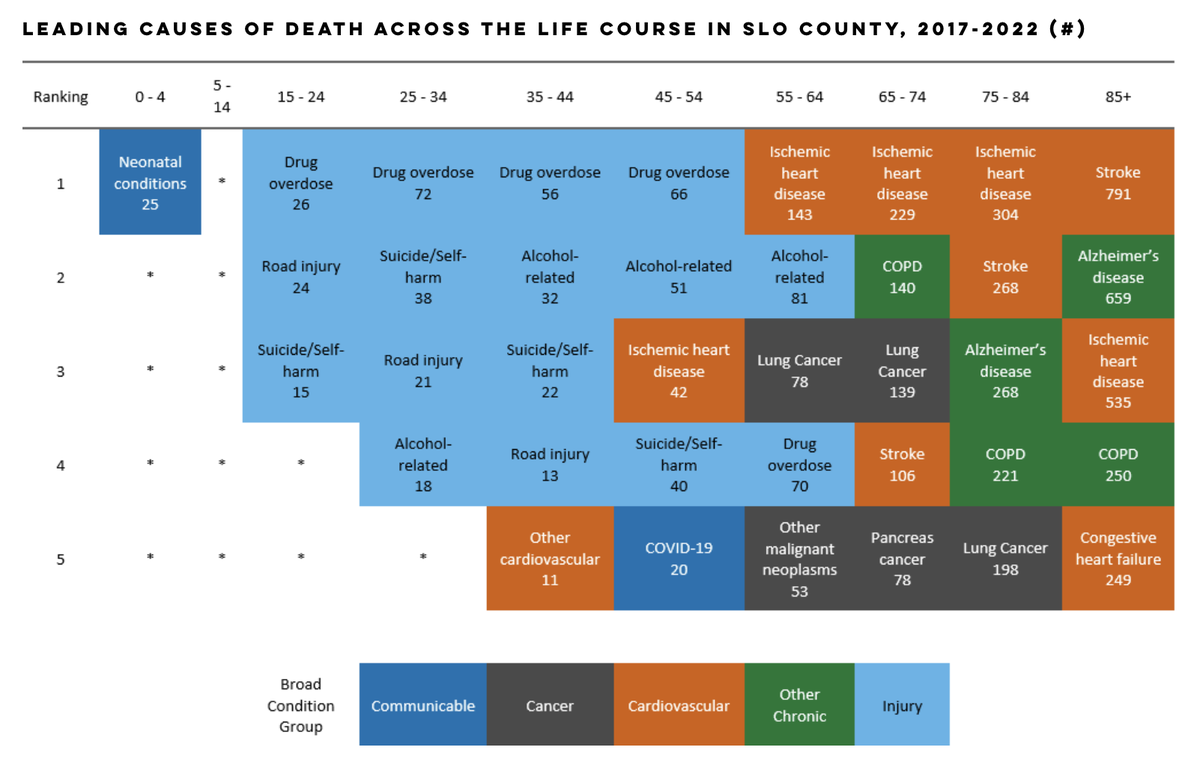
In general, the data shows a progression from multiple leading causes in the youngest age groups, to injury in the middle age groups, to cardiovascular, cancer and other chronic diseases in the older age groups.
COVID-19 also appeared as a leading cause of death statewide in the middle and older age groups in the pandemic period, the data shows — however, this trend is not consistent in SLO County.
Among Californians aged 15 to 44, the No. 1 cause of death was drug overdose, followed by road injuries, homicide and then suicide.
The county was generally on trend with the state, with drug overdose ranking highest through adults 54 years old.
Among older adults statewide and in SLO County, multiple cardiovascular conditions, strokes and Alzheimer’s disease account for the leading causes of death.