‘A new life’: How SLO County is vaccinating thousands of farmworkers with one-dose COVID shots
San Luis Obispo County’s farmworkers have put their lives at risk to keep the area’s agriculture industry going during the coronavirus pandemic — now they’re finally getting vaccinated.
The county Public Health Department is holding a series of clinics to get COVID-19 vaccines into the arms of farmworkers, who might otherwise struggle to access shots. So far, the county has given 1,800 coronavirus vaccines to farmworkers at these clinics, said Michelle Shoresman, a Public Health spokeswoman.
Many farmworkers identify as Hispanic or Latino — a community that has contracted COVID-19 at double the rate of any other race or ethnic group in SLO County.
They’ve also received just 7.9% of the county’s coronavirus vaccines, compared to white residents, who’ve received 31.9% of the shots, according to state vaccine data.
The farmworker vaccine clinics are part of a larger Public Health strategy to shift those numbers, Shoresman said.
“This is a collaborative effort among the county, the SLO County Farm Bureau, the (Promotores Collaborative of SLO County), Herencia Indígena and many of the farms and agriculture employers who will be supporting their staff in getting the vaccine,” she said in an email.
Public Health in March held farmworker vaccine clinics in Arroyo Grande and Paso Robles, where about 600 people received shots at each site.
After another clinic this Friday, Public Health “working on some new other modes of administration, including smaller clinics in locations around the county where people of color live and work,” Shoresman said.
“We will also start reaching out with vaccination opportunities to other sectors of the economy, including other parts of the food and hospitality industries. People with mobility issues and other disabilities will also be an additional focus,” she added.
The county is using most of its Johnson & Johnson one-dose coronavirus shots at its farmworker clinics, to make it easier for recipients to be fully vaccinated and to prevent the need for follow-up appointments, Shoresman said.
The North County clinic was held at the Paso Robles Event Center, where farmworkers’ vehicles filled the Riverside Avenue parking lot, and vaccine recipients were greeted by the sounds of a Spanish-language music mix that included Selena and banda musicians.
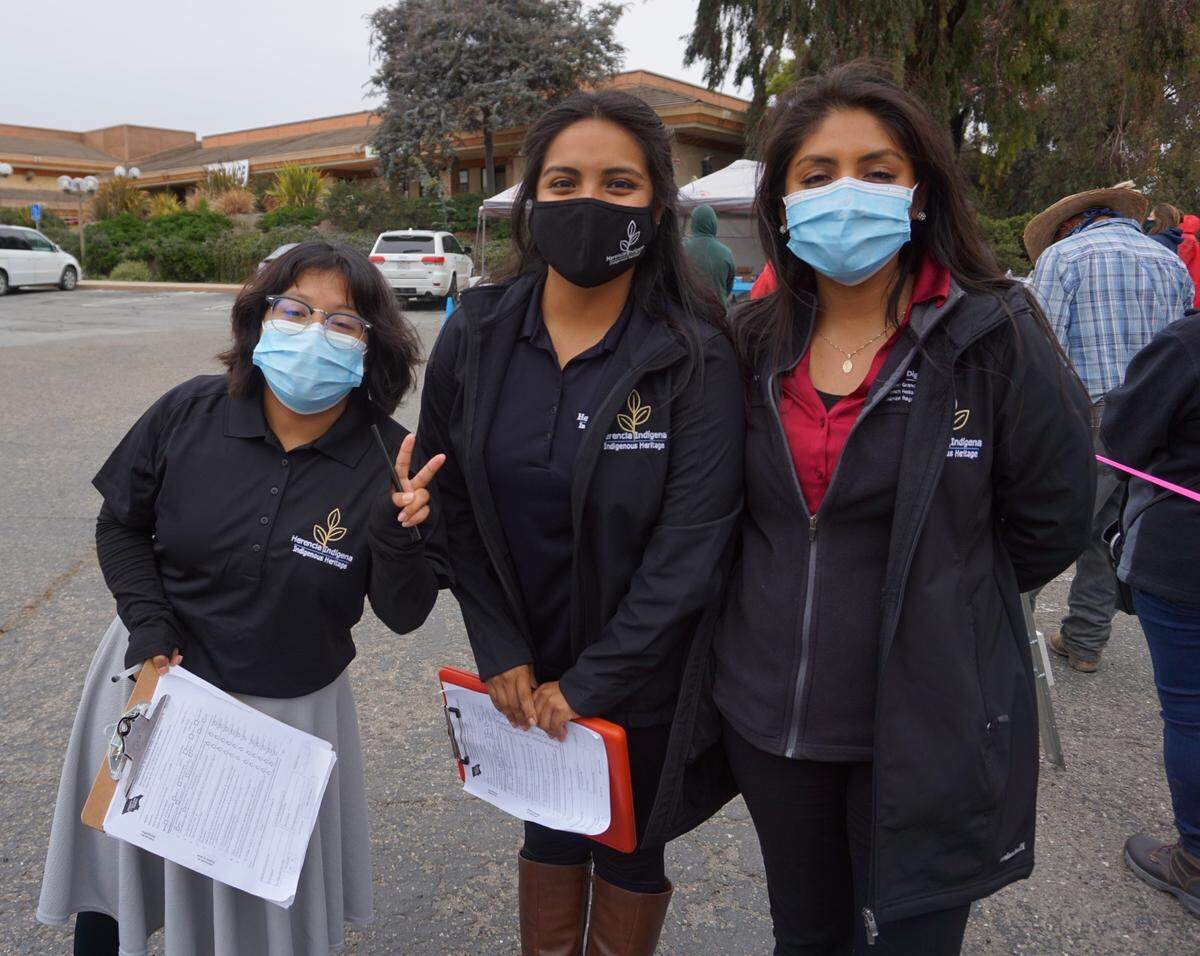
Members of the Promotores Collaborative and Herencia Indígena — organizations that serve residents who speak Spanish and Mixteco, a language indigenous to regions of Mexico — welcomed the farmworkers and helped guide them through the vaccination process.
Public Health organized the event with help from agriculture employers, who reserved appointment blocks for their workers, and, in some cases gave them paid time off to attend the event.
“There’s some companies that we work with that we’re so proud of them, supporting their employees,” said Laura Zarate, Latino outreach coordinator for the Public Health Department. “They requested education on the vaccine. Since the beginning of the pandemic, we provided education (to) several wineries here in Paso, and I think that’s huge.”
Breaking down farmworker vaccine barriers
Farmworker communities face many barriers to getting the coronavirus vaccine, from language and literacy challenges to technology gaps and misinformation, Zarate said.
Some farmworkers don’t have computers or internet access, which makes it nearly impossible to sign up for vaccines online, she said. Others have limited literacy skills and may not be able to read and write in their own languages. They come to the United States to “work and provide (for) their family,” Zarate said.
“It’s not as easy,” she said. “I mean, that there were so many people inside (the vaccine clinic) that I spoke with that they don’t read and write in Spanish. So they’re not computer literate, and that’s a barrier. I mean, not even in their own language. They’re not very fluent in their own language — so, much less in English or getting on a computer.”
Some farmworkers are eager to get their “life-changing” shots as soon as they can and have been waiting to get an appointment, Zarate said. Others have pushed through their fear to keep their families safe, she said.
“You know, the people that did decide to come, or they ended up changing their minds ... they want the best for the community. They want the best for their families,” Zarate said. “Some people that I spoke with have actually (had) relatives that passed away, or they got gravely ill because of the illness. So they were scared, and they want to protect their relatives.”
Some farmworkers are still scared to be vaccinated and typically avoid accessing government services because of their immigration status, Zarate said.
“Us Hispanics, we’re pretty superstitious,” she said. “So trust is a big issue for us. And we hear our relatives say that, you know, the vaccine is not safe enough. They hear that it has a microchip. So they’re afraid. They’re genuinely just afraid, and they need to be educated.”
‘That’s what the vaccine means for me — a new life’
The vaccine recipients who received their shots at the Paso Robles clinic were grateful and excited for their families’ lives to get back to normal.
Maria Antolino of Paso Robles said she heard about the vaccine clinic from a friend at her child’s school. She had struggled to find appointments at pharmacies before coming to the Event Center to get her shot.
“It’s important to get the vaccine right now to help protect my family more because (the virus) is all around us, going to the store, eating,” Antolino said in Spanish. “I want to be more secure with more people around.”
Vicente Hernandez of King City works in the Paso Robles area as a trimmer in various vineyards. He said the vaccine means “a new life” for him and his family.
“It means a lot of things,” Hernandez said in Spanish. “It means being more free and personal safety, and so much for those surrounding you, like your kids and for the world at large.”
The coronavirus impacted his family in many ways, especially because they also own a restaurant, Hernandez said. They were able to keep the business going with takeout-only operations, and they’re excited to be able to open for limited in-person dining now.
“It was a change that we didn’t expect,” Hernandez said. “It was huge. With the kids out of school, they’d say, ‘Papa, let’s go to the park.’ I’d say, ‘Tomorrow.’ And my girl, who’s 7 years old, would say, ‘Papa, you said tomorrow. Now it’s tomorrow. Tomorrow is here.’ And then I’d say to her again, ‘Tomorrow, tomorrow.’ But I was scared to take her to the park with everything that was going on. It was very difficult, but we adapted.”
This story was originally published April 9, 2021 at 5:00 AM.