We are ‘rationing health care’ — SLO County doctors face COVID-19 with limited supplies
Doctors at some urgent care centers and family practices in San Luis Obispo County are short on supplies and lacking access to the tests needed to respond to the public health emergency brought by the coronavirus, several health care providers told The Tribune.
Staff and patients are stressed by long waits, they said. Testing is limited to only people who meet certain criteria. And doctors are using makeshift supplies, or using them sparingly, as online orders are canceled due to shortages.
Meanwhile, spokespeople for large medical companies Tenet Health Care and Dignity Health say they do have the necessary equipment and are prepared for a surge.
On Tuesday, the county Public Health Department asked local physicians to “step it up,” as the public lab reached capacity to test people showing symptoms. But the private sector is also limited by the market on what services it can provide to patients.
Dr. Deborah Cherry, a primary care provider in San Luis Obispo, said she “absolutely does not have the equipment or test kits needed.”
“That, and the unbelievably slow preparation in the USA, considering the virus was in China three months ago, is very frustrating for medical providers,” she said.
There’s a nationwide shortage on personal protective equipment (like N95 masks) needed to safely collect specimens from patients to send to labs for testing. Availability of test kits is also limited, and test results take days to receive.
When asked what her top request is for the state and federal government, county Health Officer Dr. Penny Borenstein said: “To make laboratory testing easily available far and wide for all people who have any manner of symptom.”
And that, she said, is “absolutely connected to (medical providers’) need to have personal protective equipment to feel safe.”
The Tribune heard from several local medical providers about whether they have what they need right now. Here’s what they said.
Some care centers ‘doing the best we can’
Dr. Eric N. Sorensen, owner and medical director of Central Coast Urgent Care Inc., said “we don’t have a lot of personal protection equipment,” but “it’s enough to start with.”
His biggest concern at the onset of the virus spreading stateside was that he received no guidance or materials, and no way for his staff to protect themselves, even as public officials directed people to “go see your doctor.”
That improved this week, Sorensen told The Tribune.
His centers in Atascadero, Morro Bay and Pismo Beach are able to provide routine health care and screening. Then send patients elsewhere for testing.
Responses are taking about three days. “There is a quicker test out there, but we don’t have it,” he said, adding that he doesn’t blame the county health department for that.
As a state and country, he said, “we weren’t ready for this at all.”
“I think there is a shortage of testing. I think anyone with symptoms would like to be tested,” Sorensen said. “The term is ‘rationing health care.’ That’s what we are doing.”
For now, “we’re trying to do the best we can with what we have.”
Pediatrician is ‘operating in the dark, essentially’
A lack of guidance provided to local physicians when the virus first appeared in California left Arroyo Grande pediatrician William Morgan to call the Sheriff’s Office’s emergency line just to get in touch with the public health officer.
“It was getting so difficult to know what to do,” Morgan told The Tribune, as he described not being able to reach Public Health to figure out what to tell a family. “We were really struggling.”
Without clear guidance, he said, “we’re operating in the dark, essentially.”
He believes testing a large number of people, even those who don’t show symptoms, is essential to preventing spread of the virus, adding “if you’re just looking for sick people, you’re missing nearly everybody.”
The county’s shelter-at-home order was the right move, he said. But, in general, actions from the government at every level have been too slow coming.
“This is a pretty disappointing federal response. That’s putting it mildly,” Morgan said.
“I started realizing, this is going to be up to us locally. Everybody is in the same boat. It’s like we’re rowing with one oar and the boat is leaking.”
Right now, his office has only received three test kits, and staff can’t collect specimens from patients who have symptoms because they don’t have personal protective equipment, including N95 masks.
Before he decided that staff wouldn’t test without masks, they collected samples for two patients out in the parking lot to prevent a potential spread in the office. Four days later, they still hadn’t received results.
Meanwhile, he said, doctors in China and Italy are testing people five times over a two-week period.
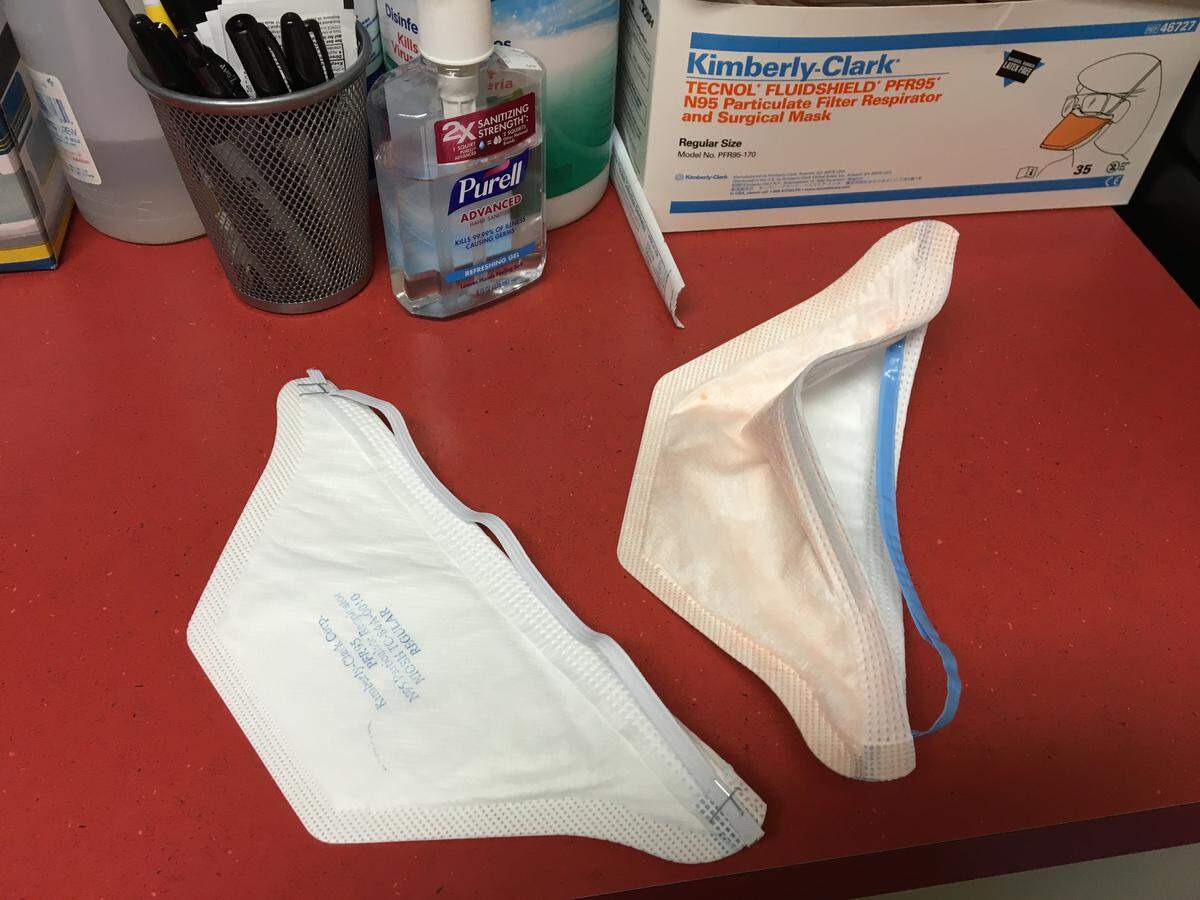
His practice did receive a box of 75 masks from the county Public Health Department the week of March 15, only to find they were defective. The straps broke as soon as he put them on. He went to Beverly’s Fabrics, bought a roll of elastic, and stapled strips to the mask.
“This is not how it should be done in the United States of America,” Morgan said.
It’s taken ‘hours and hours to get what we need’
Brian Roberts, the medical director of Med Stop Urgent Care on Madonna Road in San Luis Obispo, agreed it’s been “extremely hard to get supplies.”
“It has taken two people in our office working for hours and hours to get what we need — masks, swabs, collection containers, and things like medical goggles, gowns and more,” Roberts said.
The clinic has two-hour waits for patients to see a medical professional, and currently its biggest challenge is handling high demand for services.
The clinic set up a tent outside to make sure people who are tested are properly separated, and staff was trained to separate those who have urgent-care matters unrelated to COVID-19, such as lacerations, and those who are showing symptoms of the illness.
Samples are collected only from patients who are screened for symptoms such as fever, coughing and shortness of breath.
The clinic has enough COVID-19 collection kits for the time being, but Roberts is concerned about an uptick in cases countywide and how that might impact medical supplies, as well as whether the clinic’s staff might get sick, which could further impact operations.
Potential COVID-19 samples are sent to county Public Health and private labs, including WestPac labs. The turnaround time for results is two to five days, but the wait could be longer as cases increase.
“We’ve tested hundreds of people, and we’ve probably had just one or two positives back,” Roberts said.
Big hospitals say they are prepared
Megan Maloney, a director of marketing for Dignity Health, told The Tribune that the company’s hospitals and health centers are prepared, ready, capable and open right now.
She contacted The Tribune after this story first published online to say that while some facilities “might have issues, Dignity Health does not.”
“We have (personal protective equipment) at the ready. We have our surge tent up and ready. Our Urgent Cares, along with our hospitals, can swab symptomatic patients and send to the labs for testing. We also have the old Emergency Department that can be used for overflow if necessary for inpatients or a triage area. We have been several times a day to ensure supplies are ready, space is available, how to expand if all our surge space might be occupied etc.”
Similarly, Tenet Health Care, which operates Sierra Vista Regional Medical Center and Twin Cities hospital, said that it’s gathering samples and sending them off for testing at County Public Health, indicating it has the necessary supplies.
“Our hospital has taken the appropriate steps, and we have trained professionals and the necessary equipment to react accordingly,” said Tenet Health Care in a statement. “We can safely and appropriately care for our patients with the necessary supplies and equipment.”
However, an emergency room physician who works in a local hospital for one of those large companies told The Tribune that health care is being rationed.
“Because we have such limited testing availability right now, and there is no immediate resupply expected, we are restricting the tests to only patients where it is expected to directly affect treatment,” said the doctor, who asked to not be named.
“We do this already during flu season, but clearly the stakes are higher with the increased mortality and treatment needs of these patients. This is where the testing results really play a role in the treatment of the patient, and this is why we need to restrict their use ... at least until we have them in ample supply, at which point from an epidemiological standpoint it would be advantageous to know exactly how prevalent this virus is in our community.”
Are medical supplies headed to SLO County?
At a news conference Friday, Borenstein said the department has what it needs for a few days. She called the supply chain for testing materials “tenuous,” and said she hopes it will improve soon.
“What I hear out of the federal government is all of those components of the test should be freeing up and being made available on an ongoing basis,” she said. “But, we are still feeling a little skittish about the availability over the long haul. I hope and look forward to the supply chain issue going away once and for all.”
As for personal protective equipment, she said, it’s “not in the time frame we’d like to, but we have been managing getting the materials that are requested through the emergency operations center to the health care community.”
This story has been updated with information from Tenet Health Care and Dignity Health and to reflect services three urgent care centers are providing.
This story was originally published March 21, 2020 at 5:00 AM.