
Wildfire updates: Improved containment on Caldor Fire has crews ‘hopeful for repopulations’
Aided by moderating weather, fire crews on California’s two largest wildfires continued to make progress over Labor Day weekend, and improving containment on the Caldor Fire could bring more lifted evacuations in the days ahead.
Lighter winds in some areas have been reducing the spread of flames, and fire crews were quick to take advantage by doubling down on burning and cutting fire lines around the Caldor Fire and parts of the Dixie Fire.
The Dixie Fire, which has burned through parts of Butte, Tehama, Plumas, Shasta and Lassen counties, is the second-largest wildfire ever recorded in California history.
Meanwhile, the Caldor Fire burning in El Dorado and Amador counties remains a high priority for fire officials. The wildfire has forced evacuations of much of El Dorado County and has displaced many others in surrounding areas.
South Lake Tahoe residents were allowed to return Sunday, and fire officials could bring more good news in the days ahead.
Here’s the latest, as of Sunday morning:
Caldor Fire
The Caldor Fire has burned 215,400 acres and is 43% contained, making it the 15th-largest wildfire in California history.
On Sunday, evacuation orders for the city of South Lake Tahoe and other nearby areas along the western shore of Lake Tahoe were reduced to warnings, allowing residents of the city to return home after being ordered east toward Nevada last week.
Crews reported favorable conditions over the weekend, allowing for a chance to strengthen control lines.
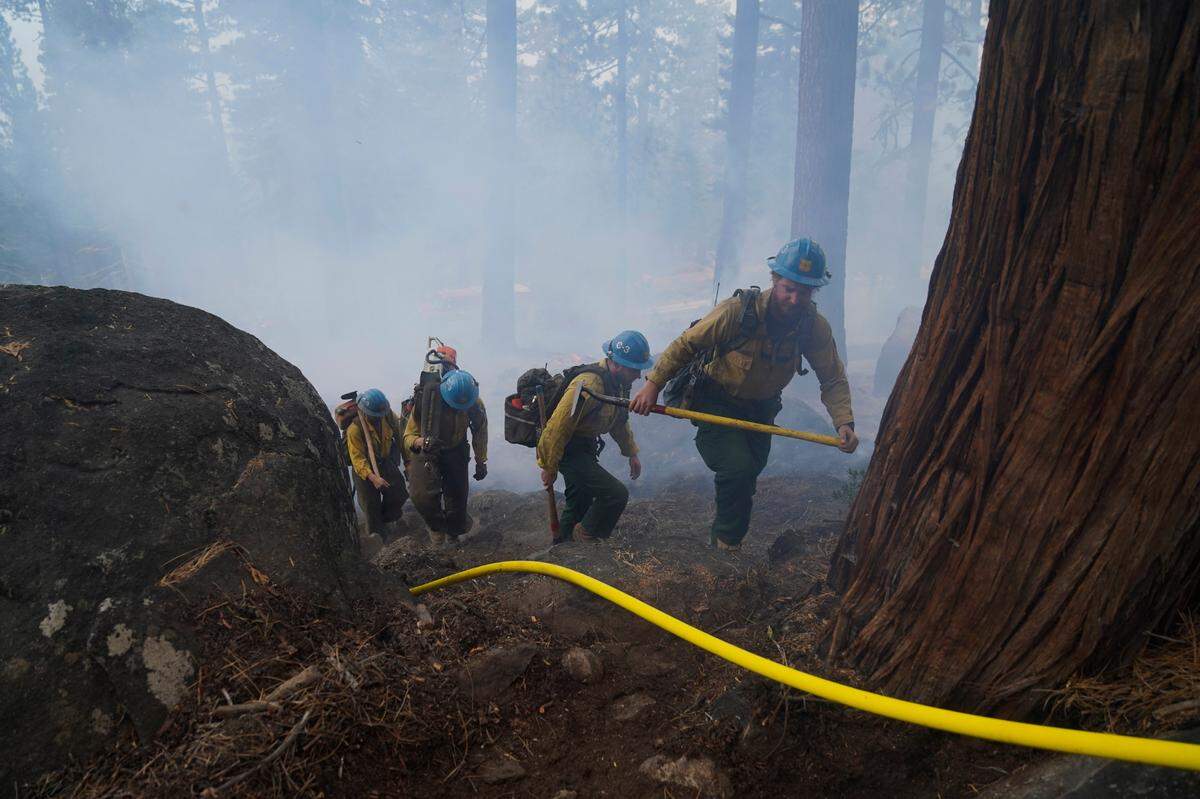
Bulldozers with giant blades, crews armed with shovels and a fleet of aircraft dropping hundreds of thousands of gallons of water and fire retardant helped keep the fire’s advance to a couple of thousand acres — a fraction of its explosive spread last month and the smallest increase in two weeks.
By Sunday, the Caldor Fire saw an even smaller spread, adding less than 1,300 acres as containment jumped up by 6% and weather conditions remained good.
“The incident continues to look better and better every day,” Tim Burton, an operations chief with the California Department of Forestry and Fire Prevention, told firefighters at a Saturday briefing. “A large part of that is due to your hard work as well as the weather cooperating in the last week or so.”
The northeast section of the immense Sierra Nevada blaze was still within a few miles of South Lake Tahoe and the Nevada state line but fire officials said it hadn’t made any significant advances in several days and wasn’t challenging containment lines in long sections of its perimeter.
Another area of concern is the southern edge of Echo Lake, where rough terrain has made the fire fight difficult for crews. Fire teams are prepared for structure protection efforts along Pioneer Trail and elsewhere along the north flank of the fire.
A Sunday morning update indicated that the weather was holding and crews were still able to take advantage of slow fire activity.
“Firefighters continue their aggressive mop up operations and direct firefighting tactics in all areas of the fire, holding the fire within containment lines,” officials said. “Firefighters are hopeful for repopulations of some of these communities in the coming days when it is safe.”
On Friday, some evacuation orders were reduced to warnings for areas on the west side of the fire. Residents of parts of Sly Park, Grizzly Flats West and all of Happy Valley were allowed to return, along with residents of Gopher Hole Road and Moonshadow.
But there was no timeline for allowing the return of several thousand El Dorado County residents. Authorities were taking that decision day by day.
“It’s all based on fire behavior,” said Jake Cagle, a fire operations section chief. “For now, things are looking good ... we’re getting close.”
On Saturday, some evacuation orders in Douglas County were lifted. The areas of Upper Kingsbury south, Upper Kingsbury north, Central Kingsbury and Lower Kingsbury were all allowed to repopulate.
As of Thursday, the Caldor Fire had displaced about 48,000 residents, according to the Governor’s Office of Emergency Services.
Fire officials said that 27,670 structures still remain threatened by the fire, which has already destroyed 712 homes. Another 190 minor structures have been burned by the blaze.
Fire crews expect the Caldor Fire to be fully contained by Sept. 27. Seven firefighters and two civilians have been hurt by the fire. A total of 4,954 fire personnel are assigned, plus 31 helicopters, 350 engines and 90 dozers.
El Dorado County officials on Friday took steps to curb barbecuing at public parks ahead of the Labor Day weekend due to concerns over fire activity. Although fires and barbecue use were already prohibited, officials said they would be covering, locking or removing barbecues at county parks.
Sierra-at-Tahoe: ‘We will be back’
In a statement emailed to The Sacramento Bee, officials of the Sierra-at-Tahoe ski resort said that recent updates from fire officials have encouraged plans to resume operations this winter season.
“We will be back, to celebrate our 75th anniversary with our Sierra Family this winter,” general manager John Rice said in a prepared statement.
The Caldor Fire caused minor damages at the ski resort as it burned into the Tahoe Basin last week. Resort officials said that the Nob Hill and Castle Creek areas appeared to be the most impacted by the fire, but further inspections will need to be completed to fully assess damages. A maintenance shop off the mountain was destroyed, as was Chill Carpet, a beginner’s surface lift. All base area buildings and lodges on the mountain were spared, according to resort officials.
Snow cannons at the ski resort were used to spray water as the fire burned into the Twin Bridges area last week.
“I was glued to the webcams, cringing at the images in the night, not knowing what would become of our beloved Sierra,” resort marketing director Katie Hunter said in a statement. “But my heart has been restored with hope after learning that our mountain was resilient through the inferno!”
Access to Sierra-at-Tahoe is still prohibited, and fire personnel are still at the resort to monitor hot spots and prevent any further damages. Resort officials are “optimistic that we will resume preparations for the upcoming 2021/22 winter season.”
Dixie Fire
The Dixie Fire has burned a total of 893,852 acres, trailing California’s biggest wildfire ever, the 2020 August Complex, by less than 150,000 acres. Crews have contained 56% of the fire. On Saturday, officials announced that a firefighter assigned to the Dixie Fire died on Thursday due to an illness.
Amid moderate weather conditions, fire crews reported slower activity on the west side of the fire, burning in the Lassen National Forest, in a Saturday morning update.
“Overnight, the fire activity was limited to lower intensity ground fire in the understory,” U.S. Forest Service and Cal Fire officials said. “Today, the inversion will begin to set in keeping more smoke in the fire area. Interior islands will continue to burn out and create short range spotting if near the control lines.”
By Sunday, the fire had grown by less than 9,000 acres and fire crews managed to increase containment by 1%. Overnight activity was still limited on the west side, although officials said that lower humidity meant that interior pockets of fire were burning through heavier fuels.
Fire officials said that the weather could change for the worse over the weekend, bringing in higher temperatures and returning winds.
“Temperatures will continue to rise through the weekend,” officials said on Saturday. “The relative humidity will remain low and winds will return to a general southwest flow.”
The east side of the fire, burning in the Plumas National Forest, has continued to face southwesterly winds, and it has remained active.
“The southeast flank of the fire continues to burn in multiple directions due to varying winds,” fire officials said in a Sunday morning update. “Very dry fuel conditions and shifting winds will cause potential for rapid fire spread resistant to containment.”
Crews have prepared to protect structures in Milford, near the south shore of Honey Lake, and also spent Saturday scooping water from Frenchman Lake and dumping it near Highway 395. Crews on Saturday worked to protect structures in Clover Valley, Dixie Valley, Genesee, Taylorsville, Greenhorn and Cromberg.
As of Thursday, the Governor’s Office of Emergency Services said that 2,700 residents remained under evacuation orders, mostly in Plumas County, due to the Dixie Fire. On Friday, an evacuation order for Greenville was lifted, but new evacuations were ordered for Milford and Herlong.
On Saturday, the west side of Milford was reduced to an evacuation warning, as was the Juniper Lake and Snag Lake areas, and evacuation warnings were lifted near Coppervale.
On Sunday, evacuation orders were lifted for the east side of Milford, along with the McCoy Flat area. Evacuation orders remain in place in the south of Milford. An online map is available showing complete Lassen County evacuations.
Fire officials said that 6,163 structures remain threatened by the fire. A total of 1,282 structures have been destroyed, including 688 single-family homes. Another 92 structures have been damaged. More than 3,800 fire personnel are assigned to the Dixie Fire, along with 24 helicopters, 265 engines and 136 dozers.
California has experienced increasingly larger and deadlier wildfires as climate change has made the West much warmer and drier over the past 30 years. Scientists have said weather will continue to be more extreme and wildfires more frequent, destructive and unpredictable. No civilian deaths have been reported so far this fire season.
This story was originally published September 4, 2021 at 2:20 PM with the headline "Wildfire updates: Improved containment on Caldor Fire has crews ‘hopeful for repopulations’."