
‘It was a firefight.’ How a vulnerable Tahoe neighborhood was saved from the Caldor Fire
It was almost like the Caldor Fire staged a sneak attack.
On the evening of Aug. 30, fierce wind gusts blew flaming embers from Echo Summit across the Johnson Pass onto Christmas Valley, a woodsy hamlet of mountain cabins and chalets about 8 miles south of Lake Tahoe.
The embers came so suddenly that some of the earliest sparks went undetected by a crew of firefighters positioned a few hundred feet away, their view blocked by a stand of pine trees. A lookout team back on the summit saw the embers land and sounded the alarm.
Little fires began taking hold on either side of Highway 89, some perilously close to the homes. Goaded by the wind, the fire established itself on the east side of the tiny community and advanced up a hillside that loomed more than 100 feet above the neighborhood. Then it started moving back down, edging closer to the yards on Saint Nick Way and Santa Claus Drive.
What happened that night, with the combined efforts of crews from Cal Fire, the USDA Forest Service and local fire districts from California and Nevada, became one of the great success stories of this dismal California fire season.
Hand crews hacked away at manzanita trees and other vegetation with chainsaws and axes. Bobcats and bulldozers cleared out brush and established defense lines. Some crews were able to get in front of the fire, allowing them to hose down the flames and shovel dirt on the leading edge to slow the advance down the hill.
“It was a firefight,” said Eric Guevin, fire marshal and division chief at the Tahoe Douglas Fire Protection District, one of several agencies that defended Christmas Valley that night. “Those guys were in harm’s way.”
The result was — well, someone has to say it — a Christmas Valley miracle.
By the next morning, Christmas Valley was coated in ash and the air was thick, but its several hundred homes were still standing. While a full accounting hasn’t been done, a Cal Fire incident map shows three homes having suffered minor damage. The fire remained a threat, with hot spots that would confound mop-up crews for days on end, but the worst of the danger had passed.
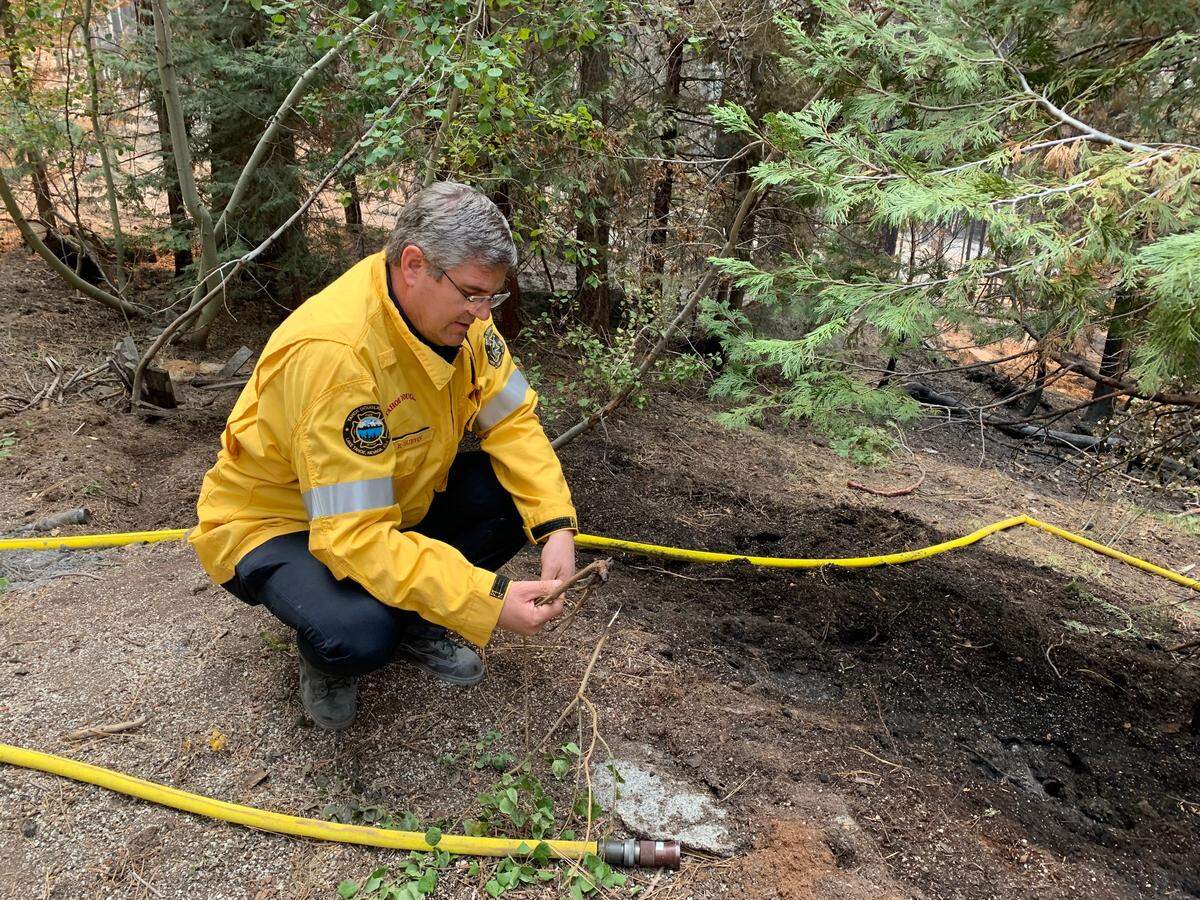
There were several reasons why Christmas Valley survived. Mother Nature cooperated for a change — once the fire landed, the wind generally nudged the fire away from many of the residential areas. It surely didn’t hurt that Christmas Valley, while decidedly rural, is citified enough to have fire hydrants.
And perhaps most importantly, tree-thinning projects undertaken several years earlier helped eliminate low-hanging limbs and other “ladder fuels” that could have created crown fires, which would have made the situation far less manageable. Firefighters and foresters interviewed for this story agreed that fuel-reduction projects played a major role in protecting Christmas Valley and Meyers.
Even so, there was no question that these residential areas were in peril that night.
“We were chasing spot fires in people’s backyards,” said Gwen Sanchez, a Forest Service official.
A few days after the battle, as logs smoldered throughout the area, a mop-up crew from the Nevada Division of Forestry, from 360 miles away in Elko, huddled along Reindeer Way in Christmas Valley, where some of the fiercest firefighting had taken place.
“There was a lot of goddamn good work put in here,” said Dustin Osborn, a task force leader, with more than a trace of awe in his voice.
Glancing up at the wooded hillside above the neighborhood, he added: “It’s literally right here in all these backyards.”
How Caldor Fire broke through at Tahoe
Two days after igniting in the Eldorado National Forest, the Caldor Fire nabbed its first victim — rural Grizzly Flats in a rugged area south of Sly Park. No one died, but much of the community was destroyed.
The fire moved up Highway 50 for the next two weeks, sparing landmarks such as Strawberry Lodge and Camp Sacramento but ravaging scores of homes and Forest Service cabins that had stood for decades. In all, more than 600 buildings had burned and the fire was hungry for more.
“It didn’t matter how many dozer lines we put on the ground, this fire was spotting ahead of us,” said Sanchez, acting forest supervisor with the Forest Service’s Tahoe basin unit.
The evening of Aug. 30, as 40 mph wind gusts were blowing through the summit, Chris Anthony, a Cal Fire assistant deputy director, arrived at Lake Tahoe Airport for a news conference. South Lake Tahoe and much of the surrounding area had just been evacuated and the fire was just 15% contained.
When it was his turn to speak, Anthony made an impassioned speech about wildfire, climate change and the anxiety felt by the “hundreds of thousands of people who hold Tahoe dear to their heart.” He then offered a brief pep talk:
“These are trying times but we will get through them together.”
That could have been for his own benefit as well. Reports were already reaching him about a spot fire detected in the Pioneer Trail neighborhood, tucked behind the Holiday Market grocery store in Meyers, just north of Christmas Valley.
Among the residents of that area: Anthony himself.
“I was hearing radio traffic,” he said in an interview afterward. “I could lose my home.”
The lure of Christmas Valley
About a mile east of the summit, across an area popular with cross-country skiers known as Johnson Pass, sits Christmas Valley.
Known for its heavy snowfalls, the community straddles Highway 89, running south from 50 just west of Meyers. Originally known as Upper Lake Valley, according to the Tahoe Daily Tribune, it got renamed in the 1950s when developers came along and built streets, naming them Elf Lane, Sleighbell Way and so on. Today, Christmas Valley is a mix of primary residences and vacation homes; some of them list for $1 million or more.
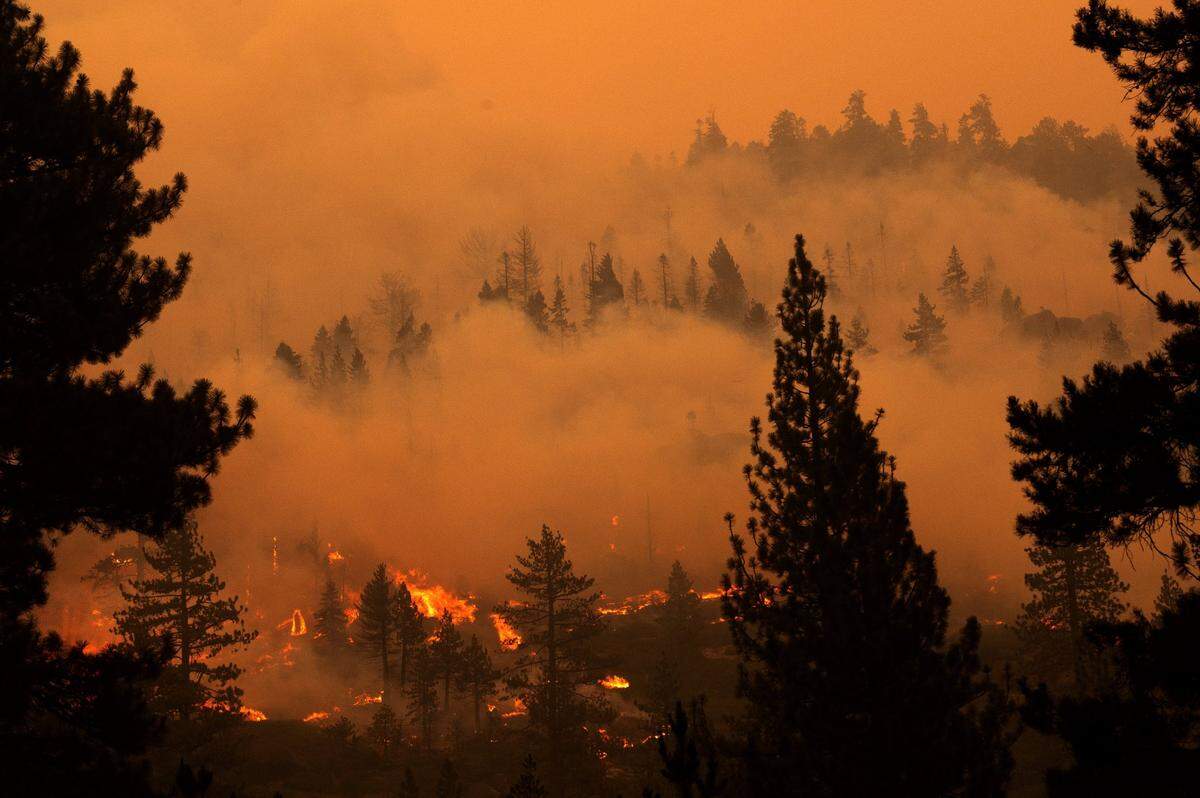
It’s the kind of place that attracts people like Dan Gilley, a Bay Area resident who scoured the Tahoe basin 20 years ago looking for the perfect place in the woods. He found his getaway spot on Memory Lane, on the west side of 89: a three-bedroom cabin tucked against the bottom of a granite hillside, with easy access to South Lake Tahoe but far enough away from the city’s summer tumult.
“It seemed too good to be true,” Gilley said.
Then came the Caldor Fire, and Gilley’s anxiety intensified as the fire advanced on the basin.
“It had completely broken through Strawberry and broken through at Sierra-at-Tahoe and it was coming for the ridgeline,” he said.
Although 50 was closed, Gilley drove from the Bay Area, routing through the remote country and thick smoke on Highway 88. Arriving in Christmas Valley, he loaded up some of his prized possessions and created a video, documenting what he was leaving behind for insurance purposes. He donned a recently-purchased N95 mask and cleared more defensible space around his property as dense smoke settled into the area.
It was the night of Aug. 29, the day before everyone was ordered out.
“I realized, OK, this is bad. I decided that the odds of them holding it back were not very good. Even though Cal Fire was still making very positive comments about their control lines and everything, I was like, ‘You know what, I don’t think it’s gonna happen. I think this fire is coming through.’
“That night the fire burned over the ridge. So at that point, I less than 10% thought the house would survive, right? Because looking at all of it, it was like a wall of fire advancing with no protections. There were no more barricades, no more trenches. You know, there was nothing right? I mean, there’s nothing to do.”
‘Preparing for the inevitable’ as fire approached
The embers from Echo Summit sprinkled Christmas Valley and nearby Meyers like snowflakes from hell. In a typical year, maybe half or 60% of those embers would light new fires. This time, “it was almost every single ember,” Sanchez said.
Some landed in residential neighborhoods on the west side of 89. There, a five-person engine crew from the Lake Valley Fire Protection District, among others, rushed to put them out.
“It was raining embers down on us,” said Martin Goldberg, an engineer with Lake Valley. “The extraordinary thing is we were able to extinguish them all.”
But the fight was just getting started. Some of the embers had blown across the highway and landed on the east side of 89, at the northern end of Christmas Valley.
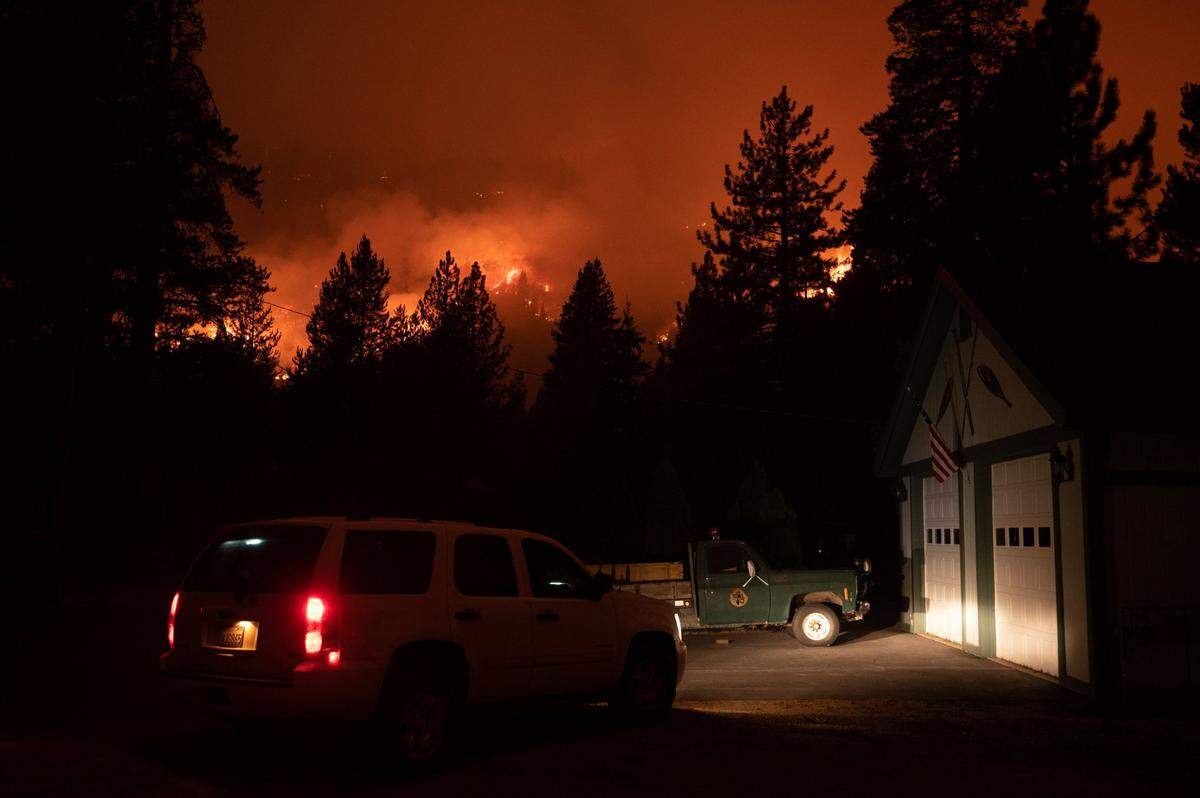
A welcoming party of sorts was waiting for it. Brian Newman, a Cal Fire operations section chief, said multiple agencies had been begun planning a couple of days in advance for a firefight in the wooded, populated areas south of the lake.
“We were preparing for the inevitable,” said Newman, who spent the evening patrolling Christmas Valley in a Cal Fire pickup.
Even before the embers started landing, he said crews from Cal Fire and other agencies were removing brush from alongside Highway 89 and directing bulldozers to start carving out defense lines.
Still, the Caldor Fire refused to cooperate. Some of the first embers landed on the east side of Highway 89 and a crew from the Tahoe Douglas district was in position an eighth of a mile away, ready to pounce. But Guevin said its view of the spot fires was blocked by trees. Another Tahoe Douglas crew, stationed at Echo Summit, noticed the spot fires and alerted the group at the Forest Service station to get moving, Guevin said.
One good thing about that landing spot: The embers were burning a half mile from the residential locations east of 89. Also, the area had been subjected to forest treatments in prior years, thinning out branches and shrubs. A bike path ran parallel to 89, creating a small measure of additional buffer.
The remaining vegetation was considered “light fuels,” Guevin said. Gesturing toward still-smoking Echo Summit, he added: “It wasn’t as intense as what we were seeing over there.”
The crew from Tahoe Douglas was able to put water on some of the spot fires quickly. But the wind was too much. The fire took hold and started moving up the slope, toward a spot called Cowboy Hat Rock, overlooking the eastern edge of Christmas Valley.
“The fire hit and spread,” Guevin said. “It gets embedded.”
Part of the fire moved in a northeasterly direction, toward the Pioneer Trail area. As he sped between Christmas Valley and Meyers in his Cal Fire SUV, Anthony watched the fire creep closer to homes in the Pioneer Trail neighborhood behind Meyers.
“At the end of the day you have a job to do, and a mission,” he said.
But the peril to his own home was on Anthony’s mind as well.
“I wasn’t fully convinced my house would still be standing,” he said.
Digging in with bulldozers and more
A little farther south, the fire began retreating down the hill, moving toward the homes in Christmas Valley clustered around Santa Claus Drive.
“That fire got bigger and bigger and it moved uphill and it moved downhill,” Goldberg said.
Although the wind was nudging eastward, slowing the fire’s progression toward the homes of Christmas Valley, the possibility of major destruction loomed.
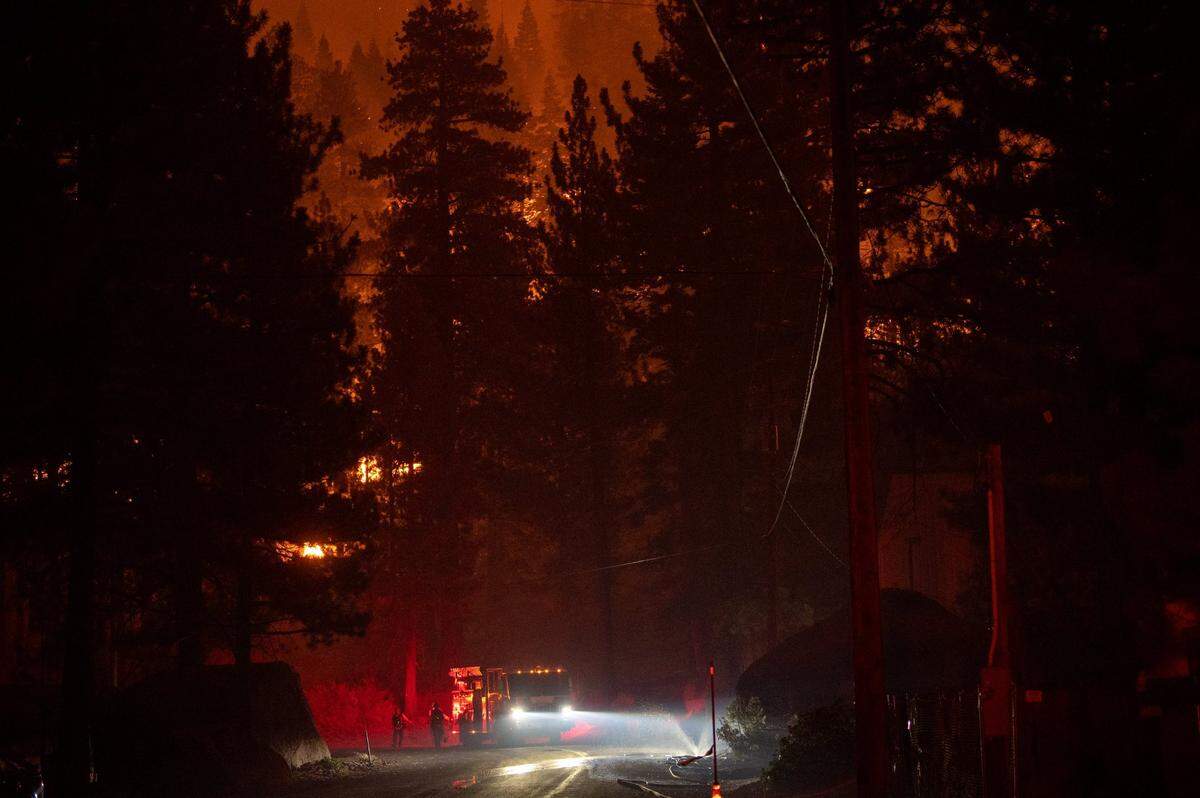
“The potential was there,” Guevin.
And the sight was something to behold.
“You’d see this long string of fire,” Anthony said.
From a Forest Service operations center established at the base of Heavenly, Sanchez directed traffic and supervised the deployment of equipment, including the heavy, urban-style fire vehicles known as structure protection engines, filled with 2,500 gallons of water apiece.
“We saw no letup from this fire,” she said.
As the fire backed down the hill, crews from multiple agencies descended on a two-story home on Reindeer Way in the northeastern area of Christmas Valley.
Sometimes fires have to be fought indirectly — on the flanks, and from behind. This fire, however, never got into the crowns of the trees and stayed relatively close to the ground, allowing the firefighters to meet it head-on.
As the crews reached Reindeer Way, they were able to douse the leading edge of the fire with water and shovels of dirt, Guevin said. Hand crews removed branches and limbs — throwing them directly on the fire to consume fuel. They created a defense line behind Reindeer and the adjoining area along Santa Claus Drive, helping cushion the neighborhood.
“This was a direct attack,” Guevin said. “They went right on the fire.”
They had to fight for every inch. Cal Fire’s Newman said crews from his agency and others established bulldozer lines throughout the hilly neighborhood and were just barely able to prevent considerable destruction.
“The fire did progress down (the hill) to back decks, and backyards,” said Newman. “A close call is a good description. We literally had fire on front yards, backyards.”
Watching ‘my home burn down’ on Facebook
Dan Kramer, the owner of that home at the end of Reindeer Way, was a riding with a friend that night en route to Truckee, where Kramer was staying after evacuating. They were returning to California from Washington state, where they’d gone to see rock band Phish — a chance to get away from the angst and feeling of helplessness from the Caldor Fire.
Then a friend texted Kramer with news: A freelance journalist named Matthew Henderson was posting real-time video of the firefight in Christmas Valley.
A self-described ski bum who captains a Tahoe sightseeing boat, Kramer has lived on Reindeer since 2007. As his friend drove toward Truckee, he sat glued to the Facebook feed. The van became silent. He recognized his neighborhood.
“I can see this bright glow behind the silhouette of trees,” he said. “I’m thinking, ‘Wow, I’m watching my home burn down on a live Facebook feed.’”
While the crews were trying to corral the fire on Reindeer, a similar drama was under way about a mile south. In a rugged spot where Snowflake Drive turns to gravel, a two-story log cabin with a metal roof was under siege.
Two engine crews from the Lake Valley fire agency, including one that had been stamping out spot fires on the other side of 89, had arrived to make a stand.
Goldberg said his crew began cutting down manzanitas and removing other vegetation. They lit their own fires with drip torches to burn up vegetation before it could reach the home.
A bulldozer arrived from somewhere in Storey County, Nev., and helped carve a buffer zone along the north side of the Snowflake property, and then was called away to another location.
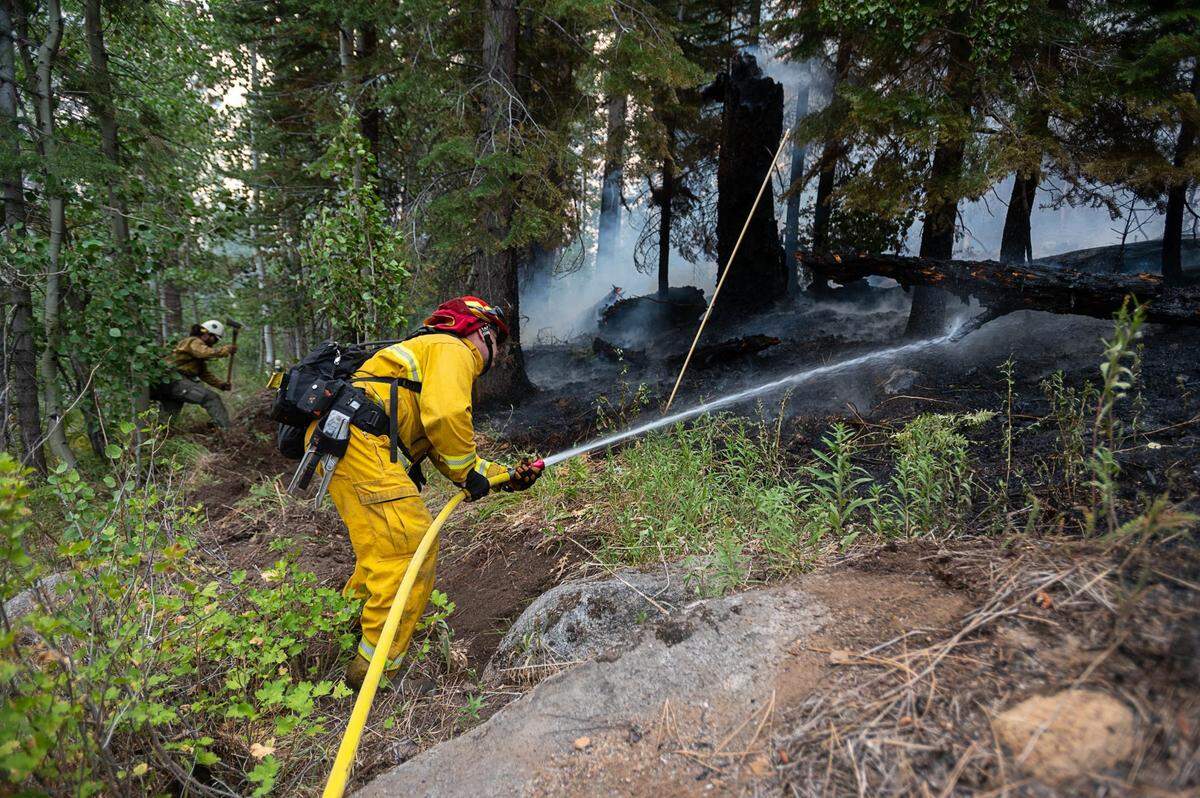
“You grab any dozer you can get,” Goldberg said.
Why all the fuss over one house? Because once homes start catching fire, a chain reaction can develop. Houses are their own fuel sources and can spread fires easily. The home at the end of Snowflake, like its counterpart on Reindeer, was, in effect, the first line of defense.
“You’re going to do what you can closest to the fire,” Goldberg said.
Would it be enough? Goldberg thought so, but at first it felt like a fairly lonely fight. For an hour or two, late that night, the group from Lake Valley was trying to defend the area around Snowflake more or less by itself.
“We had nothing,” he said.
Eventually, the cavalry came in the form of support from a multitude of fire agencies. While some trees near the home burned, the only property damage was a scorch mark on the door of a shed a few feet from the main cabin.
Forestry management prevented disaster
The worst-case scenario would have been a crown fire – a windblown monstrosity racing through tree tops and catching fire to people’s roofs and eaves homes.
“That’s the kind of fire that will burn your truck. It will kill you,” Guevin said.
As dangerous as this fire was, backing down from the ridge line above Christmas Valley, it stayed relatively close to the ground. Guevin said the flames were maybe 20 to 30 feet high. “It wasn’t a 100-foot high wall of flames,” he said.
That wasn’t just a matter of good luck. Forest-treatment projects implemented in the immediate vicinity, some as far back as a decade ago, that removed much of the low-lying ladder fuel that could have created a crown fire. According to the Forest Service, a total of about 3,300 wooded acres in the Tahoe basin had been treated since 2011.
Sanchez, the Forest Service official, said years of forest treatments didn’t halt the flames that night. But they leveled the playing field, enabling firefighters from her agency and others to move in closer and work more aggressively.
“The fire environment was ripe,” she said. “The one difference was the vegetation.”
As he traveled through Meyers and Christmas Valley that night, Cal Fire’s Anthony could see that the fire was being tamed, at least somewhat, by the fuels-reduction work. That gave him greater confidence that his home wouldn’t burn down.
The good news started seeping out to other homeowners as well.
As he was trying to fall asleep, Kramer received a Facebook message from a neighbor signaling that his home apparently had survived. The next day another Facebook message arrived, with photos of his home taken by Carson Triggs, a friend who’s with the El Dorado County Fire District and had taken part of the fight on Reindeer.
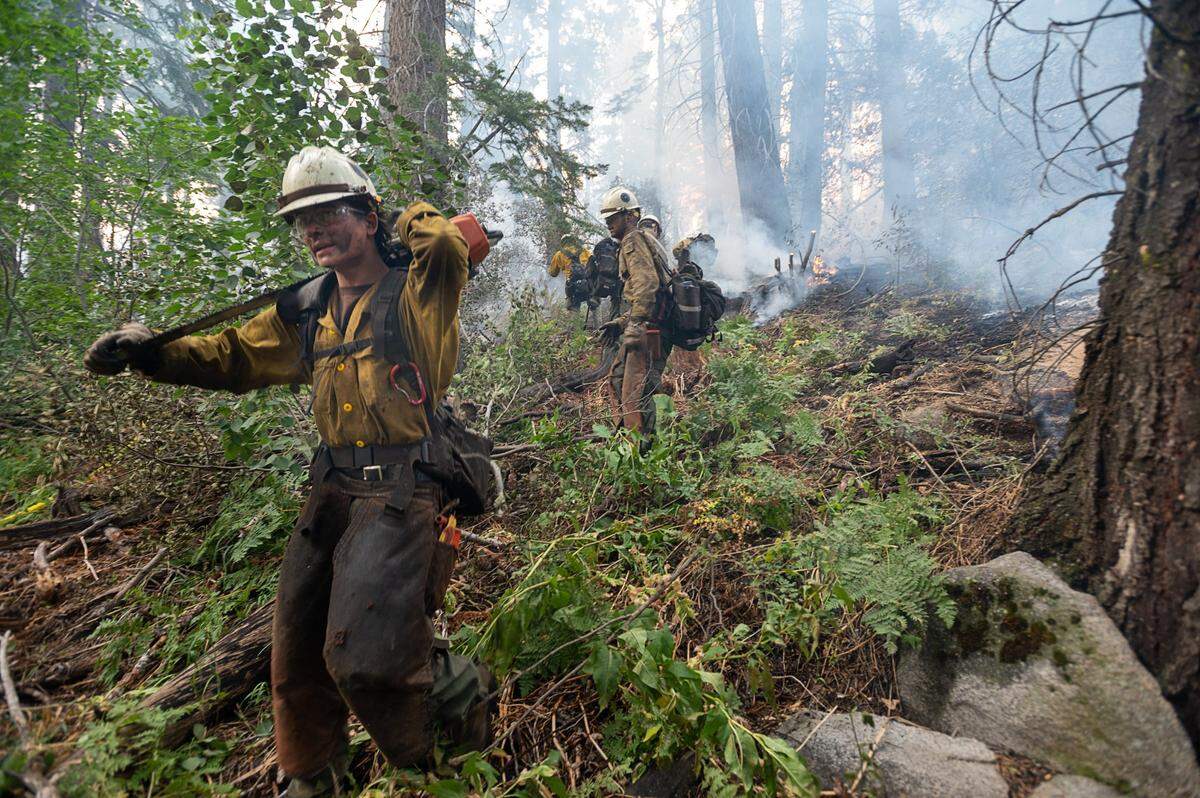
As it turned out, a shed appeared to have burned slightly. The worst damage was to Kramer’s giant wood pile. It was almost completely charred.
About the time Kramer was reviewing the photos, Gilley was staring at infrared fire maps on the internet, trying to decipher if his home on the other side of 89 had burned. While the maps can sometimes be unreliable, he gradually was able to figure out that his home was safe.
Then a close friend contacted a Sacramento Bee reporter who was in the area and asked him to swing by Gilley’s cabin. The reporter found the property cloaked in thick haze but still standing. Fire was burning in the hills not far away. The reporter snapped a photo and passed it along.
“I was super relieved,” Gilley said.
Goldberg said the experience on Christmas Valley proved the value of managing forested lands aggressively.
“The fuels treatment allowed firefighters to move around and do their job ... and do it safely, and keep the loss minimal,” he said. “We lost very little in Christmas Valley.”
Crews from the Nevada Division of Forestry, the Los Angeles Fire Department and other agencies were crawling all over the area a few days later, particularly on the east side of 89, tending to smoking logs and other hot spots. Hoses were draped over several properties, including Kramer’s on Reindeer Way, to guard against flare-ups.
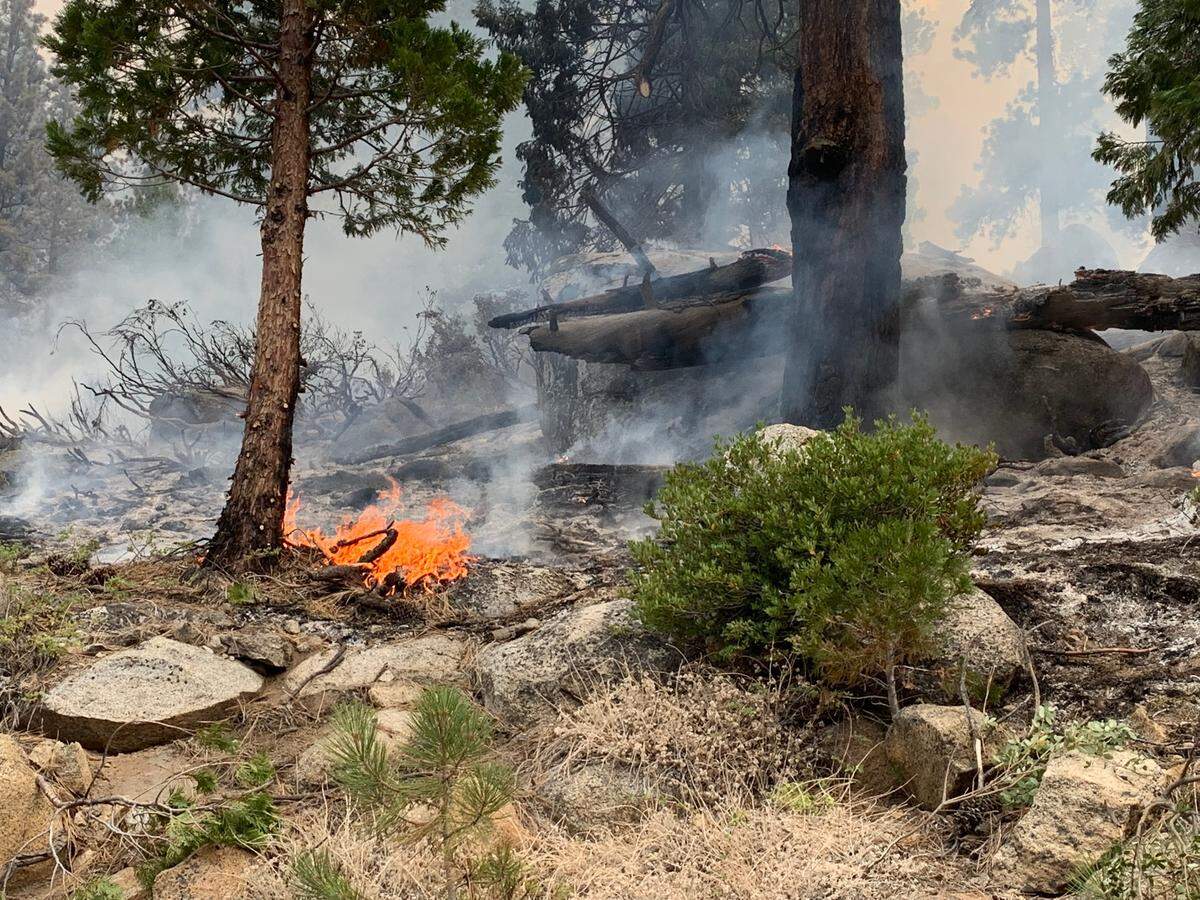
About a mile south, a major stretch of the eastern hillside was actively smoking; a small pine tree caught fire, and fallen logs were burning in several spots. Crews from Cal Fire, the city of Roseville and a hotshot team from the Forest Service’s Angeles National Forest, in Southern California, fanned out for defense.
Evacuation orders have been downgraded to warnings for large swaths of the area in and around the South Lake Tahoe area, including parts of Meyers and the Pioneer Trail area. As Christmas Valley homeowners waited to be allowed back in their homes, some were nervous about what they’ll see.
What will Christmas Valley look like, filled with dead trees and surrounded by blackened hillsides?
“I’m excited to get back up,” Gilley said. “But also, I’m just hesitant at what I’ll find.”
This story was originally published September 12, 2021 at 5:00 AM with the headline "‘It was a firefight.’ How a vulnerable Tahoe neighborhood was saved from the Caldor Fire."