California food aid programs see some support in state budget after federal cuts
Gov. Gavin Newsom and the California legislature took steps in this year’s budget to support some food access programs in the state that faced federal funding cuts, including a program that would have ceased to exist without state dollars.
Advocates cheered the hundreds of millions of dollars in the $351.7 billion budget earmarked for small farmers, food banks and food assistance programs but expressed disappointment at the state’s lack of increased assistance for immigrants who are becoming more vulnerable to food insecurity.
Experts, state officials and advocates warn that President Donald Trump’s administration’s historic cuts to the SNAP program in the Big, Beautiful Bill, or H.R. 1, will cause even greater food insecurity for hundreds of thousands of people in California. It’s why this year’s budget was particularly consequential, food advocates and policymakers said.
SNAP, known as CalFresh in California, is the nation’s largest food assistance program and offers low-income residents aid through monthly allocations of food stamps to purchase food at grocery stores and markets.
Here’s a look at some food advocates’ wins and losses in the 2026-2027 fiscal year budget.
Local Food Purchase Assistance Program
The state partially picked up the tab for the Local Food Purchase Assistance Program, which had lost all its funding from the U.S. Department of Agriculture and was terminated.
The program spent tens of millions of dollars in California to connect local growers and operators — the majority of whom were from socially disadvantaged backgrounds — to sell their products to local food assistance organizations such as food pantries. It also supported regional food hubs, which buy produce from small farmers who might not otherwise have enough supply to meet the needs of larger buyers such as schools. Food hubs can bundle produce from those small operators to create heftier packages of supplies. For farmers growing food unique to their specific cultural backgrounds, the contracts provided them with opportunities to sell to residents who share the same heritage.
The initiative was launched under President Joe Biden’s administration in 2022 and was supposed to run past this year. Instead, the Trump administration ended it early, with dollars running out in June in California.
The largest federally-funded food purchase operation in California was named Farms Together and was run by three organizations: Fresh Approach, the Community Alliance with Family Farmers, and California Food Banks, formerly known as the California Association of Food Banks.
California funded the creation of a state version of the program for one year with $15 million — a massive reduction in funding compared to the USDA dollars, which will lead to scaled down operations. Policymakers said their original budget request had been $45 million for three years.
Farmer advocates and food assistance experts said the Local Food Purchase Assistance Program is crucial to supporting small farmers, their communities and food insecure families. Farmers and advocates were frustrated and concerned when funding was cut at the federal level.
Farms Together worked with more than 860 farms, with tens of millions of federal program dollars going directly to those farmers (not administrative costs), according to the Community Alliance with Family Farmers. The organization said Farms Together worked in 53 counties and moved around 21 million pounds of food, reaching about 2 million California families.
Hector Reider, who led the development of the local food purchasing assistance for the Community Alliance with Family Farmers, called the program “transformative.” It created a circular economy for communities, he said, which led to farmers paying off debts and neighbors being fed. The end of the program, he said, meant people losing their jobs and livelihoods.
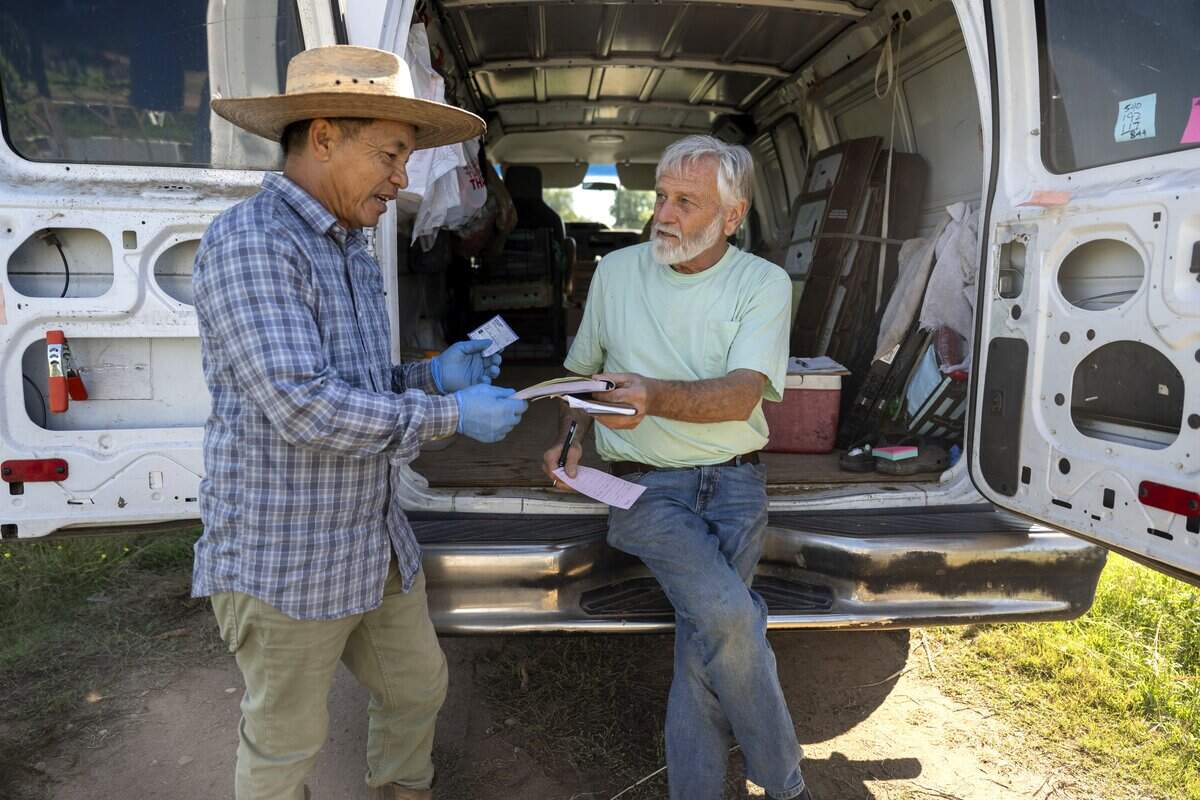
After six months of advocacy, Reider couldn’t believe it when he heard the state had funded a new version of the program.
There will be pain points as the program transitions from federal to state funding, some of which are already being felt through contract cancellations for farmers and staffers supporting program administration, Reider said.
But, overall, the partners are thrilled that a version of the program will eventually come back online.
“It is really a game changer for so many people,” Reider said.
CalFood Program
The CalFood Program received $100 million in one-time funding on top of its $8 million baseline budgeted funds, up from $80 million of combined baseline and one-time funds last year.
This program assists food banks in purchasing California-grown food, another initiative that is viewed by advocates and experts as a win-win for farmers and residents facing food insecurity.
At a time when food banks are also experiencing federal funding cuts and, concurrently, seeing increasing need from the community as residents drop off CalFresh, the added state dollars will allow food banks to better meet the rising demand, said Jared Call, director of public policy and advocacy for California Food Banks which is a membership organization for 43 food banks in the state.
Call said the $108 million is the highest amount the program has even been funded.
“It has been a very tough year for Californians who need food on the table and the food banks that serve them,” Call said. “…And we expect tough times ahead.”
CalFresh and the California Food Assistance Program
After the nation’s biggest food aid program faced historic cuts at the federal level, the governor and legislature significantly boosted dollars for SNAP, mostly for incoming higher administrative costs.
The state provided up to $223 million through June 2029 to cover increased county administrative costs and workloads for CalFresh in response to H.R. 1 participant eligibility changes, the state budget said.
Per H.R. 1, the federal government will reduce its share of support from 50% to 25% starting in October, according to California’s Legislative Analyst’s Office. The office said the state will be on the hook to cover 52.5% of administrative funding, up from 35%. Counties’ share will go from 15% to 22.5%, though the budget provided some temporary relief to phase this in.
Hinnaneh Qazi, director of budget and fiscal policy at the County Welfare Directors Association of California, said she estimates that around $150 million of the $223 million are new dollars after accounting for a loss in other funding that supported the administration of the program. The state projected a drop in the number of CalFresh recipients so decreased some dollars as a result, Qazi said.
On top of the administrative funding, the state allocated $14 million through June 2028 to fill in a gap from federal cuts for the CalFresh Outreach Program. Those dollars go to community organizations such as food banks who help assist Californians with their applications for food stamps — a system advocates said is needed even more with the new SNAP eligibility requirements.
Since Trump signed the Big, Beautiful Bill, from July 2025 through February 2026, SNAP participation has fallen by around 3.5 million people, or 9%, an analysis of U.S. Department of Agriculture data by the Center on Budget and Policy Priorities found.
The state spent over $12.5 billion and helped around 5.5 million Californians in the 2024-2025 fiscal year, state data show. Nationally, SNAP supports over 40 million Americans through around $100 billion in federal aid, according to federal data.
The California Department of Social Services, the agency that administers the CalFresh dollars, said in June that about 665,000 state residents are in jeopardy of losing their benefits due to new work requirements.
Advocates did not see their desired increase in dollars for the California Food Assistance Program, the state-funded equivalent of CalFresh that is for documented, non-citizen immigrants who are ineligible for the federal program. The state-funded food assistance program helped around 63,000 residents in the 2024 to 2025 fiscal year, according to the Legislative Analyst’s Office. Undocumented immigrants are not eligible for the state-funded program or federal SNAP funding.
H.R. 1 further restricted legal immigrants’ eligibility for food stamps. Those with humanitarian statuses such as refugees and people granted asylum are no longer eligible, with the state department of social services estimating that 72,000 Californians will lose their benefits.
“I think there was some support for food access (in the budget), but (this was) the biggest ask to really backfill H.R. 1,” said Beth Smoker, policy director for California Food and Farming Network. “Immigrants are being abandoned at such a time when the state declares to be a safe haven for them, which is really unfortunate and is a pattern that we continue to see.”
This story was originally published July 11, 2026 at 6:00 AM with the headline "California food aid programs see some support in state budget after federal cuts."