To protect cattle, California sheriffs can use rubber bullets, pepper balls on wolves
AI-generated summary reviewed by our newsroom.
- Sheriffs are authorized to use rubber bullets, pepper balls, paintballs and bean bags.
- Sierra, Lassen and Modoc sheriffs have executed hazing agreements with the state.
- Authorized hazers who accidentally kill a wolf while hazing are exempt from CESA.
California wildlife officials have begun authorizing sheriffs in the state’s northern rangeland to use rubber bullets, paintballs, pepper balls and other injury-causing harassment methods against wolves, and are working on a plan to allow ranchers to use some of the same techniques.
The authorizations mark a significant shift in the state’s approach to managing the state’s resurgent population of gray wolves, which are protected under federal and state endangered species laws and previously could only be hazed or chased by state and federal law enforcement officers.
The change was greeted cautiously by ranchers and law enforcement officials — and with concern by environmentalists.
“I don’t think any violence against wolves is something that I welcome,” said Amaroq Weiss, senior wolf advocate for the Center for Biological Diversity. “What I recognize is that there has been frustration in the livestock operator community who feel that they are not allowed to do enough.”
Weiss questioned whether such action was allowed under California’s wolf conservation plan, pointing to setbacks in reaching reproductive milestones required under the program before aggressive hazing can be permitted. She also urged strict training requirements before any authorization of actions that could harm wolves.
Hazing agreements in three counties
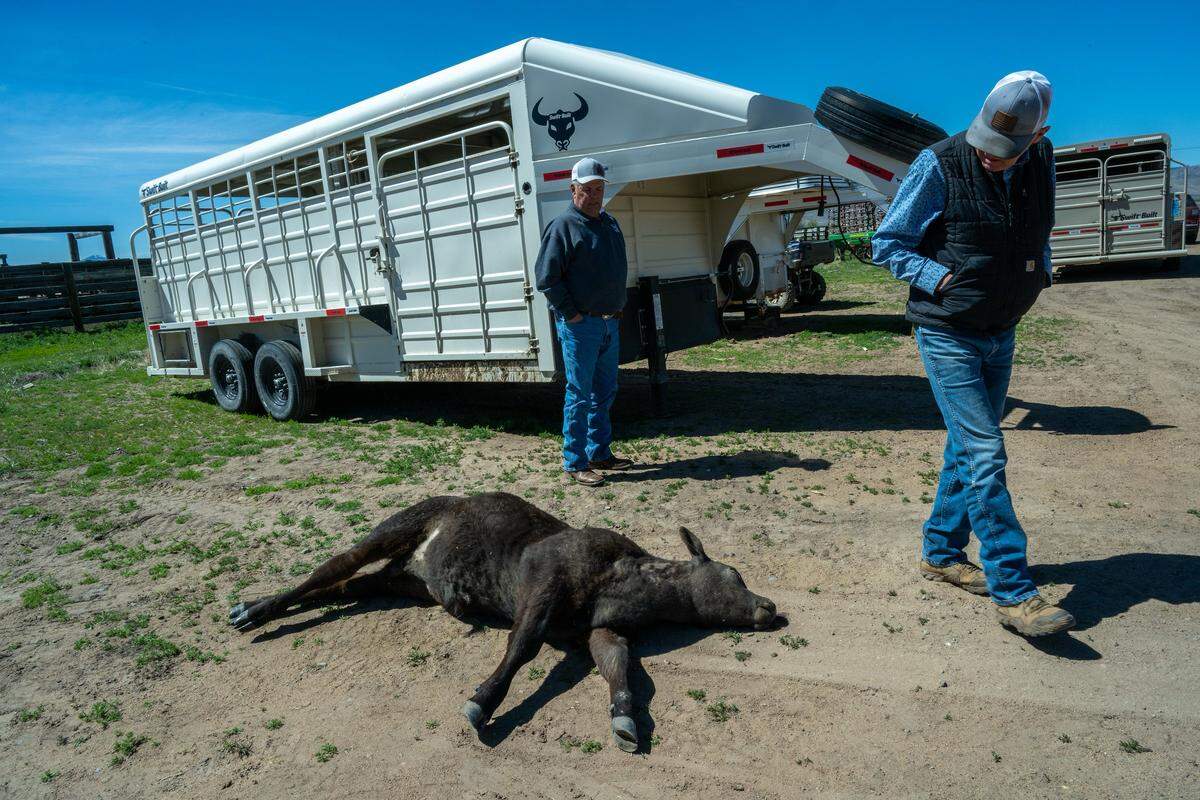
The new approach comes amid growing concern about wolves among ranchers and local law enforcement after a single pack killed nearly 100 cows and calves in seven months last year in Sierra Valley north of Truckee. Just this week, a UC Davis study showed that the diet of wolves in northeastern California was comprised mostly of cattle, prompting the lead scientist to suggest that the species’ strong recovery was due to the availability of livestock.
So far, the state has executed hazing agreements with the sheriffs of three counties interacting with wolves — Sierra, Lassen and Modoc — and has offered the same arrangement to law enforcement officers in four more, said Peter Tira, a spokesman for the California Department of Fish and Wildlife.
Under them, law enforcement officers are authorized to use paintballs, pepper balls, bean bags, rubber bullets and sustained pursuit — meaning a long chase from a truck, ATV or horse — to drive wolves away. A plan under development that would allow ranchers and other trained civilians to haze the wolves currently envisions allowing only the use of paintballs and sustained pursuit, Tira said.
Anyone authorized to use these methods who accidentally kills a wolf while hazing it would be exempt from prosecution under the California Endangered Species Act, which otherwise bans hunting them.
The new approach also includes the development of data-sharing agreements that would allow property owners and local law enforcement to know in real time whether a collared wolf is nearby.
“It’s a step forward,” said Sierra County Sheriff Mike Fisher, whose Sierra Valley jurisdiction had to cope the most with wolf attacks on cattle last summer. “It’s more than we had last year.”
.JPG "SAC_0609_RCB_20250506_Wolves (1).JPG")
But Fisher said it is unlikely that he or his deputies will be on site at exactly the right moment to intercept a wolf and then chase it down. Even though he has signed the agreement with the state, Fisher said he has not yet implemented his agreement because he is waiting for further assurance that his deputies will be protected from California environmental laws if they release pepper spray or take other actions that could affect habitat or wildlife.
More effective, Fisher suggested, would be a plan that allows ranchers to take such actions, while authorizing law enforcement to step in and, if necessary, kill rogue wolves if they are terrorizing communities or become habituated to killing and eating cattle to the degree that Sierra Valley experienced in 2025.
Why will they be allowed to harass wolves?
Wolves were locally extinct in California until about 15 years ago, when an Oregon animal dubbed OR-7 wandered into the state, setting off a flurry of interest and leading to the development of a conservation plan. Today, California has 12 identified wolf packs accounting for 50-70 animals, according to CDFW.
Their comeback has been hailed as an environmental success, but it has also raised questions about California’s ability to manage the consequences to humans and livestock as a result of a resurgent population of apex predators. In addition to wolves, the state is also struggling to manage conservation of other predators, including bears and mountain lions, and lawmakers are now considering reintroducing grizzlies, the state’s storied and long-locally extinct mascot.
Concerns came to a head last summer, when the Beyem Seo pack killed 92 cows and calves in Sierra Valley, straining law enforcement and terrifying residents. The state sent 18 biologists and law enforcement officials to the area, where they camped out for months tracking and hazing wolves if they approached human settlements or ranches, an effort that did little to stop the predation but cost millions.
In the end, state wildlife officers killed four wolves from the pack — three that were full-grown and a juvenile who was mistaken for an adult and shot accidentally from a helicopter.
The new approach would allow locals to engage in some of the activities that required state intervention last summer, Tira said.
Officials are still working on the details of allowing ordinary citizens to haze or harass wolves, he said. But any plan that is developed would require ranchers or others to be trained and certified before they can participate.
The training, as yet to be developed, would be funded through $2 million in grants recently made to groups including the California Farm Bureau, the Sierra Valley Resource Conservation District, the Honey Lake Valley Resource Conservation District and others.
How do the hazing techniques work?
Until now, local law enforcement and individuals in the community were limited to using techniques to drive away wolves that do not injure the animals, such as putting up fencing, patrolling their ranches on horseback or in vehicles, using strobe lights or installing brightly colored flags. The idea is not to stress a recovering species in such a way that its reproduction is impacted.
The new techniques, which became legal under the state’s wolf plan once certain reproductive requirements were met, are considered “injurious harassment,” meaning that the animals can be hurt or even killed when they are employed.
Sheriffs who sign the state’s agreements will be permitted to shoot rubber bullets and beanbags at wolves, Tira and Fisher said. They will also be allowed to shoot pepper balls, which release a cloud of irritating spray into the air around the animals.
Paintballs, which are already used to drive away bears, sting the animals when they are hit, prompting them to run away, Tira said.
The state is currently planning to limit any participation by ranchers to the use of paintballs. But Fisher, the Sierra County sheriff, was skeptical of their effectiveness. The paint guns are quirky and need to be handled carefully or they won’t work properly, he said. They can’t just be stored in a rancher’s truck, ready to go if a wolf comes on the scene.
State negotiators rejected the idea of allowing ranchers to use rubber bullets and other nonlethal ammunition because some can be confused for real bullets, Fisher said.
The discussions with the state started with ranchers’ desires to be able to use pepper balls, not paintballs, said Rick Roberti, president of the California Cattlemen’s Association and a rancher in Sierra Valley.
“It’s like pepper spray,” Roberti said. “If they’re in with your cattle, this gas would hurt their eyes and then they would associate that with being in the cattle.”
Though his preference would be for law enforcement and ranchers to be permitted to take stronger measures, Roberti said he was willing to give the state’s approach a chance.
“Do I think it’s going to work?” Roberti asked. “Maybe.”
Bee Staff Writer Lizzie Kane contributed to this story.
This story was originally published July 11, 2026 at 5:00 AM with the headline "To protect cattle, California sheriffs can use rubber bullets, pepper balls on wolves."